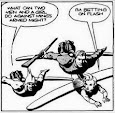
An oceanographic crew loses one of its members, eaten by a shark. They set up a new expedition to hunt said shark. A new member is added: the leader's possible biological son.
I just do not dig this filmmaker anymore. He started to lose me in the film before this one, and lost me completely in the film after this one. I guess he must please lovers of style for style's sake. His sense of humor in this film is sophomoric, and I guess if he entered a time machine into the sixties he would succeed in getting a TV sitcom spin-off greenlighted.
Rating: 36
Friday, July 23, 2010


Thursday, July 22, 2010
Bonanza: The Long Night (1962) (TV)
Adam has a $10,000 check with him. Two guys broke out from jail. One of them makes Adam exchange clothes with him. The posse is led to believe that Adam is the escaped convict.
Puerto Vallarta Squeeze (2004)
Puerto Vallarta, Mexico. A writer in deep need of money accepts to drive a man to the border. The writer may or may not know that said man just murdered two people. The writer's girlfriend insists on riding with them.
More than acceptable thriller, well made and entertaining. There is nothing really new here, the contradictions and perversities of the American foreign policy in the 60's and 70's are embodied in the hitman, sort of.
Rating: 58
More than acceptable thriller, well made and entertaining. There is nothing really new here, the contradictions and perversities of the American foreign policy in the 60's and 70's are embodied in the hitman, sort of.
Rating: 58
Wednesday, July 21, 2010
Bonanza: The Mountain Girl (1962) (TV)
Little Joe promises to a dying rancher that he will see that his granddaughter gets in touch with her rich relatives, whom she has never seen.
Bolivia (2001)
A Bolivian immigrant in Buenos Aires gets a job at a bar. He is an illegal worker and a constant victim of xenophobia.
Watchable, well acted, drama about the tense environment of a bar in a country affected by an economic crisis. The film is short and the plot is very predictable.
Rating: 46
Watchable, well acted, drama about the tense environment of a bar in a country affected by an economic crisis. The film is short and the plot is very predictable.
Rating: 46
Tuesday, July 20, 2010
Bonanza: Inger, My Love (1962) (TV)
A flashback to when Ben, a penniless widower with a young son, met Hoss's future mother and they fell in love with each other.
Bonanza: The Dowry (1962) (TV)
Little Joe witnesses the hold-up of the stagecoach he is in. A wounded passenger is taken to the Ponderosa, along with his daughter and her fiancé. The daughter's dowry is stolen by the robbers. Ben and his sons discover some monkey business on both marrying sides.
An interesting premise, but no so well worked out.
An interesting premise, but no so well worked out.
Bonanza: Blessed Are They (1962) (TV)
The inhabitants of Virginia City elect Ben as responsible for trying to end the feud between two local families. A new minister arrives who is instrumental in that enterprise.
This one was hard to swallow. It felt like Fantasy Island, with the supernatural minister as Mr. Rourke.
This one was hard to swallow. It felt like Fantasy Island, with the supernatural minister as Mr. Rourke.
Sunday, July 18, 2010
Bellamy (2009)
A retired police commissioner, while on vacation, does a private investigation about a possible murder and insurance scam. Concurrently, he lodges his irresponsible brother with him.
Watchable psychological (and criminal) drama, that offers two more or less independent subplots. The mise en scène is perfect, and so is the acting, but the screenplay is conventional and bland, and doesn't deliver much excitement. As Christopher Mulrooney pointed out, the crime is similar to the one in Nabokov's Despair.
Rating: 55
Watchable psychological (and criminal) drama, that offers two more or less independent subplots. The mise en scène is perfect, and so is the acting, but the screenplay is conventional and bland, and doesn't deliver much excitement. As Christopher Mulrooney pointed out, the crime is similar to the one in Nabokov's Despair.
Rating: 55
The Blues: Piano Blues (2003) (TV)
A series of interviews, with some performances thrown in. A feel-good documentary, which openly disregards musical labels and does not have a predominantly didactic nature.
Happy-Go-Lucky (2008)
A kindergarten teacher faces a series of situations with which she deals in a humorous, nonchalant way. Her disposition contrasts with that of her new driving instructor, an uptight, biggoted guy.
Consistently watchable, albeit a little unfocused. The configuration of the characters defies credibility at a few instances, and I will mention two. Firstly, it struck me as odd that Stravinsky's "Firebird" is such a natural and accessible topic of conversation among these characters. It does not fit with any of the cultural environments I have encountered, but then again I do not live in England, and am not the socially wisest person around. Secondly, the driving instructor's argumentation goes all the range from "multiculturalism is non-culturalism" to "the height plus the depth of [a certain American monument] makes 666", and I think this is too wide a range. The first of these statements could fit into an intellectual's mouth, the second one suggests an altogether different cultural background.
Leigh seems to be taking up from another angle the do-gooders theme from Vera Drake. In both, it is suggested that it is hard or impossible to do good to other people, the results being frequently the opposite of the intended. In Happy-Go-Lovely this is examined in conjunction with the theme of happiness as related to attitude as opposed to circumstances. This is of the utmost interest. A film that reportedly deals with this theme, and I have never had the opportunity of seeing, is The Crazy-Quilt (1966).
Rating: 56
Consistently watchable, albeit a little unfocused. The configuration of the characters defies credibility at a few instances, and I will mention two. Firstly, it struck me as odd that Stravinsky's "Firebird" is such a natural and accessible topic of conversation among these characters. It does not fit with any of the cultural environments I have encountered, but then again I do not live in England, and am not the socially wisest person around. Secondly, the driving instructor's argumentation goes all the range from "multiculturalism is non-culturalism" to "the height plus the depth of [a certain American monument] makes 666", and I think this is too wide a range. The first of these statements could fit into an intellectual's mouth, the second one suggests an altogether different cultural background.
Leigh seems to be taking up from another angle the do-gooders theme from Vera Drake. In both, it is suggested that it is hard or impossible to do good to other people, the results being frequently the opposite of the intended. In Happy-Go-Lovely this is examined in conjunction with the theme of happiness as related to attitude as opposed to circumstances. This is of the utmost interest. A film that reportedly deals with this theme, and I have never had the opportunity of seeing, is The Crazy-Quilt (1966).
Rating: 56
Bonanza: The Crucible (1962) (TV)
Adam is left for dead in the desert by two criminals. He is saved by a miner whose camp he runs into. But this proves to be another life endangering event for Adam.
Thursday, July 15, 2010
The Blues: The Soul of a Man (2003) (TV)
Second episode. Quite well done, and ten times better than the first episode. The modern covers are mostly repulsive, one sure exception being the one by Los Lobos. To be quite honest, I am not greatly attracted to blues music, although there is a certain energy to it that I find appealing. That being said, Skip James seems to transcend the genre and stand out as a fine composer and performer.
Bonanza: The Gamble (1962) (TV)
The Cartwrights spend the night in a strange town after a cattle sell. They are framed in a robbery and murder.
Tuesday, July 13, 2010
Bonanza: Look to the Stars (1962) (TV)
The famous real-life scientist who won a Nobel prize for his measurement of the velocity of light is the protagonist here as a teenager, in a plot revolving around racism in Virginia City.
Prokofieff: Sonata #7, Op. 83, 3rd Movement: precipitato
This is a music video of a performance by Misha Dichter, featuring multiple screens and assorted visual resources.
Bonanza: The Lawmaker (1962) (TV)
Sheriff Coffee is injured and has to go out of town for a surgery. The town nominates a replacement sheriff who becomes authoritarian and abusive.
Monday, July 12, 2010
Miséricorde (1994) (TV)
*SPOILERS*
In the sixties, Marie, a girl studying in a catholic school, is very fond of a nun teacher, who instills religious inclinations in her. One day the local priest, after hearing her confession, summons her to his house. When she is there he tries to make sexual advances on her, but she flees. She grows up and decides to become a nun because Jesus "is the most perfect of men", as her old teacher used to say. Her father is sad with the idea; he is not very fond of the Church. She joins the carolians (sorry if this the wrong word). Her convent is run by a stern and intolerant mother superior. Marie makes friends with Edith, who became a nun against her will, because she is poor and her mother is a devout catholic. The mother superior constantly accuses Marie of pride. Marie becomes a teacher and is loved by her students. One day Marie and Edith make a trip to the seaside to do some work there and over there Marie reencounters her old teacher of whom she was fond as a child. They get acquainted with a fisherman who becomes very lusty toward Marie (he does not know they are nuns). She rejects his advances. One evening Edith goes out to fetch something in the market and runs into the fisherman, who invites her to his boat. There they have sex. Marie goes out to look for Edith and witnesses her having sex. She becomes hostile toward Edith, who is mixed up and remorseful over her act. They decide to return to the convent. Edith becomes increasingly withdrawn and begins to lose her sanity. Marie starts doing volunteer work in a seedy side of town, and gets acquainted with a young layman who also does volunteer work; he falls in love with her. They start seeing each other, and Marie has doubts about her religious career. Edith becomes increasingly worse and one day throws herself from an upper balcony, killing herself. Marie quits the order, and marries her boyfriend. A final caption explains that her marriage lasted three years and they had no kids. Marie became a lay charity worker in China or one of those places.
Well-made yet predictable drama about modern nuns.
Rating: 50
In the sixties, Marie, a girl studying in a catholic school, is very fond of a nun teacher, who instills religious inclinations in her. One day the local priest, after hearing her confession, summons her to his house. When she is there he tries to make sexual advances on her, but she flees. She grows up and decides to become a nun because Jesus "is the most perfect of men", as her old teacher used to say. Her father is sad with the idea; he is not very fond of the Church. She joins the carolians (sorry if this the wrong word). Her convent is run by a stern and intolerant mother superior. Marie makes friends with Edith, who became a nun against her will, because she is poor and her mother is a devout catholic. The mother superior constantly accuses Marie of pride. Marie becomes a teacher and is loved by her students. One day Marie and Edith make a trip to the seaside to do some work there and over there Marie reencounters her old teacher of whom she was fond as a child. They get acquainted with a fisherman who becomes very lusty toward Marie (he does not know they are nuns). She rejects his advances. One evening Edith goes out to fetch something in the market and runs into the fisherman, who invites her to his boat. There they have sex. Marie goes out to look for Edith and witnesses her having sex. She becomes hostile toward Edith, who is mixed up and remorseful over her act. They decide to return to the convent. Edith becomes increasingly withdrawn and begins to lose her sanity. Marie starts doing volunteer work in a seedy side of town, and gets acquainted with a young layman who also does volunteer work; he falls in love with her. They start seeing each other, and Marie has doubts about her religious career. Edith becomes increasingly worse and one day throws herself from an upper balcony, killing herself. Marie quits the order, and marries her boyfriend. A final caption explains that her marriage lasted three years and they had no kids. Marie became a lay charity worker in China or one of those places.
Well-made yet predictable drama about modern nuns.
Rating: 50
La colère des dieux (2003)
English title: Anger of the Gods.
*SPOILERS*
An elderly king is terminally sick and sends for his son and for his brother. The son wants the throne for himself, the brother settles for a position in the government. The new ruler, while visiting one of the kingdom's villages, covets a young woman who lives there. He takes her for a wife, even though the woman is already engaged to a local man. She has a baby who is considered the natural heir to the throne. A prophet tells the king that the boy will bring bad luck to him. The king is told by an oracle of sorts (I do not remember it well) that the kid is really the son of his wife's former fiancé. The wife and the kid, alerted by the king's uncle, flee the palace. They meet up with her ex-fiancé. The king tracks the two lovers down and kills them but cannot find the kid. The kid grows up and, after acquiring powers from a mystical eagle, challenges the king and kills him, becoming the new king. Finally, he and his people perish under the white colonizers. He then remembers that he killed the eagle who bestowed him its three powers (metamorphosing, invisibility, and I do not remember the third one), and the agonizing eagle, back in its original human form, tells him that he did not give him the fourth power (what is it?) and it would cost him in the future. The film ends with the queen defining power: "First, not caring about what others think. Second, making others care about what you think."
A well-made cinematic fable in the ancient African style (the credits do not mention any pre-existent story as a source).
Rating: 50
*SPOILERS*
An elderly king is terminally sick and sends for his son and for his brother. The son wants the throne for himself, the brother settles for a position in the government. The new ruler, while visiting one of the kingdom's villages, covets a young woman who lives there. He takes her for a wife, even though the woman is already engaged to a local man. She has a baby who is considered the natural heir to the throne. A prophet tells the king that the boy will bring bad luck to him. The king is told by an oracle of sorts (I do not remember it well) that the kid is really the son of his wife's former fiancé. The wife and the kid, alerted by the king's uncle, flee the palace. They meet up with her ex-fiancé. The king tracks the two lovers down and kills them but cannot find the kid. The kid grows up and, after acquiring powers from a mystical eagle, challenges the king and kills him, becoming the new king. Finally, he and his people perish under the white colonizers. He then remembers that he killed the eagle who bestowed him its three powers (metamorphosing, invisibility, and I do not remember the third one), and the agonizing eagle, back in its original human form, tells him that he did not give him the fourth power (what is it?) and it would cost him in the future. The film ends with the queen defining power: "First, not caring about what others think. Second, making others care about what you think."
A well-made cinematic fable in the ancient African style (the credits do not mention any pre-existent story as a source).
Rating: 50
Saturday, July 10, 2010
The Blues: Feel Like Going Home (2003) (TV)
First part of a documentary series. Old footage and interviews with older American players are the only things in the film worth anything. I hated all the African section, not enlightening at all, and judging from what the film presents I'd say there is no connection between the blues and African music, although the film says just the opposite. The African music we hear in it is of Arabic influence, and it is obvious that occasional blues elements in some performances may be due to the fact that the African players have heard blues recordings before! What kind of an investigation is that?
Subscribe to:
Posts (Atom)