Synopsis [spoilers]: Jeannie hides Tony's important documents in a box but can't remember where she put it [this has no follow-up]. Tony and Melissa's wedding is approaching; General Stone, Melissa's father, has been appointed ambassador in Europe and invites Tony to accompany him to Europe as his military aide. Tony refuses, since he doesn't want to abandon the space project. They come over at Tony's for dinner, and Jeannie is put in charge of cooking, but she doesn't take the food items from their paper boxes to cook them, and everything is spoiled. She magically makes a wonderful dinner appear out of nowhere, and disguises herself as Kato, Tony's Japanese male cook (previously inexistent). Melissa's childhood friend Grover meddles in all of the wedding's affairs, and has been invited by Melissa to be the best man, much to Roger's disappointment. Jeannie is not very happy with the wedding, and warns Tony that he and Melissa are not suited to each other. Tony goes to his bachelor party and is surprised to see Jeannie pop up from the giant cake; he is also surprised to hear from Grover that the honeymoon will no longer be in Jamaica as he and Melissa had agreed, but in Honolulu. The next day he is rehearsing at home the speech he is about to say to Melissa -- protesting against the way he is being treated -- when she and Grover show up communicating that Melissa has given up marrying him and will marry Grover instead -- he has changed since she met him, she says. He is enormously relieved, and Jeannie remarks to herself that he has a lot to learn.
Saw it dubbed in Portuguese.
Monday, April 28, 2008


The Munsters: Tin Can Man (1964) (TV)
Synopsis [spoilers]: Eddie has flunked Science; he hid all the letters the supervisor sent to his family. Grandpa helps him build a robot for the Science fair so he doesn't get expelled from school. A fascistic school inspector -- he was formerly a prison warden -- visits the house and Grandpa shows him around the house; he is horrified by what he sees; at the science fair, he sabotages Eddie's robot; they ask Herman to entertain the audience while Grandpa fixes it; they are very amused as they think Herman is the robot.
Saw it dubbed in Portuguese.
Saw it dubbed in Portuguese.
The Addams Family: Morticia, the Matchmaker (1964) (TV)
Synopsis [spoilers]: Cousin Melancholia visits the Addams after her fiancé left her. The Addams try to find her a new fiancé. When an attorney calls about some land his firm wants to buy, and casually comments he is a bachelor, the Addams invite him to visit them. He doesn't retribute cousin Melancholia's advances, and is relieved when her former fiancé shows up and explains he didn't really leave her.
Saw it dubbed in Portuguese.
Saw it dubbed in Portuguese.
The Devil's Own (1997)
Synopsis: An IRA member who is being hunted by the police comes to U.S.A. to buy missiles; he plans to take them to Northern Ireland by boat. He stays at the house of a cop who is a friend of a Republic-sympathizer judge's.
Appraisal: Everyone has their reasons here, and the process of reparation of injustice often becomes a big bloody mess. The underlying theme appears to be the seduction of weaponry, both big and small. I am not sure this is really what the filmmaker had in mind, though; the storyline is a bit prolix and feels rather unfocused. It's a bleak film, at any rate.
Rating: 40
Appraisal: Everyone has their reasons here, and the process of reparation of injustice often becomes a big bloody mess. The underlying theme appears to be the seduction of weaponry, both big and small. I am not sure this is really what the filmmaker had in mind, though; the storyline is a bit prolix and feels rather unfocused. It's a bleak film, at any rate.
Rating: 40
Alfred Hitchcock Presents: The Derelicts (1956) (TV)
Synopsis: A man murders his silent partner to whom he owed money; a derelict saw him do it and starts to blackmail him.
Appraisal: Possibly the best episode so far; an excellent story, and a very fine performance by Newton.
Appraisal: Possibly the best episode so far; an excellent story, and a very fine performance by Newton.
The Munsters: Autumn Croakus (1964) (TV)
Synopsis [spoilers]: Grandpa is feeling lonely so he hires a dating agency to find him a fiancée. They provide him one but it's all a criminal scheme in which she marries rich old men and then kills them to get their money. She tries to poison Grandpa's breakfast but he doesn't eat it, so she sets a trap which will make him fall down the stairs. It all goes wrong because Herman quarrels with Lily and goes to sleep in the guest room, unaware that Grandpa's fiancée is sleeping there; when she notices Herman lying next to her in bed she panics and flees the house, being subsequently caught by the police.
Saw it dubbed in Portuguese.
Saw it dubbed in Portuguese.
I Dream of Jeannie: Guess What Happened on the Way to the Moon? (1965) (TV)
Synopsis [spoilers]: Tony and Roger are sent on a survival test in the desert. Jeannie sneaks into Tony's canteen and follows him to the test site. She brings him food and water, and a camel to ride back into civilization. Whereas Roger gets blisters on his foot, Tony gets them on his buttocks. Tony is assigned a new test on a desert in Saudi Arabia; Jeannie repeats her earlier procedure: she empties Tony's canteen and is ready to get inside it, but before she can do so Tony locks her inside her bottle. He leaves without refilling his canteen.
Saw it dubbed in Portuguese.
Saw it dubbed in Portuguese.
I Dream of Jeannie: My Hero (1965) (TV)
Synopsis [spoilers]: Jeannie tells Tony that she was beaten by a man. He demands to see the man. She then transports them back in time to Persia. Tony wants to go back to the present time, but Jeannie pays no heed to him and takes him to the man who beat her, a very strong man who promises to break his neck. Tony flees and comes across a slave auction, where he is stopped and put for sale; he is sold to a princess, who happens to be the strong man's employer. Tony is taken to a dungeon where the strong man threatens to torture him unless he reveals Jeannie's whereabouts. Meanwhile Jeannie meets her parents and tells them she has found a prospective husband; by the local customs, when a man stands up to defend a girl, it means he is proposing to marry her. Jeannie fetches Tony from the torture chamber, but when he refuses to marry her, she blinks him back to his torturer; this happens several times. Jeannie finally agrees to take Tony back to present times. Roger shows up at Tony's and tells him they missed him at the test he was supposed to be at; he sets up a double date with Tony for that evening. Jeannie is jealous and strips him shirtless in front of the dates.
Saw it dubbed in Portuguese.
Saw it dubbed in Portuguese.
The Munsters: My Fair Munster (1964) (TV)
Synopsis [spoilers]: Marilyn is returning from a date with her new boyfriend. He walks her to the door and when Herman opens it he is scared at the sight of him and runs like crazy. They all begin to worry that she will never marry. Grandpa makes a love potion for her, which he mixes with her oatmeal porridge. She is late that day though, and goes out without eating her breakfast; Lily pours her plate's contents back into the pan, from which she subsequently serves Herman, Eddie and herself. As a result, they all become irresistible; the woman next door, which up to then was complaining about the Munsters and even building an eletric fence to protect her from them, falls instantly in love with Herman when she sees him. The postman falls in love withLily. All of Eddie's female classmates fall for him. A great chase takes place inside the house with Herman and Lily being chased by their respective smitten ones; Eddie is chased home by a bunch of girls. When the effect of the potion wears out both the postman and the neighbor run away in horror. Grandpa tells Marilyn that he will make another dose of the potion but she doesn't want him to, since she is getting along nicely with her new boyfriend, and furthermore, since she didn't drink the potion, this proves that he really loves her.
Saw it dubbed in Portuguese.
Saw it dubbed in Portuguese.
The Addams Family: Halloween with the Addams Family (1964) (TV)
Synopsis [spoilers]: It's Halloween and Grandmama takes Pugsley and Wednesday to play trick or treat in the neighborhood. Meanwhile, two thieves are running from the police, and take refuge with the Addams.They are forced to join in their weird Halloween games, like catching a crab in a bucket, with the teeth. They see the money the Addams keep in a drawer and suggest they play hide-and-seek so they can steal it while everyone is hiding. The Thing locks the entrance door to prevent them from escaping, but they profit from Grandmama and the kids' arrival to exit. The police is waiting for them outside. Gomez reads in the paper that they were sent to prison, and Morticia comments that they were in need of a vacation anyway.
Saw it dubbed in Portuguese.
Saw it dubbed in Portuguese.
The Munsters: Low-Cal Munster (1964) (TV)
Synopsis [spoilers]: Herman is excited about going to the reunion of his army fellows. There is one thing though: he is too fat to fit in his old uniform. He goes on a strict diet consisting only of vitamin pills and water. On Thanksgiving eve, Grandpa teases him by describing all the delicious food that he will miss. Herman passes out and the doctor is called; Herman is pronounced dead, but awakes shortly thereafter, scaring the doctor away. Grandpa suggests to Herman that he be strapped, so as to be not led by temptation during Thanksgiving day; the Munsters eat out so as not to disturb him with the smell of food, but the TV set is showing a man rambling about turkey with blueberry sauce and that is too much for Herman: he breaks free from his straps and roams the streets in a frenzied state; he breaks into a house where a family is having dinner and eats the turkey all by himself. That ruins his weight-losing program, but, surprisingly, when his reunion day comes he shows up in his Army uniform. Lily gets curious about a strange thing she sensed under his jacket, and when she opens its buttons they all notice he is wearing Grandma's corset underneath it.
Saw it dubbed in Portuguese.
Saw it dubbed in Portuguese.
I Dream of Jeannie: The Lady in the Bottle (1965) (TV)
Synopsis [spoilers]: Captain Anthony Nelson is sent to space on a mission. A problem occurs with the rocket and he has to land on a desert island. He is collecting wood for writing a big S.O.S. on the beach sand when he comes across a strange bottle. From inside it comes a young and beautiful woman, who speaks in an incomprehensible language at first, but later begins to speak in English. He asks her to help the rescue helicopter to find him and it soon appears in the sky and then lands on the island. He decides to leave the genie on the island but she reenters the bottle and rolls up unto some clothes on the beach and is inadvertently taken home with them. Back on the base, CaptainNelson tells the base psychiatrist, Dr. Alfred Bellows, that he had a vision of a beautiful woman who could grant his wishes; Dr. Bellows assures him that that woman represents his mother. Captain Nelson receives the visit of his fiancée, General Stone's daughter Melissa, who sees the genie in the house wearing only Captain Nelson's shirt. She gets very jealous and leaves. Dr. Bellows and General Stone comes to Captain Nelson's house to talk to him and he throws the genie's bottle on the garbage can; he subsequently regrets it but by then it has already been thrown in the garbage truck. Dr. Bellows and General Peterson witness him offering money to the garbage man and fetching the bottle from inside the truck. Captain Nelson decides to tell everything about the genie (aka Jeannie) to the people who work with him, and to show Jeannie as proof, but she refuses to come out of the bottle. He then claims he was joking. The following evening, Jeannie conjures an Arabian Nights show, with dancers and the like, at Tony's house. General Peterson andMelissa drop by unexpectedly, and when Tony asks her to cancel the show she disappears. Tony goes out looking for her but mistakes the neighbor's barbecue smoke for Jeannie's and starts talking to it, under the perplexed gaze of General Peterson and daughter. Peterson wants to go into the house for a talk; by the time they get there, Jeannie has already gotten rid of the Arabian Nights decor and people. Melissa says she understands Tony has been through a lot of stress and forgives him. Later that night, Jeannie sneaks in Tony's bedroom but is expelled from there. She winks at us, and the screen goes black.
Saw it dubbed in Portuguese.
Saw it dubbed in Portuguese.
I Dream of Jeannie: This Is Murder (1966) (TV)
Synopsis [spoilers]: Tony is assigned to escort a Middle Eastern princess on a visit to the United States. When Jeannie sees her photo she recognizes an enemy of ages ago -- their respective families have an old feud; Jeannie swore to kill her, and is determined to do so. Tony lies to Jeannie, saying that the visit was postponed for a year and then sends Jeannie on three different tasks around the world -- to make him a yacht on the desert of Gobi, a ski station in Bermuda, and a pineapple plantation in Alaska. He expects the princess to be gone by the time Jeannie gets back from her assignments. However, she finishes earlier than expected and the princess is still there. The two women have an argument and the princess leaves the premises. Jeannie is so furious she turns Tony into a parrot, and leaves. When she comes back, she is calmer and turns him back into human form. She says that she has given up her murderous intentions, after she had a talk with the princess -- after all, the two of them had something in common: their love for Tony. Roger asks Tony if he can have the yacht, the ski station and the pineapple plantation. Jeannie turns him into a parrot.
Saw it dubbed in Portuguese.
The Munsters: A Walk on the Mild Side (1964) (TV)
Synopsis [spoilers]: Herman is stressed over his financial situation so much that it is giving him insomnia. He decides to take a stroll in the park at night to relax. Coincidentally, there has been a series of muggings occurring in the park at night. At the sight of Herman, people get scared and run away. That same night, the mugger attacks an old lady. The police receives complaints about a monster in the park, and the police begins to think that the monster and the thief are the same person. Meanwhile, Grandpa is testing his new invention which makes things bigger. He tells Herman not to worry about his insomnia: "Millions of people suffer from insomnia, and you don't see them losing their sleep over that." The chief of police disguises himself as a woman to catch the thief; when the thief strikes him, Herman lends a hand and overpowers the thief.
Saw it dubbed in Portuguese.
Saw it dubbed in Portuguese.
Sunday, April 27, 2008
The Addams Family: The New Neighbors Meet the Addams Family (1964) (TV)
Synopsis [spoilers]: A couple of newlyweds, the Petersons, move next door to the Addams, to a house which belongs to the Addams. They are startled by the horrible sound of explosions coming from the Addams' house; it's uncle Fester playing with dynamite. They visit the Addams to inquire about the explosions. Later they are visited by uncle Fester, who enters their house through the trapdoor and is greeted with a blow to the head by Mrs. Peterson. The couple wants to move out, but are bound by a one-year contract. They visit the Addams for a game of bridge in the hopes of convincing the Addams to free them from their contractual obligations. The Addams give them several pieces of their living room decoration, out of sheer generosity. Mr. Peterson tells Gomez that the reason they want to move out is that he was assigned to work in Hong Kong; Gomez assures him he will take care of that, and he does: he buys the company. The Addams' gifts are seen lying on the Peterson's front lawn; the Petersons have not been seen for three days. Gomez thinks they are enjoying their honeymoon and don't want to be disturbed.
Saw it dubbed in Portuguese.
Saw it dubbed in Portuguese.
The Munsters: Munster Masquerade (1964) (TV)
Synopsis [spoilers]: Marilyn's boyfriend Tom persuades his parents to invite the Munsters for their masquerade ball. They leave Eddie with a nanny. Herman goes dressed in a medieval armor (King Arthur, they say), Lily goes as a shepherdess (Little Bo Beep, they say), Grandpa as Napoleon, Marilyn and Tom as pilgrims (the Aldens, they say). Tom's father masquerades as Frankenstein's monster; when Herman sees him he comments that he knows that face from somewhere; Herman also asks him why he is not wearing a costume, which is taken as an insult. Herman wins the prize for best costume: when he takes off the helmet, people remark that he is wearing a mask under a mask; Lily is insulted by that remark; the Munsters leave. The nanny praises Eddie to his mother for his good behavior; she only got a little scared when he howled at the moon.
Saw it dubbed in Portuguese.
Saw it dubbed in Portuguese.
I Dream of Jeannie: My Master the Thief (1966) (TV)
Synopsis [spoilers]: Jeannie asks Tony to accompany her to an exhibit of Bukistanese relics at the museum; she says she lived in Bukistan many centuries ago. She recognizes her old slippers amidst the pieces in exhibition; they were stolen from her, back then. She steals the slippers from inside the sealed glass box in which they were being kept. The theft triggers a diplomatic crisis between the U.S. and Bukistan. The police begin investigating to find the burglar -- they know it is a NASA officer. Dr. Bellows suspects Tony; he says the culprit will probably be sent to prison.Tony begs Jeannie to return the slippers, but she refuses. Tony tries to steal the slippers from inside Jeannie's bottle while she is asleep, but then he realizes that they were shrunken when Jeannie entered the bottle. After more arguments between them, Jeannie enters the shower while leaving the slippers intentionally unguarded for Tony to take them. Tony breaks into the museum and returns the slippers, all the while being unknowingly followed by Jeannie. The crisis is thus solved; in the last scene, we see the slippers still on Jeannie's feet, presumably implying that she made a replica for Tony to return.
Saw it dubbed in Portuguese.
Saw it dubbed in Portuguese.
I Dream of Jeannie: My Master, the Great Rembrandt (1966) (TV)
Synopsis [spoilers]: A charity auction is being held at NASA where paintings by the officers will be auctioned. Tony is painting a copy of a Rembrandt, but Jeannie replaces it with an authentic one (or a perfect copy, which, for all purposes, is the same thing). It gets a very high price at the auction, and puts Tony in danger of going to jail for stealing a Rembrandt. Dr. Bellows summons an expert from France; Jeannie disguises herself as the expert and testifies that it is a copy, and not a good one at that. When the real expert arrives, Bellows is so furious that he doesn't even listen to what he is saying and sends him back to France, all the while questioning his competence.
Saw it dubbed in Portuguese.
Saw it dubbed in Portuguese.
Saturday, April 26, 2008
The Munsters: Pike's Pique (1964) (TV)
Synopsis [spoilers]: The gas company is installing a new pipeline and they're only a few meters short of completing their task. The incomplete section is right beneath the Munsters' house. The gas company decides to go through with it without asking for the Munsters' permission, but end up invading the Munsters' basement. They subsequently offer the Munsters money for the right to pass the pipeline under their house, but Grandpa is against it. Since he is outnumbered by those who are for it, they accept the money.They send Marilyn to collect the check at the gas company's president's house, but his wife is jealous and sends her back without the check. Herman decides to go himself, and this time the president's wife passes out when she answers the door; this cures her of her jealousy. The president goes to the Munsters' house and he settles everything, apologizing for the unpleasant incidents at his house; when he hands the contract for Herman to sign, they have to borrow Grandpa's pen; it is filled with vanishing ink; they get the check by mail -- the president has added a substantial additive in retribution for the solution of his marital problems. Grandpa is remorseful for having used the vanishing ink trick -- after all, the gas pipeline will service the whole neighborhood -- and uses his magical powers to restore Herman's signature on the contract.
Saw it dubbed in Portuguese.
Saw it dubbed in Portuguese.
The Addams Family: Gomez, the Politician (1964) (TV)
Synopsis [spoilers]: Election day is approaching, and the Addams are fully engaged in their support to one of the candidates for City Counselor. They soon switch to another candidate though, who has promised to illuminate the streets and dry the swamps; although the Addams are for neither of those things, they are confident in the insincerity of every politician, and so are sure none of his promises will be honored. Their candidate is eager to collect a fat check from them, but the actual involvement of the Addams in the campaign is undesirable; eventually, he comes to consider them as more of a liability than an asset. In fact, the Addams family's ancestors have a history of always backing losing candidates; their support became known as 'the kiss of death'.
Saw it dubbed in Portuguese.
Saw it dubbed in Portuguese.
Friday, April 25, 2008
Pay Day (1922/I)
Synopsis [spoilers]: Charlie finds work as a brick layer. He stands on a scaffold while his co-workers throw bricks to him from the ground at an amazing speed, which he catches and lays on a pile. At lunch hour, he doesn't have anything to eat, but the elevator keeps bringing him other people's food. He gets payed but must give almost everything to his virago wife (I borrowed the expression from the DVD's introductory documentary); he goes to a "Bachelor's Club" and gets drunk. He has an enormous difficulty to catch the tram home. Upon arriving at his apartment, he sneaks in without making a sound so as not to awake his wife. The place is crowded with cats, who have eaten all the food and steal his salami to boot (note: he got this salami in an interesting way: he entered the merchant's barrack thinking it was the tram, and held onto the salami as it were the tram's handle for standing passengers). He sleeps in the bathtub. On his way out, he is about to collect some coins he had hidden under the doormat, but is caught by his wife, who scolds him severely.
Appraisal: Delightful little film, full of charm and inventivity. I have to see it again though, for the finer details. Note: I have seen the version with 21:06 min of length, which is included in the DVD box "The ChaplinRevue".
Rating: 70
Appraisal: Delightful little film, full of charm and inventivity. I have to see it again though, for the finer details. Note: I have seen the version with 21:06 min of length, which is included in the DVD box "The ChaplinRevue".
Rating: 70
Sunday, April 13, 2008
The Pilgrim (1923)
Synopsis [spoilers]: Charlie is an escaped convict. He steals the clothes from a parson who was swimming at a lake. He arrives at a train station and a couple of elopers ask him to marry them; the girl's father soon arrives and thwarts the sweethearts' plans. Charlie picks up a city at random in the station's board and, after a first rejected outcome (Sing-Sing), Dallas is elected as his destination. By a coincidence, the folks in Dallas are expecting the arrival of their minister and mistakes Charlie for him. When a letter from the real minister arrives, warning that he will be late, the man who is supposed to read it is without his glasses and asks Charlie to do it for him; Charlie makes up a different text for the letter, namely that Lizzy is feeling much better. Charlie must now perform religious services. It begins with the choir, then proceeds with the collection -- Charlie is at a loss about these proceedings, so Charlie's new friend, the same man who received him, must guide him through them; Charlie wants to keep the results of the collection to himself but is prevented from doing so by his friend. Next comes the sermon: Charlie tells the tale of David and Goliath and is a total success. He then goes to the house where he will be lodged; they are receiving another couple's visit, with an incredibly obnoxious child, who drives everyone mad. Charlie is helping his landlady's beautiful daughter to bake a cake, and the child takes his father's hat and places it over the cake, whose shape it matches exactly. Charlie doesn't notice that and proceeds to lay the cake's cover on it. When the cake is served, the couple wants to leave but the man can't find his hat; the cake is served while he looks for his hat furiously. Charlie soon notices that the cake is abnormally hard, and eventually finds the hat under the cover. The man is furious and leaves with his wife and kid. Later in the afternoon, Charlie and the girl are idling in the front lawn when Charlie's former cellmate Nick passes in front of the house, greeting him, much to his discomfort. The girl invites him in; once inside, the guy steals one of the guests's wallet; Charlie, who had been watching him, manages to take it back and restore it to its owner. The landlady's wife says that she finally got the money to pay the house's mortgage; she puts it in a drawer, under Nick's attentive regard. During the night, Charlie stands guard; despite that, Nick overpowers him and steals the mortgage money; he flees the house, but is chased by Charlie. He goes to the casino to gamble, but there is a hold-up; Charlie boldly disguises himself as a robber and walks up to Nick and takes the money from him. The sheriff comes by the house the next morning and reveals that Charlie is an escaped convict and will never return with the money. But Charlie does. He is taken prisoner, but the sheriff takes pity of him and leads him to the Mexican border. He tells Charlie to pick some flowers on the other side of the border; Charlie doesn't realize that he is being given a chance to escape and comes back with the flowers. The sheriff takes Charlie forcefully back to the border and propels him across it with the foot. Charlie is happy to be free until he comes across a violent shootout which scares him; he returns to the border, but, not knowing where to go (presumably), he chooses to walk along the borderline.
Appraisal: This is my second viewing of it, but to be honest I had no recollection of any of it. According to my notes, I didn't like it much the first time, which is a mystery to me, since it is a respectable and entertaining movie. Note: this time, I saw the version contained in The Chaplin Revue (1959), which has a length of 39:40 min. I have no idea which one I saw the first time.
Rating: 65 (up from 45)
Appraisal: This is my second viewing of it, but to be honest I had no recollection of any of it. According to my notes, I didn't like it much the first time, which is a mystery to me, since it is a respectable and entertaining movie. Note: this time, I saw the version contained in The Chaplin Revue (1959), which has a length of 39:40 min. I have no idea which one I saw the first time.
Rating: 65 (up from 45)
Friday, April 11, 2008
The Munsters: Herman's Lawsuit (1966) (TV)
Synopsis: Herman is going back home from the store and due to a faulty semaphore is hit by a car while crossing the street. The car is totally wrecked and Herman is knocked unconscious. The woman who was driving the car is worried about him and goes off to call an ambulance; meanwhile Herman comes to and walks away from the accident scene. The woman is worried that she might have disfigured Herman, not knowing that he has always looked like that. She and her husband decide to offer them a $10,000 settlement, but when Herman reads their letter he misunderstands that they were demanding $10,000 for damages. When the woman's lawyer visits them, Lily tells him that the stipulated sum was out of the question; they raise the offer to $20,000, which makes Herman even more desperate as he thinks his debt has increased twofold. He decides to run away from his home and live off odd jobs. Lily pays the woman who hit Herman a visit and all is finally explained. Lily asks her father's help to locate Herman; using one of his inventions they manage to locate Herman in a movie studio set where he was working as an actor.
Saw it dubbed in Portuguese.
Saw it dubbed in Portuguese.
Thursday, April 10, 2008
The Addams Family: The Addams Family Tree (1964) (TV)
Synopsis [spoilers]: Pugsley and Wednesday go to the Pomeroys' kid's birthday party; they live next door to him; Pugsley and Wednesday take a tarantula for present. They return early, complaining that the kid insulted the Addams. Later, Mr. Pomeroy and his son show up at the Addams'; Mr. Pomeroy demands an apology from Pugsley for punching his son in the eye. Wednesday apologizes since it was her who actually punched him. The Addams invite Mr. Pomeroy for a cup of tea; he reveals that he is in the oil business (lubricants, not fuel), and that he has had his family tree traced, and is very proud of his ancestors. The Addams' eccentricities soon begin to freak him out and the fact that Pugsley and Wednesday were playing with the gallows and Pomeroy's son was the hanged one makes him stand up and leave with his son. The Addams decide to trace their own family tree; the genealogist indiscreetly reveals that among Pomeroy's descendants there were some real scoundrels; that fact restores the Addams' esteem for their neighbor, and Mr. Pomeroy himself is keen on reconciliation since he is interested in a piece of land of the Addams' which he believes contains oil. He is invited over again, and makes an offer, which rises every time Gomez mentions one of Pomeroy's scoundrel ancestors; they eventually reach an agreement. When the Addams introduce their lion pet, Pomeroy and his kid leave in a hurry. Gomez comments to Morticia that he has had that land probed for oil and none was found. Later on, the lion eats the genealogist.
Saw it dubbed in Portuguese.
Saw it dubbed in Portuguese.
The Bond (1918)
Synopsis: It's comprised of sketches. First, 'the bond of friendship', where Charlie meets a friend who won't let go of him and asks Charlie for some money; second, 'the bond of love', where we see Charlie and girlfriend on a park bench, and Cupid sitting on a half-moon; Charlie is hit by one of Cupid's arrows; third, 'the bond of marriage' where Charlie gets married to his girlfriend; last, 'the bond of liberty', where Charlie buys some war bonds.
The Munsters: A Visit from the Teacher (1966) (TV)
Synopsis: Grandpa is building a machine that generates electricity for the house from lightning bolts. Eddie has to write about his family for school, and everyone is shocked when he reads it to the class. The schoolteacher and the headmaster decide to visite them to see if Eddie is fantasizing.
Saw it dubbed in Portuguese.
Saw it dubbed in Portuguese.
I Dream of Jeannie: Bigger Than a Bread Box (1966) (TV)
Synopsis [ spoilers]: Jeannie creates a swimming pool for Tony to swim in before he goes to work; after he has swimmed, Tony makes her get rid of it so as not to arouse any suspicions. Roger finds a fortune teller, Madame Zolta, and Tony thinks there is foul play, so he asks Roger to introduce her to him, which he does. She invites both for a seance where they will try to contact Tony's dead uncle and aunt, which in reality he invented to test Madame Zolta. Jeannie is curious about the fortune teller, and a little jealous too, and despite Tony's orders that she stays home she sneaks in at the seance. Dr. Bellows shows up too. Jeannie, unnoticed by all, starts making all sorts of supernatural things happen, including an apparition of Tony's imaginary relatives. She tops it all with a cake she creates, and which at her command is thrown at Madame Zolta's face. Dr. Bellows passes out. Tony talks to his friend in the police, which reveals that Madame Zolta and her friend, a phony fakir, are in fact two real estate crooks, who had conned people into buying worthless land, and were now trying to gather information about some land in the vicinity of Nasa's base. Tony argues with Jeannie about the powers of crystal balls and Jeannie traps him inside one for some seconds.
Saw it dubbed in Portuguese.
Saw it dubbed in Portuguese.
I Dream of Jeannie: Permanent House Guest (1966) (TV)
Synopsis [spoilers]: Jeannie is frustrated because Tony never asks her anything except to serve him meals and small stuff like that. She tells him to think of something big, and an elephant appears. Dr. Bellows drops by at that moment, and sees it. He rushes to tell Gen. Peterson, and they both go over to Tony's but by the time they arrive Jeannie has already made the elephant disappear, making Dr. Bellows look crazy. Dr. Bellows decides to move in with Tony in order to prove that there is something wrong with him. Tony asks Roger to keep Jeannie while Dr. Bellows is at Tony's house. Roger agrees but Tony apparently decides to do that on the following day only and during that night Jeannie makes all kinds of noises, frightening Dr. Bellows, who decides to leave the house. Roger comes to fetch Jeannie the next day, but Tony tells him that it will no longer be necessary. Roger is sad because he has made a list of wishes for Jeannie: a cottage on the mountains, a house maid, etc. Tony decides to grant him one wish and a robust woman appears; she starts explaining her terms of work to Roger: she won't work weekends, will cook only one meal a day, very simple food, and if he is not happy he can eat at a restaurant.
Saw it dubbed in Portuguese.
Saw it dubbed in Portuguese.
The Munsters: A Visit from Johann (1966) (TV)
Synopsis [spoilers]: Dr. Victor Frankenstein IV phones Herman from Germany, communicating him of the existence of a "brother" of his, that is, another of the original Dr. Frankenstein's creations, earlier than Herman and not as successful. He is identical in appearance to Herman but, having lived in the woods almost all his life, he hasn't been subjected to any form of civilizing influence, not even knowing how to speak. At the request of Dr. Frankenstein (whose reasons are unexplained), they don't tell Lily about him, keeping him in the basement where Herman and Grandpa try to teach him words. Lily is making plans about a weekend alone with Herman in Happy Valley, a second honeymoon, as it were. When no one is watching him, Johann leaves the basement and wanders through the house. Lily is almost ready to leave for Happy Valley and Herman hasn't returned from the city. Lily sees Johann and mistakes him for Herman, leaving with him to Happy Valley. When Herman comes home and finds out that Lily has left with Johann, he is very upset. They contact Dr. Frankenstein who gets in touch with Johann via remote hypnosis; Herman walks all the way to Dr. Frankenstein (it appears). Lily is confused when she sees Herman and Johann together. All is explained and she comments that there wasn't much difference between them after all.
Saw it dubbed in Portuguese.
Saw it dubbed in Portuguese.
Shoulder Arms (1918)
Synopsis [spoilers]: Charlie is a World War One soldier. We first see him marching, his sergeant trying to correct his errors. Later, he is in a trench. Everyone gets a package from home except him. His package arrives a little later; it's a smelly cheese and some hard bread. He wears a gas mask to avoid smelling the cheese; he then throws it away and it lands on the enemy trench, hitting the enemy sergeant, a very short guy. At night, his barrack is flooded; he sleeps under water, and uses the record player's shell speaker as respirator. On the next day, they are selecting volunteers for an incursion into enemy territory and Charlie is selected. He disguises himself as a tree, and when an enemy soldier comes near him with the intention of chopping some wood, he hits him in the head, knocking him unconscious. The same happens with his colleagues which approach to see what happened with their mates. Charlie then sees his fellow the radio operator being taken by the Germans -- they are about to shoot him. He manages to approach and knock one of them out and then they both fight the Germans and escape. Charlie finds a house that's been almost destroyed by the bombing. He goes in and finds a French young woman living there. Then some Germans come and a fight ensues which complete the destruction of the house. Charlie escapes but the girl is taken prisoner. At the German camp the officer in charge is making advances toward the girl when Charlie arrives and subdues him; the Kaiser is visiting the camp on that same day; Charlie hides and then reappears wearing the German officer's clothes. His friend the radio operator is taken there as a prisoner, and Charlie pretends to take him under his custody. Charlie and his friends tie the Kaiser's driver and his mate up; the girl disguises herself as the driver. Charlie takes the Kaiser and another officer to the allies's camp, where they are made prisoners. Everyone is celebrating when suddenly it is all revealed to be Charlie's dream. His fellows awake him. Note: I saw the version contained in The Chaplin Revue (1959), with duration 36:08 min.
Deleted Scenes: What happens before Charlie goes to war is narrated here. We first see Charlie strolling on the sidewalk with three little kids. Charlie stops to have a drink at the bar, then returns to the kids. Charlies arrives in his house and says goodbye to the kids. Inside, he is continuously scolded by his wife, who is outside the frame at all times. She keeps throwing objects at him, and ordering him about. Charlie has to hang some clothes (enormous, implying she is very obese), cook, etc. A letter arrives, it's apparently some propaganda encouraging enlistment. Charlie decides to enlist, and he proceeds to be physically examined. We see him through the door glass, but only his shadow and the doctor's are visible. The doctor inserts a spoon in his mouth, which he accidentally swallows, then the doctor tries to retrieve the spoon with pliars, Charlie swallows the pliars, then the doctor fishes them out with line and hook, then he retrieves the spoon by punching Charlie in the chest.
Appraisal: Entertaining enough.
Rating: 60
Deleted Scenes: What happens before Charlie goes to war is narrated here. We first see Charlie strolling on the sidewalk with three little kids. Charlie stops to have a drink at the bar, then returns to the kids. Charlies arrives in his house and says goodbye to the kids. Inside, he is continuously scolded by his wife, who is outside the frame at all times. She keeps throwing objects at him, and ordering him about. Charlie has to hang some clothes (enormous, implying she is very obese), cook, etc. A letter arrives, it's apparently some propaganda encouraging enlistment. Charlie decides to enlist, and he proceeds to be physically examined. We see him through the door glass, but only his shadow and the doctor's are visible. The doctor inserts a spoon in his mouth, which he accidentally swallows, then the doctor tries to retrieve the spoon with pliars, Charlie swallows the pliars, then the doctor fishes them out with line and hook, then he retrieves the spoon by punching Charlie in the chest.
Appraisal: Entertaining enough.
Rating: 60
A Dog's Life (1918)
Synopsis [spoilers]: The Tramp is sleeping in a vacant lot; he tries to steal some sausages from the seller across the fence, but is spotted by a policeman; he flees; he sees some dogs attack one little dog over a chunk of food; he rescues the little dog; he stops by a lunch tent; he steals some food; he goes to a dancing hall, where he befriends one of the place's singers; meanwhile in the street a guy is mugged by two men -- his wallet is stolen; they are chased by the police, but one of them escapes and buries the money in the same vacant lot in which the Tramp sleeps; the dog finds the money; they go to the dancing hall, but the thugs are already there and steal the wallet back from the Tramp; the Tramp hides behind a curtain next to where the thugs are sitting, and from there he knocks one of the thugs out, and plays him like a puppeteer, sort of; he gets the other thug to give him half the money, and then knocks him out too, and takes the rest of it; he is caught; they are all chased by the police; the dog steals the wallet and gives it to the girl; they buy some land in the country and become farmers; they take the dog with them; it has puppies.
Note: I saw the version contained in The Chaplin Revue (1959), with duration 32:30 min.
Appraisal: The ingenuity of the whole structure, as well as the skill displayed in individual set-pieces are enough for a jolly good time.
Rating: 70
Note: I saw the version contained in The Chaplin Revue (1959), with duration 32:30 min.
Appraisal: The ingenuity of the whole structure, as well as the skill displayed in individual set-pieces are enough for a jolly good time.
Rating: 70
Tuesday, April 08, 2008
I Dream of Jeannie: Watch the Birdie (1966) (TV)
Synopsis: Jeannie gives a little help to Tony while he is hitting a golf ball. General Peterson watches this and thinks he is an excellent player, so he calls him to be his golf partner in a tournament.
Saw it dubbed in Portuguese.
Saw it dubbed in Portuguese.
I Dream of Jeannie: How Lucky Can You Get? (1966) (TV)
Synopsis: Tony and Roger are promoted, and must go to Nevada to teach a course. Roger hides Jeannie in his bag. When they go to the casino, he uses her to win at the crap game.
Saw it dubbed in Portuguese.
Saw it dubbed in Portuguese.
The Munsters: A House Divided (1966) (TV)
Synopsis [spoilers]: Herman and Grandpa are working on a birthday present for Eddie; they want to make it a surprise, therefore no one is allowed in the garage, which is where they are working. Both Eddie and Lily try to peek inside but they are caught by traps which had been placed to prevent it. The present is a little car for Eddie to drive; Herman wants to test drive it, and, on doing so, he wrecks it. A discussion ensues between him and Grandpa; the latter expels Herman from the house, and Herman replies that it is his house; Grandpa reminds him that he has helped pay it, so it's half his; Herman then decides to draw a line dividing the house in two; each of them must keep to his part of the house. Lily scolds them both and urges them to make up and make a new present for Eddie, which they do: it's a flying car this time.
Saw it dubbed in Portuguese.
Saw it dubbed in Portuguese.
The Addams Family: Fester's Punctured Romance (1964) (TV)
Synopsis: Fester puts an add in the newspaper's personals looking for a girlfriend. When a cosmetics saleswoman knocks on the Addams's door, he assumes she is his date.
Saw it dubbed in Portuguese.
Saw it dubbed in Portuguese.
Monday, April 07, 2008
The Munsters: Herman's Sorority Caper (1966) (TV)
Synopsis [spoilers]: The Munsters go to the movies (except for Eddie who has homework to do). While they are out, two college students pass by the house and think it would be a great place for freshmen to spend the night as their initiation into the fraternity. The Munsters return from the drive-in; they are upset because Herman had a terrible hiccup fit during the movie and the screen fell; his hiccups continue, and are so violent that the whole room is shaken and the furniture is destroyed. Grandpa tries hypnosis and Herman is put to sleep with the promise that he will be cured when he awakes in the morning. During the night, two freshmen enter the house and find it all very exciting but not very frightening -- they think the people in the house are just dummies placed there by their senior colleagues. They have the idea of taking Herman to campus as a prank; they do it and place him at the sorority's closet. Herman wakes up and doesn't know where he is; he then does his best not to be seen by any of the girls, as he is afraid of going to jail if anyone finds him there. He calls the Munsters's house and Grandpa goes for his rescue; he transmutates into a bat for better cover. Arriving at the sorority, Bat-Grandpa scares the girls, creating an opportunity for Herman to escape. Grandpa decides to stay a while and have some fun scaring people; however, the potion's effect wears out and he is changed back into human shape, without realizing it. He is arrested for disturbing the girls, but doesn't stay in jail for long. The next day, everyone is at the table and Herman is happy because he thinks he is cured from his hiccups. He eats a cracker and it triggers a relapse: a giant hiccup ensues, much for his chagrin and everyone else's annoyance.
Saw it dubbed in Portuguese.
Saw it dubbed in Portuguese.
I Dream of Jeannie: Jeannie and the Kidnap Caper (1966) (TV)
Synopsis [spoilers]: Tony thinks he has become too dependent on Jeannie and thus too lazy. He forbids her to obey any of his requests from then on. She is obliged to comply. Next thing he knows, he is kidnapped by Chinese agents who want information about the secret project he is working on; Jeannie can't do a thing. She can, however, watch what is happening to him, and so she keeps Roger updated about him; Roger in turn keeps Dr. Bellows updated, but Dr. Bellows does not believe a word Roger's saying, attributing it all to Roger's precarious mental state. Bellows exposes the situation as he sees it to General Peterson, who is very reluctant to believe that Tony and Roger are insane. At the Chinese agents's hideout, Tony is threatened with torture and is given a truth serum. He reveals all the secrets but speaks in Arab, and no one can understand him. When they are planning to move him out of the country, Jeannie devises a way out of her forced passivity: since her bound to the promise she made is only valid while Tony is her master, she asks Roger to hold the bottle and say the words which will make Roger her new master. He does so, and Jeannie is free to help Tony, which she does pronto; Roger is then convinced to give Jeannie back to Tony. Back to headquarters, Tony explains to General Peterson that he and Roger were rehearsing for a play; the General accepts the explanation and sends Dr. Bellows to forced vacation.
Saw it dubbed in Portuguese.
Saw it dubbed in Portuguese.
I Dream of Jeannie: My Master, the Doctor (1966) (TV)
Synopsis [spoilers]: When Tony reveals to Jeannie that his secret dream was to have become a surgeon, she immediately teleports him to the operating room where Roger is about to have an appendectomy. Roger freaks out to see Tony in doctor's clothes and runs away. Dr. Bellows scolds Roger for what seems to him a cowardly behaviour; however, when Tony appears to visit and Bellows finds Tony's doctor's clothes lying on the bed, he suspects that Tony was impersonating a surgeon. Bellows sets up a trap for him, but when the time comes Jeannie summons a real doctor to take Tony's place as the surgeon.
Saw it dubbed in Portuguese.
Saw it dubbed in Portuguese.
The Addams Family: Morticia Joins the Ladies' League (1964) (TV)
Synopsis [spoilers]: Gomez takes Pugsley to the circus, where he befriends Gorgo the gorilla. Morticia wants to join the neighboring women's club, and invites them for tea. Gorgo escapes from the circus and comes to the Addams's house, where he soon displays enormous housekeeping skills, arousing Lurch's jealousy. Gorgo serves tea to Morticia's guests and clumsily spoils it, jeopardizing her chances to become a member of the Ladies' League. Gorgo returns to the circus where he performs his recently developed ironing skills, attracting much audience; Morticia is accepted back into the women's circle when they conclude the Addams were merely training the gorilla for its circus act.
Saw it dubbed in Portuguese.
Saw it dubbed in Portuguese.
Bicycleran (1987)
English title: The Cyclist.
Synopsis: Nasim is an Afghan immigrant in Iran. He has no means to pay for his sick wife's hospital expenses, so he agrees to perform an endurance show for a greedy manager: he will ride his bicycle non-stop for seven consecutive days.
Appraisal [spoilers]: I don't know whether it's my fault or this film's, but several plot points remain obscure to me, for instance, when Nasim's son is told to offer his father money for quitting the race, I could not understand whether Nasim tells him about the offer -- first he is prevented to approach his father and later he manages to do so, but we never see him talking to him about it. There is also a feeble subplot about a political conspiracy, its most implausible moment being when Nasim receives a phone call accusing him of being a spy. The film is often caricatural, for instance the recurring scene of her mother having difficulty to breathe and trying to reach for the oxygen mask. It also has some badly directed scenes, for instance when the kids hide under the hospital bed and the doctor arrives; he staggers his way unto the bed and then clumsily drops a jar on the floor, which appears to imply he is drunk, yet the way he walks resembles less a drunken man's stagger than a physically disabled person's. There is also a truck who is recruiting Afghan workers, and near the ending we see it again but this time the workers don't seem to flock to it; I don't understand what exactly has happened. The social critique in this film is acerb; in one grotesque scene, juvenile delinquents who have been brought in to watch the show are urged to learn that this man's honesty and perseverance are much preferrable to a life of crimes.
Rating: 31
Synopsis: Nasim is an Afghan immigrant in Iran. He has no means to pay for his sick wife's hospital expenses, so he agrees to perform an endurance show for a greedy manager: he will ride his bicycle non-stop for seven consecutive days.
Appraisal [spoilers]: I don't know whether it's my fault or this film's, but several plot points remain obscure to me, for instance, when Nasim's son is told to offer his father money for quitting the race, I could not understand whether Nasim tells him about the offer -- first he is prevented to approach his father and later he manages to do so, but we never see him talking to him about it. There is also a feeble subplot about a political conspiracy, its most implausible moment being when Nasim receives a phone call accusing him of being a spy. The film is often caricatural, for instance the recurring scene of her mother having difficulty to breathe and trying to reach for the oxygen mask. It also has some badly directed scenes, for instance when the kids hide under the hospital bed and the doctor arrives; he staggers his way unto the bed and then clumsily drops a jar on the floor, which appears to imply he is drunk, yet the way he walks resembles less a drunken man's stagger than a physically disabled person's. There is also a truck who is recruiting Afghan workers, and near the ending we see it again but this time the workers don't seem to flock to it; I don't understand what exactly has happened. The social critique in this film is acerb; in one grotesque scene, juvenile delinquents who have been brought in to watch the show are urged to learn that this man's honesty and perseverance are much preferrable to a life of crimes.
Rating: 31
I Dream of Jeannie: Richest Astronaut in the World (1966) (TV)
Synopsis [spoilers]: Tony has Roger over at his house for some work together. Roger tells him that he has searched Jeannie all over and can't find her anywhere. Tony must leave for a short amount of time, and tells Roger to wait for him there. When Roger is alone in the house, he opens Jeannie's bottle and inadvertently makes her go out. His amazement is so big that he passes out twice. When he comes to, he decides to steal Jeannie's bottle and become her new master. He starts living like a millionaire and surrounds himself with lots of beautiful young women. Tony begs him to return the bottle but he refuses to do it. Jeannie is also displeased -- she has never worked so much; she also misses Tony. Tony finally comes up with a solution: he reports Roger's luxurious lifestyle to Dr. Bellows, and insinuates that Roger might be selling state secrets to foreign countries. Roger, when confronted by Dr. Bellows, is unable to explain his sudden wealth, and is faced with the prospect of prison or death. Tony says he will help him if he returns the bottle to him. Roger agrees and Tony commands Jeannie to erase all memories and material evidence from the period when he was Jeannie's master. Roger is relieved at first, but is subsequently sorry that he returned the bottle when he could have ordered that trick himself if he had known it was possible.
Saw it dubbed in Portuguese.
Saw it dubbed in Portuguese.
I Dream of Jeannie: Get Me to Mecca on Time (1966) (TV)
Synopsis [spoilers]: Jeannie begins to feel ill; her powers begin to wane and parts of her body start to disappear. She finds out through Roger's astrology magazine that this is a special day for her, when all genii must go with theirs masters to Mecca where the latter must utter some magical words at a specific location, or else she will be sent back to Limbo. Tony tells Roger to keep Dr. Bellows busy pretending to be mad, and travels to Mecca with Jeannie. There, they find out that the place from which the magical words must be uttered is now located inside a bank, and they break in. The alarm goes off, and several policemen show up. Tony finally gets to say the words and Jeannie reacquires her powers, which she immediately uses to make the policemen disappear. Roger returns to meet Dr. Bellows, who by that time has diagnosed Roger with insanity and has placed him on a three year psychoanalysis program.
Saw it dubbed in Portuguese.
Saw it dubbed in Portuguese.
The Munsters: The Musician (1966) (TV)
Synopsis [spoilers]: Herman thinks Eddie should learn an instrument. By suggestion of his schoolteacher, he begins learning the trumpet. He is awful though, and Grandpa secretly concocts a potion to transform him into a good classical player. When Mr. Gateman, Herman's boss, visits them they want to show him the boy's musical skills, only Grandpa can't remember the exact formula and Eddie plays jazz, which Mr. Gateman hates. Herman is fired but Mr. Gateman is later taken by remorse and shows up to give him back his job. By that time, Grandpa's mischief has been discovered by the family, and the potion's effect on Eddie has worn out. Mr. Gateman wants to give Eddie another chance at the trumpet, and Herman takes this opportunity to get even with his boss, since Eddie is his usual unmusical self again.
Saw it dubbed in Portuguese.
Saw it dubbed in Portuguese.
The Addams Family: Morticia and the Psychiatrist (1964) (TV)
Synopsis: Pugsley starts behaving weirdly for the Addams's patterns: he has become a boy scout, and is practicing baseball, among other things. His parents hire a psychiatrist to attempt to revert his tendencies.
Saw it dubbed in Portuguese.
Saw it dubbed in Portuguese.
Saturday, April 05, 2008
I Dream of Jeannie: Too Many Tonys (1965) (TV)
Synopsis [spoilers]: Jeannie, still upset about Tony's refusal to marry her, makes a double of Tony who is entirely devoted and amorous to her. Dr. Bellows has just divulged the results of a survey which points out that married astronauts are more efficient and stable than single ones. Jeannie receives an unexpected visit from Dr. Bellows while Tony is out. He inquires her about her relationship with Tony, and she says she is just a friend who always cooks for him. Dr. Bellows is enthusiastic about a possible wedding between Tony and Jeannie. She takes the opportunity to summon the phony Tony, whom she induces to propose to her in front of Dr. Bellows. Roger hears about the upcoming wedding and is deeply hurt that Tony did not invite him for best man, in fact didn't even tell him about it. Tony tries to revert Jeannie's catastrophic deeds, but all his efforts are in vain. Jeannie tells Tony to disappear until the wedding, because it is bad luck for the brides-to-be to see each other right before the ceremony. When Tony appears at the wedding he behaves exactly like the phony Tony, disturbing the ceremony with his improper displays of affection. Jeannie is freaked out with Tony's atypical behavior, and leaves the church before the wedding is concluded. When she meets Tony later, she tells him that she actually knew that at the wedding it was the real Tony faking to be the phony one; he asks her why then she didn't go on with the wedding and she tells him that she would never marry him against his will. He says they would never marry, and she is so angry that she makes his drink and his newspaper -- both of which she had just produced to him -- disappear.
(Saw it dubbed in Portuguese.)
(Saw it dubbed in Portuguese.)
I Dream of Jeannie: What House Across the Street? (1965) (TV)
Synopsis [spoilers]: Tony is still being harassed by Jeannie's insistence on getting married. This time she pretends to accept Roger's marriage proposal, in the hopes of making Tony jealous. Roger begins to worry about never having seen Jeannie's parents and never having been to her house. Jeannie summons her mother, who helps her to stage a sham for Roger. Jeannie magically brings into existence a house on the vacant lot across the street from Tony's house. She also fabricates phony parents, fashioned after characters from TV commercials (her real mother is made to pass off as the maid). Dr. Bellows, by an unfortunate coincidence, has just bought the vacant lot where her magical house is; every time he is in the neighborhood, Jeannie has to make the house disappear, with funny consequences for those inside it. Jeannie's phony parents also talk like TV commercials, much to Roger's discomfort.
(Saw it dubbed in Portuguese.)
(Saw it dubbed in Portuguese.)
Friday, April 04, 2008
The Munsters: Zombo (1966) (TV)
Synopsis [spoilers]: Eddie is fond of a television horror show, whose host becomes a idol for him. Herman becomes jealous and tries to "enhance" his appearance to match said host's. Eddie is not impressed: the host is authentic, his father is an imitation. Eddie wins a trip to the studio where he meets his idol; he is shocked to learn that Zombo (that's the name of the character impersonated by the show host) is a sham, nothing but an actor in costumes and make-up. His affections return to his father.
(Saw it dubbed in Portuguese.)
(Saw it dubbed in Portuguese.)
The Addams Family: The Addams Family Goes to School (1964) (TV)
Synopsis [spoilers]: The education officer goes to the Addams's with the mission to urge them to put their kids in school. He is so terrified with everything and everyone in the house that he gives up his intent and flees the house in a hurry. The children get sent to school all the same, but their parents get horrified by the violence in the fairy tales they are told in school -- e.g. dragons being slain, the old woman being baked by Hansel and Gretel, etc..
This is the first episode of this series based on Charles Addams's cartoons published mainly in the 30's in the New Yorker magazine.
(Saw it dubbed in Portuguese.)
This is the first episode of this series based on Charles Addams's cartoons published mainly in the 30's in the New Yorker magazine.
(Saw it dubbed in Portuguese.)
Le train (1973)
English titles: The Last Train; The Train.
Synopsis: When the Germans invade France in 1940, many people start fleeing their cities. The film centers on a man who leaves his house and city; he is accompanied by his pregnant wife and daughter. They board a train, only they must go in different cars -- first class is for women, children and older people only. He meets a beautiful Jewish woman and falls in love with her. The car he is in gets separated from the one his wife is in. Based on the novel by Georges Simenon, 1st ed. 1961.
Appraisal: To decide whether this film is far-fetched is somewhat beside the point; it is clearly devised with that apparent far-fetchedness in its center. The important fact is, it works fine dramatically, and so it may be considered a success; the ending may have carried the romanticism a little too far though.
Rating: 61
Synopsis: When the Germans invade France in 1940, many people start fleeing their cities. The film centers on a man who leaves his house and city; he is accompanied by his pregnant wife and daughter. They board a train, only they must go in different cars -- first class is for women, children and older people only. He meets a beautiful Jewish woman and falls in love with her. The car he is in gets separated from the one his wife is in. Based on the novel by Georges Simenon, 1st ed. 1961.
Appraisal: To decide whether this film is far-fetched is somewhat beside the point; it is clearly devised with that apparent far-fetchedness in its center. The important fact is, it works fine dramatically, and so it may be considered a success; the ending may have carried the romanticism a little too far though.
Rating: 61
The Addams Family: The Winning of Morticia Addams (1965) (TV)
Synopsis [spoilers]: Fester reads an article saying that couples that never fight are very unstable, so he fears for Morticia and Gomez; he tries to make them fight without success. He then goes to the author of the article, a French psychologist named Chalon, and hires him to come to the mansion under the pretense of being an old school acquaintance ("I was in a course by mail", he says). He meets the family ("Oh, how sad", he says to Wednesday, "your doll lost her head." "No", she answers, "it's Marie Antoinette -- I decapitated her."). He falls for Morticia; Fester urges Gomez to do something. Gomez challenges Chalon for a sword duel. Before the fatal hour arrives, Chalon gives up and leaves; he has come to the conclusion that they really are a perfect couple.
Saw it dubbed in Portuguese.
Saw it dubbed in Portuguese.
I Dream of Jeannie: Russian Roulette (1965) (TV)
Synopsis [spoilers]: Bellows puts Roger and Tony in charge of chaperoning two Soviet officers in visit to the U.S.. Tony gets to chaperone a beautiful blonde, while Roger is put in charge of a guy. The blonde is very direct with Tony: she wants him. Jeannie finds out reading the newspaper that Tony is chaperoning a girl and gets furiously jealous. Tony locks her up in her bottle, but she manages to swing the bottle into Roger's jacket. Roger finds it and gives it to the Russian girl. Tony finds out about it and rushes back to her apartment. He tries to get the bottle back but Bellows and the general witness this and make Tony give the bottle to her. She opens it and Jeannie is obliged to submit to her. Tony gets very worried about all the power that the bottle would give to the U.S.S.R., but the Russian officer's wish was to become a rich American capitalist woman. After that is accomplished, Jeannie fabricates a double of Tony; the Russian girl is duped into marrying the double, whereas Jeannie goes back to the real Tony.
Saw it dubbed in Portuguese.
Saw it dubbed in Portuguese.
I Dream of Jeannie: Where'd You Go-Go? (1965) (TV)
Synopsis [spoilers]: Jeannie is tired of being neglected by Tony; she changes into a chimp and he hardly notices it. Tony is visited by an old girlfriend; they set up a date. Jeannie rears the car into Roger's; he excuses her -- she is so pretty. They set up a date -- Jeannie wants to make Tony jealous. Tony gives Roger all the best tips to win a girl; he doesn't know it's Jeannie. The four of them end up in a double date. Jeannie goes to Roger's apartment; she uses her magical powers to keep the lights on, despite his best efforts in contrary. It gets late; she goes home. Tony pays a visit to Roger that same night under the false pretense of borrowing something, and is relieved to know that nothing happened. Jeannie is glad that he's concerned.
Saw it dubbed in Portuguese.
Saw it dubbed in Portuguese.
Thursday, April 03, 2008
Top Cat: Hawaii Here We Come (1961) (TV)
Synopsis [spoilers]: Benny wins a trip to Hawaii in a contest. The rest of the gang (Top Cat, Choo-Choo, Fancy, Brain, Spook) accompanies him as stowaways. Officer Dibble (T.C. calls him Dribble) gets on board while trying to return a money bill given to him as a tip by an old lady he helped, and the ship leaves the shore. The old lady is actually a money counterfeiter; he is carrying the money in a suitcase. The cats find the suitcase and begin spending the money; they put themselves in the Royal Suite. Dibble gets tip from his boss about the counterfeiter and queries the boat's employee who received money from T.C.; the guy didn't know that five dollar bills were not supposed to have Davy Crockett's face on them. T.C. gets rid of the suitcase, which then goes back to the counterfeiter's hands. Top Cat gives Dibble the following suggestion to catch the crook: have the captain announce that he has the suitcase and that its owner should present himself to him in order to get it back. All passengers claim to be the owner, except for the real one, who has the suitcase with him. He is arrested. Dibble boasts about being the idea's owner, T.C. gets furious and spoils a plate of food on his head, then disappears from the ship along with the gang. Dibble gets worried sick that they jumped overboard and drowned, and when they appear on the shore (riding a wave on a surfboard) he is so overcome with joy that he mistakes his own name and calls himself Dribble.
Wednesday, April 02, 2008
The Addams Family: Lurch, the Teenage Idol (1965) (TV)
Synopsis [spoilers]: Lurch's guttural voice draws the attention of Gomez, who thinks that, what with the ever-increasing weirdness of popular taste in music, maybe that's what people are after, so he decides to launch him as a singer. His predictions are confirmed: he is a success and dozens of teenagers flock to their mansion to get a glimpse -- or if they're lucky something more -- of their new idol. Needless to say, he gets way behind in his housekeeping duties, which forces Uncle Fester to cook his own meal, only he mistakes the witches' brew in Macbeth for a culinary recipe, and serendipitously too! Lurch is scheduled for a European tour, but he can't get past his admirers, who rip his clothes apart, so he decides to quit his career and devote himself to less violent affairs.
(Saw it dubbed in Portuguese.)
(Saw it dubbed in Portuguese.)
The Goldbergs: Money for Seeds (1938) (radio)
Synopsis [spoilers]: Molly tries to raise money to make a mail order of flower seeds which she intends to sell for profit. For some reason which I didn't understand, there is a deadline for the placement of the order, and she will only meet it by posting it on that same day. She doesn't have the money, but, when all seems lost, all her friends contribute (I didn't understand how exactly this happens) and the required sum is achieved. She doesn't have the money for the mailing fee, which is a few cents, so the postman himself pays for it -- he wants it back in seeds.
Comment: As you probably have gathered from the above synopsis, it was impossible for me to understand what was being said at certain spots.
Comment: As you probably have gathered from the above synopsis, it was impossible for me to understand what was being said at certain spots.
Alfred Hitchcock Presents: Shopping for Death (1956) (TV)
Synopsis: Two retired insurance salesmen scour the city for people whose likelihood for suffering accidents is high; they find a woman in that category and try to lecture her into changing her ways.
Appraisal: Interesting stuff; no surprise ending.
Appraisal: Interesting stuff; no surprise ending.
Tuesday, April 01, 2008
Lavoura arcaica (2001)
English title: To the Left of the Father.
Synopsis: The intermediary son of an agrarian family flees home and his elder brother goes after him and finds him. Based on the novel by Raduan Nassar (1st ed. 1975).
Appraisal: As has already been pointed out around the time of its cinematic release, this film is totally subservient to the source novel, being flooded by omnipresent voiceover and extremely verbose dialogue (or monologue, as is perhaps the case at times). I haven't read the source novel but, based on Nassar's novella Um Copo de Cólera, which I have, and on what is heard and seen in this film, both his style and plots seem parodic (or self-parodic, perhaps) to me. I seem to be the only one who thinks that way; this filmmaker, for one, surely doesn't, judging by the evidence of the "quality TV" gloss with which he imbues the movie, and of which he is the certified King. Here and there, real emotion seeps in, as in the scene of André by the farm's gate, being regarded by his mother.
Rating: 33
Synopsis: The intermediary son of an agrarian family flees home and his elder brother goes after him and finds him. Based on the novel by Raduan Nassar (1st ed. 1975).
Appraisal: As has already been pointed out around the time of its cinematic release, this film is totally subservient to the source novel, being flooded by omnipresent voiceover and extremely verbose dialogue (or monologue, as is perhaps the case at times). I haven't read the source novel but, based on Nassar's novella Um Copo de Cólera, which I have, and on what is heard and seen in this film, both his style and plots seem parodic (or self-parodic, perhaps) to me. I seem to be the only one who thinks that way; this filmmaker, for one, surely doesn't, judging by the evidence of the "quality TV" gloss with which he imbues the movie, and of which he is the certified King. Here and there, real emotion seeps in, as in the scene of André by the farm's gate, being regarded by his mother.
Rating: 33
Sunday, March 30, 2008
Forever Young (1992)
Synopsis: An aviator is cryogenically frozen in an Army experiment, and wakes up 53 years later.
Appraisal: This completely befooled me for a while. I was expecting something along the lines of Sleeper (1973) or Idiocracy (2006), which have a similar premise but are set in the future. However this film took a different turn and the subject of the comparison between different periods is not tackled except in the most casual manner (e.g., regarding television he comments simply that he had already seen it on the 1939 fair). Only in the last scene did I realize what this is actually about, and perhaps got a clue what the title is about also, a sense of irony by the filmmakers being implied. That being said, I am not entirely convinced that the long path it takes to make its point -- act now, don't procrastinate, you will not remain forever young -- is rewarding enough from a dramatic standpoint.
Rating: 41
Appraisal: This completely befooled me for a while. I was expecting something along the lines of Sleeper (1973) or Idiocracy (2006), which have a similar premise but are set in the future. However this film took a different turn and the subject of the comparison between different periods is not tackled except in the most casual manner (e.g., regarding television he comments simply that he had already seen it on the 1939 fair). Only in the last scene did I realize what this is actually about, and perhaps got a clue what the title is about also, a sense of irony by the filmmakers being implied. That being said, I am not entirely convinced that the long path it takes to make its point -- act now, don't procrastinate, you will not remain forever young -- is rewarding enough from a dramatic standpoint.
Rating: 41
She's Gotta Have It (1986)
Synopsis: A young woman keeps a simultaneous affair with three different men, who are dissatisfied with that situation.
Appraisal: This is situated in the frontiers of irrelevance, and yet it is kind of watchable, maybe because the characters have some amount of definition.
Rating: 32
Appraisal: This is situated in the frontiers of irrelevance, and yet it is kind of watchable, maybe because the characters have some amount of definition.
Rating: 32
Saturday, March 29, 2008
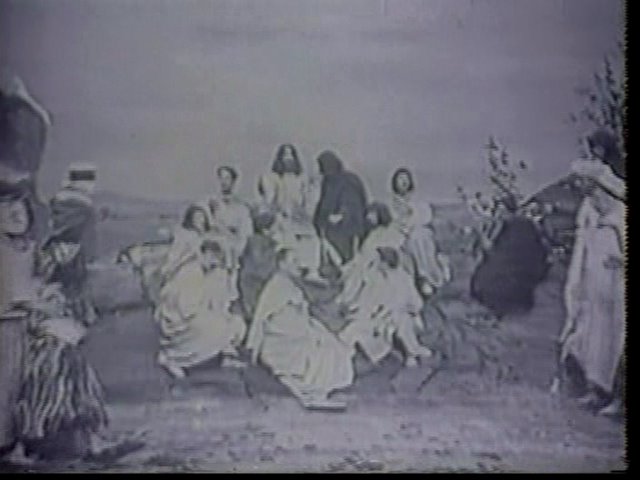
David and Saul (c1912)
More information about it at
http://biblefilms.blogspot.com/2006/03/early-films-about-david-and-saul-1911.html
and at
http://biblical-studies.ca/blog/wp/2006/03/16/king-saul-on-the-silver-screen-an-early-film-about-saul-and-david/ .
I will reproduce those pages below, almost in their entirety. The former page is by Matt Page. There it goes.
*begin quote*
Friday, March 03, 2006
Early films about David and Saul (1911-1913)
The final films on the DVD I've been discussing this week are both about the Hebrew King Saul; David et Saul (David and Saul) made in 1911 and La Mort de Saül (The Death of Saul) made two years later in 1913.
These films are also made by Pathé Frères and not listed in Campbell and Pitts' "The Bible on Film". They do list two other related films David and Goliath (1908) and Saul and David (1909), which is also listed on the IMDB . What is unusual about these two films is the subject material they choose to handle, particularly given that only a couple of films based on 1 Samuel had been made by this point. I imagine if you asked a modern day viewer which episodes from the books of Samuel they were most familiar with they would firstly list David and Goliath, and then perhaps David and Bathsheba, or the calling of Samuel, or the anointing of Saul or David. I'm not sure whether it's a sign of how much the parts of the bible we focus on have changed so much in 95 years, or that, even upon its release, they were unusual choices. Suffice to say none of the above scenes are in either of these films, the details of which are below:
David and Saul (1911)
David returns from beating the Philistines - (1 Sam 17/ 1 Sam 18:27)
David marries Michal - (1 Sam 18:27)
Saul grows jealous - (1 Sam 18:6-9)
David feigns madness whilst in hiding - (1 Sam 21:10-15
Saul slaughters the priests - (1 Sam 22:6-18)
David hides from Saul - (1 Sam 23:24-28)
Death of Saul (1913)
Saul slaughters the priests - (1 Sam 22:6-18)
The Witch of Endor - (1 Sam 28)
The death of Saul - (1 Sam 31:1-6)
What we do see is a great deal of attention given to Saul ordering the killing of the priests of Nob, which appears in both films. The review of The Death of Saul at IMDb notes how:
"The story of David and Saul is an interesting and ambitious choice of material, and this short feature does a creditable job of filming it. The story has plenty of action, plus some significant psychological themes, and this movie succeeds in bringing out at least some of both."
In my opinion the most successful biblical films have been those that use less familiar material to challenge our pre-conceptions, or are at least more concerned with trying to explore their protagonist's motives.
A few notes:
It's interesting that the first film starts with a celebration of David's victory over the Philistines. I put chapter 17 as a possible reference, but that's probably just re-coiling from the fact that the most likely victory this refers to is the one where he gives 200 Philistine foreskins to Saul as a wedding dowry (1 Sam 18:27). Certainly the fact that at the end of the scene Saul holds David and a very un-cinematic Michal together indicates that it is this victory which is being celebrated.
Although this film doesn't actually show the incident where David chooses not to kill Saul when he had the chance, it does refer to it in the intertitles "Fatigued Saul seeks repose in the cave where David was hidden". However, instead of seeing David cut Saul's cloak or steal his spear, the scene following this intertitle seems to portray David hiding on the other side of the mountain (1 Sam 23:24-28). The film crams a lot in, in a very short time, and it's hard for the viewer - even if they have a good knowledge of the various stories - to work out what is being depicted.
The break between the two films on the DVD I have is very slight, and most of the scant discussion of these two films on the web seems to treat them as one. In fact I noticed that the title of the film, placed at the top of each intertitle, changed before I noticed the briefly shown intertitle card that announced the new film.
The second film is two years later, and the filmmakers have significantly improved in that time. The use of a red colour wash during the sacking of Nob is quite effective, as is the use of special effects when Samuel appears in the witch's cave. There's also a really impressive scene (coming soon) where a large crowd of Philistines rush past the camera into the battle. Except for the old black and white celluloidthe way this action is filmed is on a par with anything today, and is the most impressive sequence I can recall at any point before Birth of a Nation revolutionised film in 1915.
It is interesting how the second film paraphrases Saul's prophesy into three clauses and then shows each happening in turn:
"Thy armies shall be delivered into the hands of the PhilistinesThy sons shall perishThy sword shall avenge the God of Israel"
It's not quite what Samuel says (1 Sam 28:19), but the way the film takes each clause and shows it happening is a far more sophisticated narrative device than was standard for the era.
Finally, although the second film is about the same length as the first it takes things much more slowly. The emphasis here seems to be much more on Saul and what is happening to him internally, than the events that are happening around him. It also allows a chiastic structure to the events. The film starts with Saul destroying the priests of Nob, and ends with him being destroyed by them, separated only by an announcement of God's judgement upon him, and linking the two actions nicely together.
Matt
Labels: David
posted at 2:10 PM © Matt Page 2005-2008
*end quote*
The second web page I gave at the beginning is reproduced, almost in its entirety, below. Its author is Tyler F. Williams.
*begin quote*
King Saul on the Silver Screen: An Early Film about Saul and David
16th March 2006
I recently bought on eBay a DVD with a silent film from the early 1900s about Saul and David. The amateur DVD is entitled, “Early Religious Films” and besides the film on Saul and David, it includes two other early Jesus films. Matt Page over at Bible Film Blog purchased the same DVD and has blogged on the two Jesus films here and here, and the Saul and David film here. As Matt noted in his blog entries, identifying these films is a bit challenging. The distributor who made the DVD from old reels doesn’t have any further information on the films included. In particular, a major problem with the Saul and David film is trying to determine whether or not it is one film or two. Matt thinks what is on the DVD is actually two films, a film called “David and Saul” and another film called “The Death of Saul.” Matt’s summary of this film is excellent and I encourage you to read it. I thought I would offer my own slightly different take on this early film about Saul and David.
Identification
According to my research, in the early 1900s there were four films made that focused particularly on the reign of Saul, the first king of Israel, and his stormy relationship with David. My primary sources for this information are:
Richard Abel, The Ciné Goes to Town: French Cinema 1896-1914 (University of California Press, 1994; Buy from Amazon.ca Buy from Amazon.com)
Richard H. Campbell and Michael R. Pitts, The Bible on Film: A Checklist, 1897-1980 (Scarecrow Press, 1981; out of print)
Jon Solomon, The Ancient World in the Cinema (Revised & Expand edition; Yale University Press, 2001; Buy from Amazon.ca Buy from Amazon.com)
As I piece the various lists together, there are four early films on Saul and David. In chronological order they are:
Saul and David. This early American film was directed by J. Stuart Blackton with the scenario written by Madison C. Peters. Produced and distributed by Vitagraph in 1909. [Noted in Campbell and Pitts, 3; Solomon, 5, 166; IMDb]
Saul and David [Saül et David]. A French film produced and directed by Léon Gaumont in 1911. [Noted as “lost to the ages” in Campbell and Pitts, 5; Solomon, 7]
David and Saul [David et Saül]. Produced by the French studio Pathé-Frères and distributed by their export office C.G.P.C. in 1912. Campbell and Pitts has this film listed as “Saul and David” while IMDb has it as “David and Saul.” In addition IMDb notes this film was directed by André (Henri) Andréani and dates it to 1911. This identification is plausible since Andréani directed many of Pathé-Frères biblical films in this period; the earlier date likely represents its actual production date, while the later date is its American distribution. [Noted in Campbell and Pitts, 5; Solomon, 7; IMDb]
The Death of Saul [La Mort de Saül]. This French film was directed by André (Henri) Andréani with the scenario written by Eugène Creissel with Louis Ravet playing Saul. It was produced by Pathé-Frères in June 1912, while its American distribution date is typically listed as 1913. 12 minutes long. [Noted in Abel, 319; Solomon, 7, 141; and IMDb]
The challenge with identifying the film on the DVD is that, based on the intertitles, it appears to be two films spliced together. The first three intertitles include the title “David and Saul” in small print at the top of the frame; then there is a full-frame intertitle introducing “The Death of Saul” while the rest of the intertitles in film have “The Death of Saul” in small print at the top. In addition, while there is remarkable consistency between the two sections in regards to costuming and it appears Louis Ravet plays Saul in both parts, the actor playing Saul’s son Jonathan is different between the two sections.
Matt Page identifies the first part with the 1911/12 film “David and Saul” and the second part with the 1912/13 film “The Death of Saul.” This identification is more than likely correct, since both films are by the same studio. From the discussion in Abel (which is based on the version of the film in the Library of Congress archives), however, it is clear that the “Death of Saul” on the DVD does not include its original beginning. Perhaps that is why excerpts from “Saul and David” were included at the beginning.
What should be clear from this discussion is that figuring out the early history of Bible related films is challenging to say the least!
Analysis
The origin of the film aside, the version that I have consists of two main sections, Saul and David and the Death of Saul. Here is my breakdown and discussion of the two parts (my divisions are based primarily on the intertitles):
David and Saul
This part of the film may be divided into three sections based on the intertitles. It’s camera work is pretty basic, consisting of almost exclusively of stationary longshots.
David, conqueror of the Philistines, asks Saul to Keep his Promise [to give his daughter Michal in marriage]
This section is based on 1Sam 18:27 and has David returning from battle, being greeted by a portly Jonathan, and being given Michal in marriage by Saul.
Jealous of David’s Popularity, Anger Invades Saul’s Heart.
This section consists of five scenes. The first has Saul in his palace looking out at the crowds who are evidently praising David’s military prowess (inspired by 1Sam 18:7). The second scene, based on 1Samuel 19 (cf. 19:1, 17), shows a confrontation between Saul and a group consisting of Michal, Jonathan, and some others. Saul is evidently asking for the whereabouts of David, but he leaves none the smarter. The third scene shows a dejected looking David and his motley crew of followers at the cave of Adullam (1Sam 22:1-2). Note that Matt Page identifies this scene as “David feigns madness whilst in hiding” based on 1 Sam 21:10-15. The problem with this identification is that the setting is does not appear to be Achish and David doesn’t look too insane (at least he’s not scratching marks on gates or drooling). The fourth scene is very roughly based on 1Sam 22:6-18. It has Saul going to the sanctuary at Nob and confronting Ahimelech the priest about David’s whereabouts (I say only roughly, since in the biblical account the priests are brought to Saul). Ahimelech refuses and is then killed by a nasty looking Doeg the Edomite. The fifth and final scene of this section has Saul and his guard leaving in search of David.
Fatigued, Saul Seeks Repose in the Cave where David was Hidden.
This third and final section appears to be cut off prematurely. It is made up of two brief scenes based on 1Sam 24:1-3 (not 1 Sam 23:24-28 as Matt Page suggests). The first has Saul and his guard coming to a cave in the wilderness of En-gedi and Saul going into the cave to relieve himself (for more on the euphemisms used in this passage see my post here). The second scene shows David and his followers within the cave hiding themselves from the approaching Saul.
The Death of Saul
The second part of the film is, as Matt noted, of a higher quality and shows more innovation in camera work. It includes a pan shot as well as some ambitious outside action shots. It consists of seven parts of various lengths.
Saul Decides that the Priests and Other Inhabitants of the City shall be Slain.
This scene somewhat accurately represents the story in 1Sam 22:11-19 where Saul (in his palace) decides to kill Ahimelech and put the entire city to the sword. Interestingly, Abel, in his discussion of the film, mistakenly identifies the besieged city as Keilah (1Samuel 23). This is quite unlikely, especially considering Saul gave up his expedition against Keilah once he heard that David had fled the city.
Jonathan Endeavors to Avert the Massacre.
This section is quite long and involved, consisting of at least seven different scenes. The first two scenes of Jonathan fleeing the palace and warning Ahimelech of the coming massacre does not appear to be inspired by any biblical passage. The next scene has the priest going out and praying for the inhabitants of the city. Then the fourth scene shifts to Saul and his guard leaving the palace. The next three scenes has Saul and his army entering the city of Nob and burning it and putting it to the sword. These scenes employ some of Pathé’s patented special effects of red smoke and small explosions. The final scene of this section shows Saul receiving a written message just leaving the city. The message, which is signed by David, is presented on an intertitle. It says, “O King, know thou that the Philistines have gathered together to do battle with us. May the God of Israel protect us.” This may be based on 1Sam 23:27, though one cannot be sure.
Saul Seeks the Witch of Endor.
This section consists of two scenes based on 1Sam 28:3-8. The first has Saul encamped at Gilboa in fear of the Philistines who are assembled against Israel at Shunem. While the second has Saul leaving camp with two men to inquire of the medium at Endor since the Lord did not answer him. This second scene includes a primitive pan shot as the three men are walking towards Endor.
The Witch Evokes the Spirit of Samuel.
This section, taken from 1Sam 28:8-25, begins with a scene with Saul and the two men coming to the cave where the witch lives and then there is an interesting close-up bridge shot of Saul going down the narrow tunnel to the cave entrance alone. The scene where the disguised Saul asks the witch to consult Samuel has some interesting camera shots. Samuel appears on the cave wall with a flaming special effect and fade in shot and then later disappears with a straight cut. Samuel’s message to Saul, paraphrased from 1Sam 28:18-19, is included on an intertitle. Interestingly, the next three sections of the film are introduced by intertitles including excerpts of this message.
Thy Armies Shall be Delivered unto the Hands of the Philistines.
This section starts with Saul returning to the Israelite encampment, cuts to an amazing scene of the Philistine army rushing the Israelites, and ends with Saul and his army rushing out to meet them.
Thy Sons shall Perish.
This brief scene includes a son of Saul coming back from battle and dying in Saul’s arms (if this is Jonathan, then it is a different actor from the first film as noted above), Saul lamenting and then falling on his sword.
They Sword shall Avenge the God of Israel.
This final scene shows Saul dying — with, of course, the sword handle appropriately protruding from his belly!
Final Thoughts
There are a number of noteworthy things about this early film. First, as perhaps is clear from the various departures from the biblical storyline, that even in the early days of cinema films were interpretations of the biblical story. The scenario writer and director crafted their story with liberty to modify the biblical version as they thought appropriate. Second, what the film chose to focus on is interesting. The attention given to the massacre of the city of Nob and the visit with the witch of Endor likely stem from a number of things, including the simple desire to show off some of the special effects. Finally, I have to concur with Matt Page when he notes, “the most successful biblical films have been those that use less familiar material to challenge our pre-conceptions, or are at least more concerned with trying to explore their protagonist’s motives.” In this regard, I found this film to be quite intriguing.
For a complete listing of films based on the Hebrew Bible, please see my Old Testament on Film pages.
*end quote*
http://biblefilms.blogspot.com/2006/03/early-films-about-david-and-saul-1911.html
and at
http://biblical-studies.ca/blog/wp/2006/03/16/king-saul-on-the-silver-screen-an-early-film-about-saul-and-david/ .
I will reproduce those pages below, almost in their entirety. The former page is by Matt Page. There it goes.
*begin quote*
Friday, March 03, 2006
Early films about David and Saul (1911-1913)
The final films on the DVD I've been discussing this week are both about the Hebrew King Saul; David et Saul (David and Saul) made in 1911 and La Mort de Saül (The Death of Saul) made two years later in 1913.
These films are also made by Pathé Frères and not listed in Campbell and Pitts' "The Bible on Film". They do list two other related films David and Goliath (1908) and Saul and David (1909), which is also listed on the IMDB . What is unusual about these two films is the subject material they choose to handle, particularly given that only a couple of films based on 1 Samuel had been made by this point. I imagine if you asked a modern day viewer which episodes from the books of Samuel they were most familiar with they would firstly list David and Goliath, and then perhaps David and Bathsheba, or the calling of Samuel, or the anointing of Saul or David. I'm not sure whether it's a sign of how much the parts of the bible we focus on have changed so much in 95 years, or that, even upon its release, they were unusual choices. Suffice to say none of the above scenes are in either of these films, the details of which are below:
David and Saul (1911)
David returns from beating the Philistines - (1 Sam 17/ 1 Sam 18:27)
David marries Michal - (1 Sam 18:27)
Saul grows jealous - (1 Sam 18:6-9)
David feigns madness whilst in hiding - (1 Sam 21:10-15
Saul slaughters the priests - (1 Sam 22:6-18)
David hides from Saul - (1 Sam 23:24-28)
Death of Saul (1913)
Saul slaughters the priests - (1 Sam 22:6-18)
The Witch of Endor - (1 Sam 28)
The death of Saul - (1 Sam 31:1-6)
What we do see is a great deal of attention given to Saul ordering the killing of the priests of Nob, which appears in both films. The review of The Death of Saul at IMDb notes how:
"The story of David and Saul is an interesting and ambitious choice of material, and this short feature does a creditable job of filming it. The story has plenty of action, plus some significant psychological themes, and this movie succeeds in bringing out at least some of both."
In my opinion the most successful biblical films have been those that use less familiar material to challenge our pre-conceptions, or are at least more concerned with trying to explore their protagonist's motives.
A few notes:
It's interesting that the first film starts with a celebration of David's victory over the Philistines. I put chapter 17 as a possible reference, but that's probably just re-coiling from the fact that the most likely victory this refers to is the one where he gives 200 Philistine foreskins to Saul as a wedding dowry (1 Sam 18:27). Certainly the fact that at the end of the scene Saul holds David and a very un-cinematic Michal together indicates that it is this victory which is being celebrated.
Although this film doesn't actually show the incident where David chooses not to kill Saul when he had the chance, it does refer to it in the intertitles "Fatigued Saul seeks repose in the cave where David was hidden". However, instead of seeing David cut Saul's cloak or steal his spear, the scene following this intertitle seems to portray David hiding on the other side of the mountain (1 Sam 23:24-28). The film crams a lot in, in a very short time, and it's hard for the viewer - even if they have a good knowledge of the various stories - to work out what is being depicted.
The break between the two films on the DVD I have is very slight, and most of the scant discussion of these two films on the web seems to treat them as one. In fact I noticed that the title of the film, placed at the top of each intertitle, changed before I noticed the briefly shown intertitle card that announced the new film.
The second film is two years later, and the filmmakers have significantly improved in that time. The use of a red colour wash during the sacking of Nob is quite effective, as is the use of special effects when Samuel appears in the witch's cave. There's also a really impressive scene (coming soon) where a large crowd of Philistines rush past the camera into the battle. Except for the old black and white celluloidthe way this action is filmed is on a par with anything today, and is the most impressive sequence I can recall at any point before Birth of a Nation revolutionised film in 1915.
It is interesting how the second film paraphrases Saul's prophesy into three clauses and then shows each happening in turn:
"Thy armies shall be delivered into the hands of the PhilistinesThy sons shall perishThy sword shall avenge the God of Israel"
It's not quite what Samuel says (1 Sam 28:19), but the way the film takes each clause and shows it happening is a far more sophisticated narrative device than was standard for the era.
Finally, although the second film is about the same length as the first it takes things much more slowly. The emphasis here seems to be much more on Saul and what is happening to him internally, than the events that are happening around him. It also allows a chiastic structure to the events. The film starts with Saul destroying the priests of Nob, and ends with him being destroyed by them, separated only by an announcement of God's judgement upon him, and linking the two actions nicely together.
Matt
Labels: David
posted at 2:10 PM © Matt Page 2005-2008
*end quote*
The second web page I gave at the beginning is reproduced, almost in its entirety, below. Its author is Tyler F. Williams.
*begin quote*
King Saul on the Silver Screen: An Early Film about Saul and David
16th March 2006
I recently bought on eBay a DVD with a silent film from the early 1900s about Saul and David. The amateur DVD is entitled, “Early Religious Films” and besides the film on Saul and David, it includes two other early Jesus films. Matt Page over at Bible Film Blog purchased the same DVD and has blogged on the two Jesus films here and here, and the Saul and David film here. As Matt noted in his blog entries, identifying these films is a bit challenging. The distributor who made the DVD from old reels doesn’t have any further information on the films included. In particular, a major problem with the Saul and David film is trying to determine whether or not it is one film or two. Matt thinks what is on the DVD is actually two films, a film called “David and Saul” and another film called “The Death of Saul.” Matt’s summary of this film is excellent and I encourage you to read it. I thought I would offer my own slightly different take on this early film about Saul and David.
Identification
According to my research, in the early 1900s there were four films made that focused particularly on the reign of Saul, the first king of Israel, and his stormy relationship with David. My primary sources for this information are:
Richard Abel, The Ciné Goes to Town: French Cinema 1896-1914 (University of California Press, 1994; Buy from Amazon.ca Buy from Amazon.com)
Richard H. Campbell and Michael R. Pitts, The Bible on Film: A Checklist, 1897-1980 (Scarecrow Press, 1981; out of print)
Jon Solomon, The Ancient World in the Cinema (Revised & Expand edition; Yale University Press, 2001; Buy from Amazon.ca Buy from Amazon.com)
As I piece the various lists together, there are four early films on Saul and David. In chronological order they are:
Saul and David. This early American film was directed by J. Stuart Blackton with the scenario written by Madison C. Peters. Produced and distributed by Vitagraph in 1909. [Noted in Campbell and Pitts, 3; Solomon, 5, 166; IMDb]
Saul and David [Saül et David]. A French film produced and directed by Léon Gaumont in 1911. [Noted as “lost to the ages” in Campbell and Pitts, 5; Solomon, 7]
David and Saul [David et Saül]. Produced by the French studio Pathé-Frères and distributed by their export office C.G.P.C. in 1912. Campbell and Pitts has this film listed as “Saul and David” while IMDb has it as “David and Saul.” In addition IMDb notes this film was directed by André (Henri) Andréani and dates it to 1911. This identification is plausible since Andréani directed many of Pathé-Frères biblical films in this period; the earlier date likely represents its actual production date, while the later date is its American distribution. [Noted in Campbell and Pitts, 5; Solomon, 7; IMDb]
The Death of Saul [La Mort de Saül]. This French film was directed by André (Henri) Andréani with the scenario written by Eugène Creissel with Louis Ravet playing Saul. It was produced by Pathé-Frères in June 1912, while its American distribution date is typically listed as 1913. 12 minutes long. [Noted in Abel, 319; Solomon, 7, 141; and IMDb]
The challenge with identifying the film on the DVD is that, based on the intertitles, it appears to be two films spliced together. The first three intertitles include the title “David and Saul” in small print at the top of the frame; then there is a full-frame intertitle introducing “The Death of Saul” while the rest of the intertitles in film have “The Death of Saul” in small print at the top. In addition, while there is remarkable consistency between the two sections in regards to costuming and it appears Louis Ravet plays Saul in both parts, the actor playing Saul’s son Jonathan is different between the two sections.
Matt Page identifies the first part with the 1911/12 film “David and Saul” and the second part with the 1912/13 film “The Death of Saul.” This identification is more than likely correct, since both films are by the same studio. From the discussion in Abel (which is based on the version of the film in the Library of Congress archives), however, it is clear that the “Death of Saul” on the DVD does not include its original beginning. Perhaps that is why excerpts from “Saul and David” were included at the beginning.
What should be clear from this discussion is that figuring out the early history of Bible related films is challenging to say the least!
Analysis
The origin of the film aside, the version that I have consists of two main sections, Saul and David and the Death of Saul. Here is my breakdown and discussion of the two parts (my divisions are based primarily on the intertitles):
David and Saul
This part of the film may be divided into three sections based on the intertitles. It’s camera work is pretty basic, consisting of almost exclusively of stationary longshots.
David, conqueror of the Philistines, asks Saul to Keep his Promise [to give his daughter Michal in marriage]
This section is based on 1Sam 18:27 and has David returning from battle, being greeted by a portly Jonathan, and being given Michal in marriage by Saul.
Jealous of David’s Popularity, Anger Invades Saul’s Heart.
This section consists of five scenes. The first has Saul in his palace looking out at the crowds who are evidently praising David’s military prowess (inspired by 1Sam 18:7). The second scene, based on 1Samuel 19 (cf. 19:1, 17), shows a confrontation between Saul and a group consisting of Michal, Jonathan, and some others. Saul is evidently asking for the whereabouts of David, but he leaves none the smarter. The third scene shows a dejected looking David and his motley crew of followers at the cave of Adullam (1Sam 22:1-2). Note that Matt Page identifies this scene as “David feigns madness whilst in hiding” based on 1 Sam 21:10-15. The problem with this identification is that the setting is does not appear to be Achish and David doesn’t look too insane (at least he’s not scratching marks on gates or drooling). The fourth scene is very roughly based on 1Sam 22:6-18. It has Saul going to the sanctuary at Nob and confronting Ahimelech the priest about David’s whereabouts (I say only roughly, since in the biblical account the priests are brought to Saul). Ahimelech refuses and is then killed by a nasty looking Doeg the Edomite. The fifth and final scene of this section has Saul and his guard leaving in search of David.
Fatigued, Saul Seeks Repose in the Cave where David was Hidden.
This third and final section appears to be cut off prematurely. It is made up of two brief scenes based on 1Sam 24:1-3 (not 1 Sam 23:24-28 as Matt Page suggests). The first has Saul and his guard coming to a cave in the wilderness of En-gedi and Saul going into the cave to relieve himself (for more on the euphemisms used in this passage see my post here). The second scene shows David and his followers within the cave hiding themselves from the approaching Saul.
The Death of Saul
The second part of the film is, as Matt noted, of a higher quality and shows more innovation in camera work. It includes a pan shot as well as some ambitious outside action shots. It consists of seven parts of various lengths.
Saul Decides that the Priests and Other Inhabitants of the City shall be Slain.
This scene somewhat accurately represents the story in 1Sam 22:11-19 where Saul (in his palace) decides to kill Ahimelech and put the entire city to the sword. Interestingly, Abel, in his discussion of the film, mistakenly identifies the besieged city as Keilah (1Samuel 23). This is quite unlikely, especially considering Saul gave up his expedition against Keilah once he heard that David had fled the city.
Jonathan Endeavors to Avert the Massacre.
This section is quite long and involved, consisting of at least seven different scenes. The first two scenes of Jonathan fleeing the palace and warning Ahimelech of the coming massacre does not appear to be inspired by any biblical passage. The next scene has the priest going out and praying for the inhabitants of the city. Then the fourth scene shifts to Saul and his guard leaving the palace. The next three scenes has Saul and his army entering the city of Nob and burning it and putting it to the sword. These scenes employ some of Pathé’s patented special effects of red smoke and small explosions. The final scene of this section shows Saul receiving a written message just leaving the city. The message, which is signed by David, is presented on an intertitle. It says, “O King, know thou that the Philistines have gathered together to do battle with us. May the God of Israel protect us.” This may be based on 1Sam 23:27, though one cannot be sure.
Saul Seeks the Witch of Endor.
This section consists of two scenes based on 1Sam 28:3-8. The first has Saul encamped at Gilboa in fear of the Philistines who are assembled against Israel at Shunem. While the second has Saul leaving camp with two men to inquire of the medium at Endor since the Lord did not answer him. This second scene includes a primitive pan shot as the three men are walking towards Endor.
The Witch Evokes the Spirit of Samuel.
This section, taken from 1Sam 28:8-25, begins with a scene with Saul and the two men coming to the cave where the witch lives and then there is an interesting close-up bridge shot of Saul going down the narrow tunnel to the cave entrance alone. The scene where the disguised Saul asks the witch to consult Samuel has some interesting camera shots. Samuel appears on the cave wall with a flaming special effect and fade in shot and then later disappears with a straight cut. Samuel’s message to Saul, paraphrased from 1Sam 28:18-19, is included on an intertitle. Interestingly, the next three sections of the film are introduced by intertitles including excerpts of this message.
Thy Armies Shall be Delivered unto the Hands of the Philistines.
This section starts with Saul returning to the Israelite encampment, cuts to an amazing scene of the Philistine army rushing the Israelites, and ends with Saul and his army rushing out to meet them.
Thy Sons shall Perish.
This brief scene includes a son of Saul coming back from battle and dying in Saul’s arms (if this is Jonathan, then it is a different actor from the first film as noted above), Saul lamenting and then falling on his sword.
They Sword shall Avenge the God of Israel.
This final scene shows Saul dying — with, of course, the sword handle appropriately protruding from his belly!
Final Thoughts
There are a number of noteworthy things about this early film. First, as perhaps is clear from the various departures from the biblical storyline, that even in the early days of cinema films were interpretations of the biblical story. The scenario writer and director crafted their story with liberty to modify the biblical version as they thought appropriate. Second, what the film chose to focus on is interesting. The attention given to the massacre of the city of Nob and the visit with the witch of Endor likely stem from a number of things, including the simple desire to show off some of the special effects. Finally, I have to concur with Matt Page when he notes, “the most successful biblical films have been those that use less familiar material to challenge our pre-conceptions, or are at least more concerned with trying to explore their protagonist’s motives.” In this regard, I found this film to be quite intriguing.
For a complete listing of films based on the Hebrew Bible, please see my Old Testament on Film pages.
*end quote*
Gone Baby Gone (2007)
Synopsis: A private investigator is hired to help locate a missing child. The mother is a drug addict.
Appraisal: Quite well directed. The several situations and characters develop in an interesting way, but the whole is less than compelling; it's a sort of formulaic structure designed in such a way as to insert bleak social -- and moral, if you will -- commentary into a mystery plot with some action set-pieces thrown in for good measure.
Rating: 64
Appraisal: Quite well directed. The several situations and characters develop in an interesting way, but the whole is less than compelling; it's a sort of formulaic structure designed in such a way as to insert bleak social -- and moral, if you will -- commentary into a mystery plot with some action set-pieces thrown in for good measure.
Rating: 64
Friday, March 28, 2008
Waterborne (2005)
Synopsis: Someone is tampering with the water supply of Los Angeles. Several people die and panic sets in among the population.
Appraisal: Even though the filmmaker shows some ability on some individual scenes, the film as a whole is very poor, both in psychological characterizations, and in showing the progression of the crisis.
Rating: 25
Appraisal: Even though the filmmaker shows some ability on some individual scenes, the film as a whole is very poor, both in psychological characterizations, and in showing the progression of the crisis.
Rating: 25
Buona Sera, Mrs. Campbell (1968)
Synopsis: In a small Italian town, a woman tells everyone that her daughter is the fruit of her marriage with an American World War II captain, who died soon afterwards. In reality, she slept with three different men during the War, and she later told each one of them he was the father, so that she could collect checks from all of them. The upcoming visit of the three of them with an American group for a celebration puts her in a state of panic.
Appraisal: Very bland comedy, with a very weak premise which resolves itself quite easily in the end, which was to be expected since it didn't make much sense from the beginning. The dialogue constantly tries to insert risqué allusions, which seem very dated and contrived.
Rating: 32
Appraisal: Very bland comedy, with a very weak premise which resolves itself quite easily in the end, which was to be expected since it didn't make much sense from the beginning. The dialogue constantly tries to insert risqué allusions, which seem very dated and contrived.
Rating: 32
Wednesday, March 26, 2008
Where's Marlowe? (1998)
Synopsis: Two filmmakers do a documentary about a private investigating agency.
Appraisal: Second viewing. Thematically akin to Real Life (1979) and Guy (1997). Entertaining and funny, but its limitations became more evident on second viewing.
Rating: 65 (down from 69)
Appraisal: Second viewing. Thematically akin to Real Life (1979) and Guy (1997). Entertaining and funny, but its limitations became more evident on second viewing.
Rating: 65 (down from 69)
The Death of Christ (c1900)
More information at http://biblefilms.blogspot.com/2006/03/death-of-christ-c1900.html, the contents of which I am reproducing below almost integrally. The author of the page (and of the blog) is Matt Page.
*begin quote*
Thursday, March 02, 2006
Death of Christ (c.1900)
Following on from the last two days' posts where I have been looking at a couple of very early Jesus films, I wanted to post today, in more detail on the second of these The Death of Christ. It was hard enough trying to date The Life of Christ, but at least it provided a date to be sceptical about! With this film I would place it at around the same time, maybe even slightly earlier than The Life of Christ, but I wouldn't place it any early than the date claimed at the start of the Life of Christ. Anyway - the full discussion of that was two days ago.
This film is actually more interesting to right about than the earlier one since whereas that film largely contained material that was incorporated into The Life and Passion of Jesus Christ. Whilst this film is shorter (only 10 minutes long), most of the material is original to this film. First things first the scenes guide with scripture citations.
Last Supper (start of) - (Mark 14:16-17)
*Gethsemane - (Mark 14:32-42)
*Arrest of Jesus - (Mark 14:43-46)
*Trial before Pilate - (Mark 15:1-14)
*Scourging & Mocking - (Mark 15:15-20)
*Presented before the People - (Matt 27:24-26)
Road to the cross - (Luke 23:26-28)
*Crucifixion - (Mark 15:22-33)
*Death of Jesus - (John 19:30,34)
*Resurrection - (Mark 16:1-8)
Ascension - (Luke 24:50-53)
A Few Notes
*These scenes are different from those in The Life and Passion of Jesus Christ, although in many cases they have strongly influenced that film, with it being really clear that it re-filmed some scenes almost exactly the same, with only minor "improvements". A good example of this is the trial of Jesus in front of Pilate where in this film it is not very clear that Barabbas is present, whereas in the later The Life and Passion of Jesus Christ Barabbas is far more distinct. The shot is very similar in most other respects.
Only three scenes then are used in The Life and Passion of Jesus Christ. Firstly, the last supper, where the scant footage shown here is actually that which immediately preceds the longer scene in The Life and Passion. Next is the road to the cross scene, and finally, the ascension scene. These last two scenes are actually in all three films. The latter scene is far more complex than any of the other scenes in this film, and has been reasonably well done so it is not surprising that no-one went to the trouble fo re-filming it.
Two further points. Firstly, in comparing the scenes here with the Life of Christ, I noticed that that film seems to jump from the money-changers scene straight to Jesus's trail. Even for viewers who know the story this is a strange move. It does make me wonder if some of the material here was at one stage part of that film.
Secondly, of all three of these early films I think this is my favourite. This is partly because it is the least coloured, and the technique is a bit of a distraction, it's partly because it contains one really great scene - that in the Garden of Gethsemane, as well as being the source, I assume, for the innovative ascension scene. I also like the depiction of the scourging in contrast to The Life and Passion of Jesus Christ. Here Jesus offers some resistance, there Jesus almost seems to volunteer for it. I wonder if this was the main reason that this scene was re-filmed as except for a difference in background it is more or less the same. I also much refer the resurrection scene. It's one of the hardest things to film, and film-makers have used a variety of approaches. This is one of the best. Fairly literal, and yet not sensational, kitschy, or cheesy. That said it doesn't really rely on any of the gospels (non of which describe the actual resurrection), and perhaps is most similar to Mel Gibson's version, but it's far more simple, and effective, and not nearly so pleased with itself.
All in all, I'm glad I've uncovered this early classic. Jesus films for the next 110 years have swung between the kitsch and the more profound, and I'm glad that at least one of the very earliest Jesus films falls into the latter category.
Matt
Labels: Life and Passion of Jesus Christ
posted at 9:04 AM © Matt Page 2005-2008
*end quote*
*begin quote*
Thursday, March 02, 2006
Death of Christ (c.1900)
Following on from the last two days' posts where I have been looking at a couple of very early Jesus films, I wanted to post today, in more detail on the second of these The Death of Christ. It was hard enough trying to date The Life of Christ, but at least it provided a date to be sceptical about! With this film I would place it at around the same time, maybe even slightly earlier than The Life of Christ, but I wouldn't place it any early than the date claimed at the start of the Life of Christ. Anyway - the full discussion of that was two days ago.
This film is actually more interesting to right about than the earlier one since whereas that film largely contained material that was incorporated into The Life and Passion of Jesus Christ. Whilst this film is shorter (only 10 minutes long), most of the material is original to this film. First things first the scenes guide with scripture citations.
Last Supper (start of) - (Mark 14:16-17)
*Gethsemane - (Mark 14:32-42)
*Arrest of Jesus - (Mark 14:43-46)
*Trial before Pilate - (Mark 15:1-14)
*Scourging & Mocking - (Mark 15:15-20)
*Presented before the People - (Matt 27:24-26)
Road to the cross - (Luke 23:26-28)
*Crucifixion - (Mark 15:22-33)
*Death of Jesus - (John 19:30,34)
*Resurrection - (Mark 16:1-8)
Ascension - (Luke 24:50-53)
A Few Notes
*These scenes are different from those in The Life and Passion of Jesus Christ, although in many cases they have strongly influenced that film, with it being really clear that it re-filmed some scenes almost exactly the same, with only minor "improvements". A good example of this is the trial of Jesus in front of Pilate where in this film it is not very clear that Barabbas is present, whereas in the later The Life and Passion of Jesus Christ Barabbas is far more distinct. The shot is very similar in most other respects.
Only three scenes then are used in The Life and Passion of Jesus Christ. Firstly, the last supper, where the scant footage shown here is actually that which immediately preceds the longer scene in The Life and Passion. Next is the road to the cross scene, and finally, the ascension scene. These last two scenes are actually in all three films. The latter scene is far more complex than any of the other scenes in this film, and has been reasonably well done so it is not surprising that no-one went to the trouble fo re-filming it.
Two further points. Firstly, in comparing the scenes here with the Life of Christ, I noticed that that film seems to jump from the money-changers scene straight to Jesus's trail. Even for viewers who know the story this is a strange move. It does make me wonder if some of the material here was at one stage part of that film.
Secondly, of all three of these early films I think this is my favourite. This is partly because it is the least coloured, and the technique is a bit of a distraction, it's partly because it contains one really great scene - that in the Garden of Gethsemane, as well as being the source, I assume, for the innovative ascension scene. I also like the depiction of the scourging in contrast to The Life and Passion of Jesus Christ. Here Jesus offers some resistance, there Jesus almost seems to volunteer for it. I wonder if this was the main reason that this scene was re-filmed as except for a difference in background it is more or less the same. I also much refer the resurrection scene. It's one of the hardest things to film, and film-makers have used a variety of approaches. This is one of the best. Fairly literal, and yet not sensational, kitschy, or cheesy. That said it doesn't really rely on any of the gospels (non of which describe the actual resurrection), and perhaps is most similar to Mel Gibson's version, but it's far more simple, and effective, and not nearly so pleased with itself.
All in all, I'm glad I've uncovered this early classic. Jesus films for the next 110 years have swung between the kitsch and the more profound, and I'm glad that at least one of the very earliest Jesus films falls into the latter category.
Matt
Labels: Life and Passion of Jesus Christ
posted at 9:04 AM © Matt Page 2005-2008
*end quote*
The Life of Christ (c1900)
More information at http://biblefilms.blogspot.com/2006/03/life-of-christ-1898.html, the contents of which I am reproducing below almost integrally. The author of the page (and of the blog) is Matt Page.
*begin quote*
Wednesday, March 01, 2006
Life of Christ (1898)
Yesterday's entry looked at the problems of dating some early films picked up on eBay. Today's post will look at the first of those (as it arrived on the disc), The Life of Christ, purporting to be from 1898. The film is just 14:23 minutes long, and none of the actors' names are given. Here's the scene order (as ever, scripture citations are in the normal format.)
Angels and Joseph's Dream - Matt 2:13-14
Escape to Egypt - Matt 2:15
*The Boy Jesus and the Doctors - Luke 2:40-52
Baptism - Mark 1:6-11
*Woman at Samaria - John 4:4-29
†Feeding 5000 with Fish and Bread - Mark 6:30-44
Christ Walks on Water - Mark 6:47-48
*Entering into Jerusalem - Mark 11:1-10
*Driving out the Money Changers - Mark 11:15-19
Trial before Pilate - Mark 15:1-15
*Ecce Homo - John 19:5
(Veronica) - Tradition
Road to the cross - Luke 23:26-28
Crucifixion - Mark 15:22-33
Death of Jesus - John 19:30,34
Resurrection - Mark 16:1-8
Acension - Luke 24:50-53
A Few Notes:
†This scene (the feeding of the 5000, or the "Fish and Bread" as the intertitles call it is the only one in the film without parallel in The Life and Passion of Jesus Christ. That said...
*Scenes marked with a * are different from those in The Life and Passion of Jesus Christ, even if the later film copies / improves upon them. Sometimes the details are fairly minor (e.g. different actors or backgrounds), at other times the whole composition of the shot is fundamentally different.
Four scenes use camera trickery - essentially double exposure. The two appearances by angels in the first two scenes both use this technique fairly simply, but the resurrection scene, where Jesus floats out of his grave, and "Christ Walks on Water" are both a bit more sophisticated. The later is possibly significant as renown camera trickery pioneer George Méliès released a film in 1899 called Christ Walks on Water. This was thought to be the first part of the bible to be shown on camera outside of Jesus's Passion. Part of me wonders if this scene (later incorporated into The Life and Passion of Jesus Christ) was Méliès's original, and whether this effects the potential dating of this film.
The film starts in a strange place as well, not showing the nativity or any of the events leading up to it, but starting after the departure of the wise men as Joseph is about to have the dream that instructs him to take his family to Egypt. Having thought about the dating of the film more since yesterday, this was one piece of evidence I didn't really consider enough.
As with The Life and Passion of Jesus Christ this film was shot in black and white, but a number of scenes have been hand coloured. In addition some scenes stencil on extra details, most notably the Holy Spirit stenciled on as a dove in the baptism scene (see left) and the ascension scene.
In terms of episodes that rarely make Jesus films, obviously this film has nearly all of it's material in common with The Life and Passion of Jesus Christ. Even so, both films show the Ascension in an unusual way, and in fact, depictions of this are rare in themself. The scene with the woman of Samaria is also fairly rare in film version of Jesus's life, which is unusual as it gives us a rare three dimensional female role. Directors are usually keen on such roles, note for example one of the most frequently filmed scenes outside of his Passion - the woman taken in adultery.
Finally, one comment that is often made about The Life and Passion of Jesus Christ is worth repeating here. As this was filmed in the very early days of cinema, it's very obvious from this film that even the most basic aspects of moviemaking have yet to be discovered. For example, the camera is always static, and the acting takes place in front of it - this works similarly to watching a play. In a similar vein, nearly all the action takes place in the middle distance. There are a couple of exceptions in this film, and these may have been the first films to pioneer these new techniques. The first is the Ecce Homo moment. The camera get that bit closer to Jesus, just showing his upper half as he stands in front of the words "Ecce Homo" behind him. The second is a shot of Veronica, after she has wiped his face. The camera cuts to a shot of her holding her cloth, close enough for the viewer to see she has a perfect image of Jesus's face upon it.
This film will probably be available from this seller on eBay as part of a compilation DVD Early Religious Films.
Matt
Labels: Life and Passion of Jesus Christ
posted at 10:00 AM © Matt Page 2005-2008
3 Comments:
(...)
At 2:45 AM, March 16, 2008, Antonio Ventaja said…
Sorry, I don´t speak and not wright in english ( I am spanish).I beliver that this film is La Vie et la Passion de Jésus-Christ of 1898 of directors Georges Hatot and Louis Lumière.Thanks for your blog.
At 3:11 AM, March 16, 2008, Matt Page said…
Thanks for that, I'm not sure I've heard that before.
Thanks
Matt
*end quote*
*begin quote*
Wednesday, March 01, 2006
Life of Christ (1898)
Yesterday's entry looked at the problems of dating some early films picked up on eBay. Today's post will look at the first of those (as it arrived on the disc), The Life of Christ, purporting to be from 1898. The film is just 14:23 minutes long, and none of the actors' names are given. Here's the scene order (as ever, scripture citations are in the normal format.)
Angels and Joseph's Dream - Matt 2:13-14
Escape to Egypt - Matt 2:15
*The Boy Jesus and the Doctors - Luke 2:40-52
Baptism - Mark 1:6-11
*Woman at Samaria - John 4:4-29
†Feeding 5000 with Fish and Bread - Mark 6:30-44
Christ Walks on Water - Mark 6:47-48
*Entering into Jerusalem - Mark 11:1-10
*Driving out the Money Changers - Mark 11:15-19
Trial before Pilate - Mark 15:1-15
*Ecce Homo - John 19:5
(Veronica) - Tradition
Road to the cross - Luke 23:26-28
Crucifixion - Mark 15:22-33
Death of Jesus - John 19:30,34
Resurrection - Mark 16:1-8
Acension - Luke 24:50-53
A Few Notes:
†This scene (the feeding of the 5000, or the "Fish and Bread" as the intertitles call it is the only one in the film without parallel in The Life and Passion of Jesus Christ. That said...
*Scenes marked with a * are different from those in The Life and Passion of Jesus Christ, even if the later film copies / improves upon them. Sometimes the details are fairly minor (e.g. different actors or backgrounds), at other times the whole composition of the shot is fundamentally different.
Four scenes use camera trickery - essentially double exposure. The two appearances by angels in the first two scenes both use this technique fairly simply, but the resurrection scene, where Jesus floats out of his grave, and "Christ Walks on Water" are both a bit more sophisticated. The later is possibly significant as renown camera trickery pioneer George Méliès released a film in 1899 called Christ Walks on Water. This was thought to be the first part of the bible to be shown on camera outside of Jesus's Passion. Part of me wonders if this scene (later incorporated into The Life and Passion of Jesus Christ) was Méliès's original, and whether this effects the potential dating of this film.
The film starts in a strange place as well, not showing the nativity or any of the events leading up to it, but starting after the departure of the wise men as Joseph is about to have the dream that instructs him to take his family to Egypt. Having thought about the dating of the film more since yesterday, this was one piece of evidence I didn't really consider enough.
As with The Life and Passion of Jesus Christ this film was shot in black and white, but a number of scenes have been hand coloured. In addition some scenes stencil on extra details, most notably the Holy Spirit stenciled on as a dove in the baptism scene (see left) and the ascension scene.
In terms of episodes that rarely make Jesus films, obviously this film has nearly all of it's material in common with The Life and Passion of Jesus Christ. Even so, both films show the Ascension in an unusual way, and in fact, depictions of this are rare in themself. The scene with the woman of Samaria is also fairly rare in film version of Jesus's life, which is unusual as it gives us a rare three dimensional female role. Directors are usually keen on such roles, note for example one of the most frequently filmed scenes outside of his Passion - the woman taken in adultery.
Finally, one comment that is often made about The Life and Passion of Jesus Christ is worth repeating here. As this was filmed in the very early days of cinema, it's very obvious from this film that even the most basic aspects of moviemaking have yet to be discovered. For example, the camera is always static, and the acting takes place in front of it - this works similarly to watching a play. In a similar vein, nearly all the action takes place in the middle distance. There are a couple of exceptions in this film, and these may have been the first films to pioneer these new techniques. The first is the Ecce Homo moment. The camera get that bit closer to Jesus, just showing his upper half as he stands in front of the words "Ecce Homo" behind him. The second is a shot of Veronica, after she has wiped his face. The camera cuts to a shot of her holding her cloth, close enough for the viewer to see she has a perfect image of Jesus's face upon it.
This film will probably be available from this seller on eBay as part of a compilation DVD Early Religious Films.
Matt
Labels: Life and Passion of Jesus Christ
posted at 10:00 AM © Matt Page 2005-2008
3 Comments:
(...)
At 2:45 AM, March 16, 2008, Antonio Ventaja said…
Sorry, I don´t speak and not wright in english ( I am spanish).I beliver that this film is La Vie et la Passion de Jésus-Christ of 1898 of directors Georges Hatot and Louis Lumière.Thanks for your blog.
At 3:11 AM, March 16, 2008, Matt Page said…
Thanks for that, I'm not sure I've heard that before.
Thanks
Matt
*end quote*
Tuesday, March 25, 2008
I Am David (2003)
Synopsis: In the 50's, a little boy escapes from a concentration camp in Bulgaria. He faces many perils in his journey to a safe place. Based on the novel "David", by Anne Holm (1st ed. 1963).
Appraisal: Total incompetence are the defining words here, so let's not waste our time. The book is considered somewhat of a classic in literature for children, and the skeleton of the plot does reveal the possibility of a sound divertissement, which evidently was spoiled.
Rating: 16
Appraisal: Total incompetence are the defining words here, so let's not waste our time. The book is considered somewhat of a classic in literature for children, and the skeleton of the plot does reveal the possibility of a sound divertissement, which evidently was spoiled.
Rating: 16
Monday, March 24, 2008
Dark Blue (2002)
Synopsis: A cop and his rookie partner are assigned to investigate a multiple murder at a store. It turns out to be a very complicated affair, involving police corruption and the theft of a safe full of money.
Appraisal: One of the better cop movies of the last few years. The interconnection among the several elements of the story is very well handled, and the film flows in a crescendo of action and dramatic tension right until the end. Gleeson's performance is absolutely amazing. Russell doesn't do so badly either.
Rating: 69
Appraisal: One of the better cop movies of the last few years. The interconnection among the several elements of the story is very well handled, and the film flows in a crescendo of action and dramatic tension right until the end. Gleeson's performance is absolutely amazing. Russell doesn't do so badly either.
Rating: 69
Le grand restaurant (1966)
English titles: What's Cooking in Paris; The Big Restaurant.
Synopsis: The president of a foreign country disappears from a restaurant and a kidnapping is assumed; the restaurant's owner is summoned by the police to help find him.
Appraisal: It's practically two different films; it begins as a comedy set at a restaurant and later becomes a more action-oriented film. Both parts are moderately enjoyable.
Rating: 41
Synopsis: The president of a foreign country disappears from a restaurant and a kidnapping is assumed; the restaurant's owner is summoned by the police to help find him.
Appraisal: It's practically two different films; it begins as a comedy set at a restaurant and later becomes a more action-oriented film. Both parts are moderately enjoyable.
Rating: 41
Les bronzés font du ski (1979)
Synopsis: The same group of friends from Les bronzés are now on a ski resort.
Appraisal: Passable sequel.
Rating: 46
Appraisal: Passable sequel.
Rating: 46
Subscribe to:
Posts (Atom)