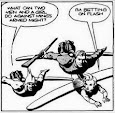
The infant son of a wealthy man is kidnapped. A reporter wants to find it and get the reward. At nearly the same time, another baby is taken from its carriage during an absence of its caretaker and, by a coincidence, the reporter is the baby's uncle and lives in the same house. Also coincidentally, the maid at that house is courted by a man who works for the kidnapper of the first baby.
As you may have noticed, the plot is full of coincidences. The film is a near-total disgrace, a disjointed mix of unfunny narrative and musical numbers. The latter are nothing special, although the kind of Brazilian music they show is not unpleasant. The most remarkable thing about the movie is the abundance of racial references in the dialogue and even in one song. The most curious one is perhaps a line by the black male servant about the mixed-race gangster: "when a guy is neither white nor black, beware of him!" This article (in Portuguese) has a commentary about this and another remark by the same character, besides similar ones in other Brazilian movies. Here is an extensive online review (also in Portuguese) which, despite getting the plot appallingly wrong, has some useful information about the actors and singers in the movie.
Rating: 12
Saturday, June 13, 2015


Friday, June 12, 2015
Rue de l'Estrapade (1953)
English title: Françoise Steps Out
A woman finds out about her husband's infidelity and leaves home, setting up a new home at a modest apartment in a building with some other interesting lodgers.
This is possibly a seminal film for a genre that has become very popular, especially from the 1970s onwards, having as protagonist a cheated-on woman who after separation acquires a new outlook on life. While this is a genre that has steadily radicalized itself towards hatred of the male sex, this is not the case in question here, as this early item is very circumspect and would be deemed conservative by modern-day feminists. Anyway, it is not an especially inspired film, struggling as it does in its middle section to find incidents to fill the void between separation and reconciliation. But the acting is good, and the mood is light and agreeable.
Rating: 40
Sahara (1983)
Young American heiress to an automobile industry, and auto racer, goes to Africa to take part in a Sahara rally. Trouble is, there is a tribal war along the rally route.
Reportedly a variation on The Sheik (1921), with echoes also of The Wind and the Lion (1975), it is also an allegory on World War II, where Gypsies stand for Jews, and the two warring desert tribes stand respectively for the Nazis and the Allies. It would not be an unreasonable interpretation to say that circumstances dictated that America, a young virgin, would go to bed with the Soviet Union. Further parallels could be drawn at one's own risk. Apart from this amusing allegorical aspect, the film is antiquated, and will provide for some entertainment only on the most basic level.
Rating: 33
Wednesday, June 10, 2015
Baby It's You (1983)
The late sixties. A well-behaved high school girl with acting ambitions is courted by an academic misfit from a lower social class than her. If their relationship seems improbable even while they live in the same city, will it survive after high school is over and they have physical distance between them?
I suppose many people have known or heard about couples like the one in this film. Probably not exactly identical, but sharing some aspects with them. Anyway, this kind of story is always interesting. The "firstness" factor is crucial, and the filmmaker himself says as much. The film relies on this appeal, and handles the development in a correct way. Among the curious incidents, a teacher proposes a "puzzle" about Ulysses S. Grant to his class.
Rating: 50
Tuesday, June 09, 2015
Bullseye! (1990)
An American nuclear physicist develops a fusion technique for energy generation and, in partnership with an English aristocrat, has plans to sell it to the highest bidder. Two criminals who happen to be their respective lookalikes try to rob them, and in the process are coopted by the American and English secret services to help them get the recipe.
Moderately entertaining farce, fast and eventful. The dual lookalike premise dates way back (The Comedy of Errors), and, more recently, was used in Our Relations (1936). The editing is quick and the filming has a penchant for odd low-angles and very near close-ups.
Rating: 50
Monday, June 08, 2015
Le cercle rouge (1970)
Second viewing; first viewed on January 25, 1998
English title: The Red Circle
A man who has just been released from prison teams up with a fugitive from police custody and an alcoholic ex-policeman who is an expert marksman in the spectacular robbery of a jewelry store. The police detective from whose custody the second man escaped leads the investigation to catch them.
Strangely compelling, slow-moving policier. Crime is a sordid business which the fiction machine transforms into a seductive dreamworld very much analogous to a casino where desperate characters lay all their chips on one job, and callous lawmen eschew ethics in the pursuit of their goals. Both cops and robbers lead lives on the margin of society. You could say this is Rififi on ice. A curious bit of dialogue is when detective Mattei's chief wonders about the race of his subordinate ("he has blond hair and light eyes, he's very much unlike a Corsican"). If you care to read some reviews, I suggest Christopher Mulrooney's and Ted Goranson (tedg)'s (in both cases, you will have to browse the page).
Rating: 66 (unchanged)
Sunday, June 07, 2015
My Foolish Heart (1949)
An unhappily married woman recollects a wartime love affair.
There are some good moments here and there, and the theme of war and its effect on sexual morals is interesting, but mostly it is a lame melodrama, being neither convincing nor engaging.
Rating: 36
Friday, June 05, 2015
The Scarlet Pimpernel (1934)
Second viewing; first viewed on December 10, 1995
Based on the play and the novel, both 1903, by Emma Orczy.
An English aristocrat leads a group of his peers to save French people from the guillotine in 1792 terror-ruled France. His identity is kept scrupulously secret.
Very well-made adventure. The premise is quite depressing, as are all films about fictitious interferences in historical catastrophes (except for those "what if" stories where history is significantly changed). The general tone is juvenile, but the film is fairly enjoyable and the actors do a good job, especially Howard as the titular character.
Rating: 56 (down from 68)
A baronesa transviada (1957)
The IMDB plot summary ("Manicurist finds out she's the daughter of a rich baroness, and inherits her fortune. Now, she'll have to fight her mother's parents, with help from some of her friends.") is almost right: "parents" should be replaced by "relatives".
The title of this Brazilian comedy has, perhaps involuntarily, a double meaning; the apparent one ("the perverted baroness") and a less obvious one ("the stray baroness") related to the premise of a child which got separated from her mother. Although this film was made to please general audiences of all ages, its display of moral wretchedness is somewhat disturbing. The emphasis on grotesque elements wouldn't be out of place in a movie by John Waters or Jack Hill, for example (except for the sex, that is absent here). Some of the verbal wit is heavily dated; take, for instance, the line (the accuracy of whose transcription is as good as the poor audio and my ear allow): "Inteligente é o cor de abóbora, que tem o Pedro Álvares Cabral nas costas." ("The orange-colored is the intelligent one, because it's got Pedro Álvares Cabral on its back."). You would be clueless about its meaning, unless you knew that at that time there was a money bill in Brazil which was orange-colored and had the portrait of Cabral on it (come to think of it, even after knowing that I am still not sure about its meaning). Although it screams low-brow on every frame, there is a sense that there might be something more to this film than a superficial glance will show, a sort of anarchy in its conception (or lack thereof) that attenuates its obvious shortcomings.
Rating: 31
Thursday, June 04, 2015
Le vice et la vertu (1963)
English title: Vice and Virtue
In occupied France, two sisters choose opposite paths: one becomes a German officer's mistress, the other marries a Resistance member.
Pulpish dialogue and situations, well filmed, with a penchant for mirrors. The association of Sade and the Axis is a seminal one which would spawn the nazisploitation genre in the 70s and Salò.
Rating: 51
Monday, June 01, 2015
O homem que comprou o mundo (1968)
Englisht title: The Man Who Bought the World
A working-class man receives a trillionaire check from a dying man, and all of a sudden disturbs the balance of power in the world.
A variation on The Man Who Could Work Miracles, without supernatural elements. Unlike its predecessor, it is very shallow on its psychological and political considerations, favoring absurdist comedy instead. Released during the military regime in Brazil, it displays some mild criticism of that period's authoritarianism.
Rating: 31
Sunday, May 31, 2015
The Man Who Could Work Miracles (1936)
Second viewing; first viewed on March 9, 1997.
Based on the 1898 short story by H.G. Wells.
A man is suddenly given extraordinary powers over the material reality around him (but not over other people's minds). He goes around consulting various people on what to do with his newly acquired powers, and in the process his own mind matures about it.
Amusing fable about power, which, by disturbing the state of things, analyzes its many aspects. There are excellent special effects, and the performances are very good too. On the negative side, there is a bit of repetitiveness about the proceedings, and also the development is not exactly full of surprises (I hope my having seen it before has not conditioned me into this perception). It is never unpleasant though, and its insights into human nature and the workings of society are mostly correct. As for the phenomenon of concentration of excessive power in a single individual, it finds alarming parallels in present-day reality and its power-wielding billionaires, who far surpass in political influence those of the time this film was made.
Rating: 65 (up from 50)
Saturday, May 30, 2015
Lance maior (1968)
I have reviewed this film in July, 2007, which is the date of my first viewing.
You can go to the link of that blog entry, or just read it below:
[begin quote]
Synopsis: Mário is a young law student who works at a bank. He starts a relationship with a humble yet attractive shopgirl. He then starts a concomitant relationship with a rich girl.
Appraisal: Urban drama whose grim candor in character depiction and economic narrative style make for an interesting portrait of how the Brazilian upper and lower middle classes of the late sixties behaved and interacted. Although it abides by a realistic worldview, it has a certain theatricality to its dialogue and mise-en-scene that betrays some roughness in the overall execution; in spite of that, it is a worthy film, probably one of its director's better ones.
[end quote]
I have little to add, except that the aforementioned "theatricality" was possibly a misperception of mine, and that I found the dialog hard to decipher in several instances. I also note that I may have finally understood the meaning of the film's title, something like "Higher Bid" or "Highest Bid". Films which have thematic or plot points in common with this one are A Place in the Sun (or An American Tragedy) and Les bonnes femmes.
Rating: 60 (up from 57)
Wednesday, May 27, 2015
Shadows and Fog (1991)
Second viewing; first viewed on October 11, 1992.
Based on the play Death, by Woody Allen, first published in 1975.
In a German-speaking European city, a homicidal maniac is on the loose. A modest bureaucratic employee is summoned in the middle of the night to take part in a vigilante group. He spends that entire night in a series of adventures involving, among others, a circus woman.
This is an oddly conceived film, at once heavily theatrical and heavily cinematic, swinging between those two aesthetic poles, or at times combining them into a scene, and not worrying about compatibility or unity. The film's plot also brings together two somewhat disjointed strands (the killer, the circus), with little reason for doing it. It is an easy watch, though, with pleasant enough dialogue and pleasant enough imagery. Allusions to persecution and to accusations of "well poisoning" are casually thrown in, but the word "Jew" is never mentioned.
Rating: 53 (down from 56)
Tuesday, May 26, 2015
Blade Runner (1982)
Second viewing, first viewing of the final cut; first viewed in 1982 or 1983.
Based on the novel Do Androids Dream of Electric Sheep? by Philip K. Dick, first published in 1968.
In the future, androids have achieved a high degree of sophistication. A group of them rebel and are hunted by a bounty hunter. The persecuted machines try to survive and also seek the man who engineered their lifespan to be a short one.
I never really understood people's (mostly Americans', it seems to me) obsession with intelligent machines. I mean, I do understand that children would be somewhat fascinated by their human appearance, but that grown men should dedicate so much of their energy and time to philosophize over this is beyond me. As Michael Moorcock puts it: "the bulk of American sf could be said to be written by robots, about robots, for robots" (Wizardry and Wild Romance). There are even "scientists" who specialize in the problems of so-called "hard" artificial intelligence. As I said, go figure. In any case, there are some interesting real life issues that are structurally analogous to the ones posed in this genre of fiction, and in Blade Runner specifically (for example, Jews-related issues). However, the film is flawed in more than one aspect, involving both script and direction. There are positive qualities too, but they are mostly in the character construction (including the actors' work). Viewed as a series of set-pieces offering an assortment of bizarre types, the film is passable.
Rating: 51 (down from 63)
Saturday, May 23, 2015
Harry and Tonto (1974)
Second viewing; first viewed on December 21, 1991
An elderly man gets thrown out of his apartment on account of its building getting demolished, and then goes on a tour through relatives and America.
Can I say phony? Can I say trite? Can I say that this is exactly programmed for unanimity, and achieves as much of it as anyone can? To give one example of a crack in that unanimity, someone in the IMDB's user comments area who calls himself Neil Doyle has observed that Harry's "most philosophical comment" is "Did you know that the strangest thing about being old is, all your friends are dead." This film is an inferior product in a very nice package, because the screenplay is inferior and everything else including the score, the acting, the cinematography, etc., is good. But I think the film is still interesting because it is a window to how people who know little about the world picture that world in their minds. In other words, it is an anatomy of its own ignorance.
Rating: 50 (up from 48)
Friday, May 22, 2015
Prophecy (1979)
An idealistic medical doctor takes some time off from his activities as a clinician to travel to a countryside area in the role of environmental inspector. There has been an ongoing conflict between a paper manufacturing company and some Native Americans, and environmental analysis is hoped to settle the dispute.
Grim ecological fiction. The issues it brings forth are really important, and the narrative and imagery are gripping and even shocking at times. Despite all that, I do not think films are an effective way of dealing with those matters. It just tends to alienate people, instead of motivating them. This includes me, as I do not consider myself to be any different from most people.
Rating: 50
Sunday, May 17, 2015
How to Steal a Million (1966)
Second viewing; first viewed between 1983 and 1986
A art forger cedes a fake sculpture of his for an exhibition and that is when his troubles start. His daughter helps him get out of the jam, with the help of a mysterious character.
It is entertaining and funny, and also a reflection on the bizarre world of art trade. The plot is very imaginative, and everything is very elegant and good looking.
(pan-and-scan copy)
Rating: 67 (unchanged)
Thursday, May 14, 2015
A Kiss Before Dying (1956)
Second viewing; first viewed between 1983 and 1986
A college student gets his girlfriend pregnant; this makes him very, very upset.
Although the production is somewhat classy, this movie tells an absurd story, which anyone with a brain will dismiss after a minute of reflection. Apart from the central performance, which I consider perfect, I do not see many reasons for watching it, and find it rather saddening that I liked it on my previous viewing.
(pan-and-scan copy)
Rating: 31 (down from 63)
Festa (1989)
Literal translation of title: Party.
At a big house a party is being thrown for very rich and famous guests. Three persons who have been hired to entertain the guests are told to wait in a downstairs parlor. They are a snooker player and his sidekick, and a harmonica player. They wait and talk while upstairs the party rages on.
Social allegory with little or no insightful or inspired dialogue and barely any action.
Rating: 22
Subscribe to:
Posts (Atom)