Thursday, April 03, 2008
Top Cat: Hawaii Here We Come (1961) (TV)
Synopsis [spoilers]: Benny wins a trip to Hawaii in a contest. The rest of the gang (Top Cat, Choo-Choo, Fancy, Brain, Spook) accompanies him as stowaways. Officer Dibble (T.C. calls him Dribble) gets on board while trying to return a money bill given to him as a tip by an old lady he helped, and the ship leaves the shore. The old lady is actually a money counterfeiter; he is carrying the money in a suitcase. The cats find the suitcase and begin spending the money; they put themselves in the Royal Suite. Dibble gets tip from his boss about the counterfeiter and queries the boat's employee who received money from T.C.; the guy didn't know that five dollar bills were not supposed to have Davy Crockett's face on them. T.C. gets rid of the suitcase, which then goes back to the counterfeiter's hands. Top Cat gives Dibble the following suggestion to catch the crook: have the captain announce that he has the suitcase and that its owner should present himself to him in order to get it back. All passengers claim to be the owner, except for the real one, who has the suitcase with him. He is arrested. Dibble boasts about being the idea's owner, T.C. gets furious and spoils a plate of food on his head, then disappears from the ship along with the gang. Dibble gets worried sick that they jumped overboard and drowned, and when they appear on the shore (riding a wave on a surfboard) he is so overcome with joy that he mistakes his own name and calls himself Dribble.


Wednesday, April 02, 2008
The Addams Family: Lurch, the Teenage Idol (1965) (TV)
Synopsis [spoilers]: Lurch's guttural voice draws the attention of Gomez, who thinks that, what with the ever-increasing weirdness of popular taste in music, maybe that's what people are after, so he decides to launch him as a singer. His predictions are confirmed: he is a success and dozens of teenagers flock to their mansion to get a glimpse -- or if they're lucky something more -- of their new idol. Needless to say, he gets way behind in his housekeeping duties, which forces Uncle Fester to cook his own meal, only he mistakes the witches' brew in Macbeth for a culinary recipe, and serendipitously too! Lurch is scheduled for a European tour, but he can't get past his admirers, who rip his clothes apart, so he decides to quit his career and devote himself to less violent affairs.
(Saw it dubbed in Portuguese.)
(Saw it dubbed in Portuguese.)
The Goldbergs: Money for Seeds (1938) (radio)
Synopsis [spoilers]: Molly tries to raise money to make a mail order of flower seeds which she intends to sell for profit. For some reason which I didn't understand, there is a deadline for the placement of the order, and she will only meet it by posting it on that same day. She doesn't have the money, but, when all seems lost, all her friends contribute (I didn't understand how exactly this happens) and the required sum is achieved. She doesn't have the money for the mailing fee, which is a few cents, so the postman himself pays for it -- he wants it back in seeds.
Comment: As you probably have gathered from the above synopsis, it was impossible for me to understand what was being said at certain spots.
Comment: As you probably have gathered from the above synopsis, it was impossible for me to understand what was being said at certain spots.
Alfred Hitchcock Presents: Shopping for Death (1956) (TV)
Synopsis: Two retired insurance salesmen scour the city for people whose likelihood for suffering accidents is high; they find a woman in that category and try to lecture her into changing her ways.
Appraisal: Interesting stuff; no surprise ending.
Appraisal: Interesting stuff; no surprise ending.
Tuesday, April 01, 2008
Lavoura arcaica (2001)
English title: To the Left of the Father.
Synopsis: The intermediary son of an agrarian family flees home and his elder brother goes after him and finds him. Based on the novel by Raduan Nassar (1st ed. 1975).
Appraisal: As has already been pointed out around the time of its cinematic release, this film is totally subservient to the source novel, being flooded by omnipresent voiceover and extremely verbose dialogue (or monologue, as is perhaps the case at times). I haven't read the source novel but, based on Nassar's novella Um Copo de Cólera, which I have, and on what is heard and seen in this film, both his style and plots seem parodic (or self-parodic, perhaps) to me. I seem to be the only one who thinks that way; this filmmaker, for one, surely doesn't, judging by the evidence of the "quality TV" gloss with which he imbues the movie, and of which he is the certified King. Here and there, real emotion seeps in, as in the scene of André by the farm's gate, being regarded by his mother.
Rating: 33
Synopsis: The intermediary son of an agrarian family flees home and his elder brother goes after him and finds him. Based on the novel by Raduan Nassar (1st ed. 1975).
Appraisal: As has already been pointed out around the time of its cinematic release, this film is totally subservient to the source novel, being flooded by omnipresent voiceover and extremely verbose dialogue (or monologue, as is perhaps the case at times). I haven't read the source novel but, based on Nassar's novella Um Copo de Cólera, which I have, and on what is heard and seen in this film, both his style and plots seem parodic (or self-parodic, perhaps) to me. I seem to be the only one who thinks that way; this filmmaker, for one, surely doesn't, judging by the evidence of the "quality TV" gloss with which he imbues the movie, and of which he is the certified King. Here and there, real emotion seeps in, as in the scene of André by the farm's gate, being regarded by his mother.
Rating: 33
Sunday, March 30, 2008
Forever Young (1992)
Synopsis: An aviator is cryogenically frozen in an Army experiment, and wakes up 53 years later.
Appraisal: This completely befooled me for a while. I was expecting something along the lines of Sleeper (1973) or Idiocracy (2006), which have a similar premise but are set in the future. However this film took a different turn and the subject of the comparison between different periods is not tackled except in the most casual manner (e.g., regarding television he comments simply that he had already seen it on the 1939 fair). Only in the last scene did I realize what this is actually about, and perhaps got a clue what the title is about also, a sense of irony by the filmmakers being implied. That being said, I am not entirely convinced that the long path it takes to make its point -- act now, don't procrastinate, you will not remain forever young -- is rewarding enough from a dramatic standpoint.
Rating: 41
Appraisal: This completely befooled me for a while. I was expecting something along the lines of Sleeper (1973) or Idiocracy (2006), which have a similar premise but are set in the future. However this film took a different turn and the subject of the comparison between different periods is not tackled except in the most casual manner (e.g., regarding television he comments simply that he had already seen it on the 1939 fair). Only in the last scene did I realize what this is actually about, and perhaps got a clue what the title is about also, a sense of irony by the filmmakers being implied. That being said, I am not entirely convinced that the long path it takes to make its point -- act now, don't procrastinate, you will not remain forever young -- is rewarding enough from a dramatic standpoint.
Rating: 41
She's Gotta Have It (1986)
Synopsis: A young woman keeps a simultaneous affair with three different men, who are dissatisfied with that situation.
Appraisal: This is situated in the frontiers of irrelevance, and yet it is kind of watchable, maybe because the characters have some amount of definition.
Rating: 32
Appraisal: This is situated in the frontiers of irrelevance, and yet it is kind of watchable, maybe because the characters have some amount of definition.
Rating: 32
Saturday, March 29, 2008
David and Saul (c1912)
More information about it at
http://biblefilms.blogspot.com/2006/03/early-films-about-david-and-saul-1911.html
and at
http://biblical-studies.ca/blog/wp/2006/03/16/king-saul-on-the-silver-screen-an-early-film-about-saul-and-david/ .
I will reproduce those pages below, almost in their entirety. The former page is by Matt Page. There it goes.
*begin quote*
Friday, March 03, 2006
Early films about David and Saul (1911-1913)
The final films on the DVD I've been discussing this week are both about the Hebrew King Saul; David et Saul (David and Saul) made in 1911 and La Mort de Saül (The Death of Saul) made two years later in 1913.
These films are also made by Pathé Frères and not listed in Campbell and Pitts' "The Bible on Film". They do list two other related films David and Goliath (1908) and Saul and David (1909), which is also listed on the IMDB . What is unusual about these two films is the subject material they choose to handle, particularly given that only a couple of films based on 1 Samuel had been made by this point. I imagine if you asked a modern day viewer which episodes from the books of Samuel they were most familiar with they would firstly list David and Goliath, and then perhaps David and Bathsheba, or the calling of Samuel, or the anointing of Saul or David. I'm not sure whether it's a sign of how much the parts of the bible we focus on have changed so much in 95 years, or that, even upon its release, they were unusual choices. Suffice to say none of the above scenes are in either of these films, the details of which are below:
David and Saul (1911)
David returns from beating the Philistines - (1 Sam 17/ 1 Sam 18:27)
David marries Michal - (1 Sam 18:27)
Saul grows jealous - (1 Sam 18:6-9)
David feigns madness whilst in hiding - (1 Sam 21:10-15
Saul slaughters the priests - (1 Sam 22:6-18)
David hides from Saul - (1 Sam 23:24-28)
Death of Saul (1913)
Saul slaughters the priests - (1 Sam 22:6-18)
The Witch of Endor - (1 Sam 28)
The death of Saul - (1 Sam 31:1-6)
What we do see is a great deal of attention given to Saul ordering the killing of the priests of Nob, which appears in both films. The review of The Death of Saul at IMDb notes how:
"The story of David and Saul is an interesting and ambitious choice of material, and this short feature does a creditable job of filming it. The story has plenty of action, plus some significant psychological themes, and this movie succeeds in bringing out at least some of both."
In my opinion the most successful biblical films have been those that use less familiar material to challenge our pre-conceptions, or are at least more concerned with trying to explore their protagonist's motives.
A few notes:
It's interesting that the first film starts with a celebration of David's victory over the Philistines. I put chapter 17 as a possible reference, but that's probably just re-coiling from the fact that the most likely victory this refers to is the one where he gives 200 Philistine foreskins to Saul as a wedding dowry (1 Sam 18:27). Certainly the fact that at the end of the scene Saul holds David and a very un-cinematic Michal together indicates that it is this victory which is being celebrated.
Although this film doesn't actually show the incident where David chooses not to kill Saul when he had the chance, it does refer to it in the intertitles "Fatigued Saul seeks repose in the cave where David was hidden". However, instead of seeing David cut Saul's cloak or steal his spear, the scene following this intertitle seems to portray David hiding on the other side of the mountain (1 Sam 23:24-28). The film crams a lot in, in a very short time, and it's hard for the viewer - even if they have a good knowledge of the various stories - to work out what is being depicted.
The break between the two films on the DVD I have is very slight, and most of the scant discussion of these two films on the web seems to treat them as one. In fact I noticed that the title of the film, placed at the top of each intertitle, changed before I noticed the briefly shown intertitle card that announced the new film.
The second film is two years later, and the filmmakers have significantly improved in that time. The use of a red colour wash during the sacking of Nob is quite effective, as is the use of special effects when Samuel appears in the witch's cave. There's also a really impressive scene (coming soon) where a large crowd of Philistines rush past the camera into the battle. Except for the old black and white celluloidthe way this action is filmed is on a par with anything today, and is the most impressive sequence I can recall at any point before Birth of a Nation revolutionised film in 1915.
It is interesting how the second film paraphrases Saul's prophesy into three clauses and then shows each happening in turn:
"Thy armies shall be delivered into the hands of the PhilistinesThy sons shall perishThy sword shall avenge the God of Israel"
It's not quite what Samuel says (1 Sam 28:19), but the way the film takes each clause and shows it happening is a far more sophisticated narrative device than was standard for the era.
Finally, although the second film is about the same length as the first it takes things much more slowly. The emphasis here seems to be much more on Saul and what is happening to him internally, than the events that are happening around him. It also allows a chiastic structure to the events. The film starts with Saul destroying the priests of Nob, and ends with him being destroyed by them, separated only by an announcement of God's judgement upon him, and linking the two actions nicely together.
Matt
Labels: David
posted at 2:10 PM © Matt Page 2005-2008
*end quote*
The second web page I gave at the beginning is reproduced, almost in its entirety, below. Its author is Tyler F. Williams.
*begin quote*
King Saul on the Silver Screen: An Early Film about Saul and David
16th March 2006
I recently bought on eBay a DVD with a silent film from the early 1900s about Saul and David. The amateur DVD is entitled, “Early Religious Films” and besides the film on Saul and David, it includes two other early Jesus films. Matt Page over at Bible Film Blog purchased the same DVD and has blogged on the two Jesus films here and here, and the Saul and David film here. As Matt noted in his blog entries, identifying these films is a bit challenging. The distributor who made the DVD from old reels doesn’t have any further information on the films included. In particular, a major problem with the Saul and David film is trying to determine whether or not it is one film or two. Matt thinks what is on the DVD is actually two films, a film called “David and Saul” and another film called “The Death of Saul.” Matt’s summary of this film is excellent and I encourage you to read it. I thought I would offer my own slightly different take on this early film about Saul and David.
Identification
According to my research, in the early 1900s there were four films made that focused particularly on the reign of Saul, the first king of Israel, and his stormy relationship with David. My primary sources for this information are:
Richard Abel, The Ciné Goes to Town: French Cinema 1896-1914 (University of California Press, 1994; Buy from Amazon.ca Buy from Amazon.com)
Richard H. Campbell and Michael R. Pitts, The Bible on Film: A Checklist, 1897-1980 (Scarecrow Press, 1981; out of print)
Jon Solomon, The Ancient World in the Cinema (Revised & Expand edition; Yale University Press, 2001; Buy from Amazon.ca Buy from Amazon.com)
As I piece the various lists together, there are four early films on Saul and David. In chronological order they are:
Saul and David. This early American film was directed by J. Stuart Blackton with the scenario written by Madison C. Peters. Produced and distributed by Vitagraph in 1909. [Noted in Campbell and Pitts, 3; Solomon, 5, 166; IMDb]
Saul and David [Saül et David]. A French film produced and directed by Léon Gaumont in 1911. [Noted as “lost to the ages” in Campbell and Pitts, 5; Solomon, 7]
David and Saul [David et Saül]. Produced by the French studio Pathé-Frères and distributed by their export office C.G.P.C. in 1912. Campbell and Pitts has this film listed as “Saul and David” while IMDb has it as “David and Saul.” In addition IMDb notes this film was directed by André (Henri) Andréani and dates it to 1911. This identification is plausible since Andréani directed many of Pathé-Frères biblical films in this period; the earlier date likely represents its actual production date, while the later date is its American distribution. [Noted in Campbell and Pitts, 5; Solomon, 7; IMDb]
The Death of Saul [La Mort de Saül]. This French film was directed by André (Henri) Andréani with the scenario written by Eugène Creissel with Louis Ravet playing Saul. It was produced by Pathé-Frères in June 1912, while its American distribution date is typically listed as 1913. 12 minutes long. [Noted in Abel, 319; Solomon, 7, 141; and IMDb]
The challenge with identifying the film on the DVD is that, based on the intertitles, it appears to be two films spliced together. The first three intertitles include the title “David and Saul” in small print at the top of the frame; then there is a full-frame intertitle introducing “The Death of Saul” while the rest of the intertitles in film have “The Death of Saul” in small print at the top. In addition, while there is remarkable consistency between the two sections in regards to costuming and it appears Louis Ravet plays Saul in both parts, the actor playing Saul’s son Jonathan is different between the two sections.
Matt Page identifies the first part with the 1911/12 film “David and Saul” and the second part with the 1912/13 film “The Death of Saul.” This identification is more than likely correct, since both films are by the same studio. From the discussion in Abel (which is based on the version of the film in the Library of Congress archives), however, it is clear that the “Death of Saul” on the DVD does not include its original beginning. Perhaps that is why excerpts from “Saul and David” were included at the beginning.
What should be clear from this discussion is that figuring out the early history of Bible related films is challenging to say the least!
Analysis
The origin of the film aside, the version that I have consists of two main sections, Saul and David and the Death of Saul. Here is my breakdown and discussion of the two parts (my divisions are based primarily on the intertitles):
David and Saul
This part of the film may be divided into three sections based on the intertitles. It’s camera work is pretty basic, consisting of almost exclusively of stationary longshots.
David, conqueror of the Philistines, asks Saul to Keep his Promise [to give his daughter Michal in marriage]
This section is based on 1Sam 18:27 and has David returning from battle, being greeted by a portly Jonathan, and being given Michal in marriage by Saul.
Jealous of David’s Popularity, Anger Invades Saul’s Heart.
This section consists of five scenes. The first has Saul in his palace looking out at the crowds who are evidently praising David’s military prowess (inspired by 1Sam 18:7). The second scene, based on 1Samuel 19 (cf. 19:1, 17), shows a confrontation between Saul and a group consisting of Michal, Jonathan, and some others. Saul is evidently asking for the whereabouts of David, but he leaves none the smarter. The third scene shows a dejected looking David and his motley crew of followers at the cave of Adullam (1Sam 22:1-2). Note that Matt Page identifies this scene as “David feigns madness whilst in hiding” based on 1 Sam 21:10-15. The problem with this identification is that the setting is does not appear to be Achish and David doesn’t look too insane (at least he’s not scratching marks on gates or drooling). The fourth scene is very roughly based on 1Sam 22:6-18. It has Saul going to the sanctuary at Nob and confronting Ahimelech the priest about David’s whereabouts (I say only roughly, since in the biblical account the priests are brought to Saul). Ahimelech refuses and is then killed by a nasty looking Doeg the Edomite. The fifth and final scene of this section has Saul and his guard leaving in search of David.
Fatigued, Saul Seeks Repose in the Cave where David was Hidden.
This third and final section appears to be cut off prematurely. It is made up of two brief scenes based on 1Sam 24:1-3 (not 1 Sam 23:24-28 as Matt Page suggests). The first has Saul and his guard coming to a cave in the wilderness of En-gedi and Saul going into the cave to relieve himself (for more on the euphemisms used in this passage see my post here). The second scene shows David and his followers within the cave hiding themselves from the approaching Saul.
The Death of Saul
The second part of the film is, as Matt noted, of a higher quality and shows more innovation in camera work. It includes a pan shot as well as some ambitious outside action shots. It consists of seven parts of various lengths.
Saul Decides that the Priests and Other Inhabitants of the City shall be Slain.
This scene somewhat accurately represents the story in 1Sam 22:11-19 where Saul (in his palace) decides to kill Ahimelech and put the entire city to the sword. Interestingly, Abel, in his discussion of the film, mistakenly identifies the besieged city as Keilah (1Samuel 23). This is quite unlikely, especially considering Saul gave up his expedition against Keilah once he heard that David had fled the city.
Jonathan Endeavors to Avert the Massacre.
This section is quite long and involved, consisting of at least seven different scenes. The first two scenes of Jonathan fleeing the palace and warning Ahimelech of the coming massacre does not appear to be inspired by any biblical passage. The next scene has the priest going out and praying for the inhabitants of the city. Then the fourth scene shifts to Saul and his guard leaving the palace. The next three scenes has Saul and his army entering the city of Nob and burning it and putting it to the sword. These scenes employ some of Pathé’s patented special effects of red smoke and small explosions. The final scene of this section shows Saul receiving a written message just leaving the city. The message, which is signed by David, is presented on an intertitle. It says, “O King, know thou that the Philistines have gathered together to do battle with us. May the God of Israel protect us.” This may be based on 1Sam 23:27, though one cannot be sure.
Saul Seeks the Witch of Endor.
This section consists of two scenes based on 1Sam 28:3-8. The first has Saul encamped at Gilboa in fear of the Philistines who are assembled against Israel at Shunem. While the second has Saul leaving camp with two men to inquire of the medium at Endor since the Lord did not answer him. This second scene includes a primitive pan shot as the three men are walking towards Endor.
The Witch Evokes the Spirit of Samuel.
This section, taken from 1Sam 28:8-25, begins with a scene with Saul and the two men coming to the cave where the witch lives and then there is an interesting close-up bridge shot of Saul going down the narrow tunnel to the cave entrance alone. The scene where the disguised Saul asks the witch to consult Samuel has some interesting camera shots. Samuel appears on the cave wall with a flaming special effect and fade in shot and then later disappears with a straight cut. Samuel’s message to Saul, paraphrased from 1Sam 28:18-19, is included on an intertitle. Interestingly, the next three sections of the film are introduced by intertitles including excerpts of this message.
Thy Armies Shall be Delivered unto the Hands of the Philistines.
This section starts with Saul returning to the Israelite encampment, cuts to an amazing scene of the Philistine army rushing the Israelites, and ends with Saul and his army rushing out to meet them.
Thy Sons shall Perish.
This brief scene includes a son of Saul coming back from battle and dying in Saul’s arms (if this is Jonathan, then it is a different actor from the first film as noted above), Saul lamenting and then falling on his sword.
They Sword shall Avenge the God of Israel.
This final scene shows Saul dying — with, of course, the sword handle appropriately protruding from his belly!
Final Thoughts
There are a number of noteworthy things about this early film. First, as perhaps is clear from the various departures from the biblical storyline, that even in the early days of cinema films were interpretations of the biblical story. The scenario writer and director crafted their story with liberty to modify the biblical version as they thought appropriate. Second, what the film chose to focus on is interesting. The attention given to the massacre of the city of Nob and the visit with the witch of Endor likely stem from a number of things, including the simple desire to show off some of the special effects. Finally, I have to concur with Matt Page when he notes, “the most successful biblical films have been those that use less familiar material to challenge our pre-conceptions, or are at least more concerned with trying to explore their protagonist’s motives.” In this regard, I found this film to be quite intriguing.
For a complete listing of films based on the Hebrew Bible, please see my Old Testament on Film pages.
*end quote*
http://biblefilms.blogspot.com/2006/03/early-films-about-david-and-saul-1911.html
and at
http://biblical-studies.ca/blog/wp/2006/03/16/king-saul-on-the-silver-screen-an-early-film-about-saul-and-david/ .
I will reproduce those pages below, almost in their entirety. The former page is by Matt Page. There it goes.
*begin quote*
Friday, March 03, 2006
Early films about David and Saul (1911-1913)
The final films on the DVD I've been discussing this week are both about the Hebrew King Saul; David et Saul (David and Saul) made in 1911 and La Mort de Saül (The Death of Saul) made two years later in 1913.
These films are also made by Pathé Frères and not listed in Campbell and Pitts' "The Bible on Film". They do list two other related films David and Goliath (1908) and Saul and David (1909), which is also listed on the IMDB . What is unusual about these two films is the subject material they choose to handle, particularly given that only a couple of films based on 1 Samuel had been made by this point. I imagine if you asked a modern day viewer which episodes from the books of Samuel they were most familiar with they would firstly list David and Goliath, and then perhaps David and Bathsheba, or the calling of Samuel, or the anointing of Saul or David. I'm not sure whether it's a sign of how much the parts of the bible we focus on have changed so much in 95 years, or that, even upon its release, they were unusual choices. Suffice to say none of the above scenes are in either of these films, the details of which are below:
David and Saul (1911)
David returns from beating the Philistines - (1 Sam 17/ 1 Sam 18:27)
David marries Michal - (1 Sam 18:27)
Saul grows jealous - (1 Sam 18:6-9)
David feigns madness whilst in hiding - (1 Sam 21:10-15
Saul slaughters the priests - (1 Sam 22:6-18)
David hides from Saul - (1 Sam 23:24-28)
Death of Saul (1913)
Saul slaughters the priests - (1 Sam 22:6-18)
The Witch of Endor - (1 Sam 28)
The death of Saul - (1 Sam 31:1-6)
What we do see is a great deal of attention given to Saul ordering the killing of the priests of Nob, which appears in both films. The review of The Death of Saul at IMDb notes how:
"The story of David and Saul is an interesting and ambitious choice of material, and this short feature does a creditable job of filming it. The story has plenty of action, plus some significant psychological themes, and this movie succeeds in bringing out at least some of both."
In my opinion the most successful biblical films have been those that use less familiar material to challenge our pre-conceptions, or are at least more concerned with trying to explore their protagonist's motives.
A few notes:
It's interesting that the first film starts with a celebration of David's victory over the Philistines. I put chapter 17 as a possible reference, but that's probably just re-coiling from the fact that the most likely victory this refers to is the one where he gives 200 Philistine foreskins to Saul as a wedding dowry (1 Sam 18:27). Certainly the fact that at the end of the scene Saul holds David and a very un-cinematic Michal together indicates that it is this victory which is being celebrated.
Although this film doesn't actually show the incident where David chooses not to kill Saul when he had the chance, it does refer to it in the intertitles "Fatigued Saul seeks repose in the cave where David was hidden". However, instead of seeing David cut Saul's cloak or steal his spear, the scene following this intertitle seems to portray David hiding on the other side of the mountain (1 Sam 23:24-28). The film crams a lot in, in a very short time, and it's hard for the viewer - even if they have a good knowledge of the various stories - to work out what is being depicted.
The break between the two films on the DVD I have is very slight, and most of the scant discussion of these two films on the web seems to treat them as one. In fact I noticed that the title of the film, placed at the top of each intertitle, changed before I noticed the briefly shown intertitle card that announced the new film.
The second film is two years later, and the filmmakers have significantly improved in that time. The use of a red colour wash during the sacking of Nob is quite effective, as is the use of special effects when Samuel appears in the witch's cave. There's also a really impressive scene (coming soon) where a large crowd of Philistines rush past the camera into the battle. Except for the old black and white celluloidthe way this action is filmed is on a par with anything today, and is the most impressive sequence I can recall at any point before Birth of a Nation revolutionised film in 1915.
It is interesting how the second film paraphrases Saul's prophesy into three clauses and then shows each happening in turn:
"Thy armies shall be delivered into the hands of the PhilistinesThy sons shall perishThy sword shall avenge the God of Israel"
It's not quite what Samuel says (1 Sam 28:19), but the way the film takes each clause and shows it happening is a far more sophisticated narrative device than was standard for the era.
Finally, although the second film is about the same length as the first it takes things much more slowly. The emphasis here seems to be much more on Saul and what is happening to him internally, than the events that are happening around him. It also allows a chiastic structure to the events. The film starts with Saul destroying the priests of Nob, and ends with him being destroyed by them, separated only by an announcement of God's judgement upon him, and linking the two actions nicely together.
Matt
Labels: David
posted at 2:10 PM © Matt Page 2005-2008
*end quote*
The second web page I gave at the beginning is reproduced, almost in its entirety, below. Its author is Tyler F. Williams.
*begin quote*
King Saul on the Silver Screen: An Early Film about Saul and David
16th March 2006
I recently bought on eBay a DVD with a silent film from the early 1900s about Saul and David. The amateur DVD is entitled, “Early Religious Films” and besides the film on Saul and David, it includes two other early Jesus films. Matt Page over at Bible Film Blog purchased the same DVD and has blogged on the two Jesus films here and here, and the Saul and David film here. As Matt noted in his blog entries, identifying these films is a bit challenging. The distributor who made the DVD from old reels doesn’t have any further information on the films included. In particular, a major problem with the Saul and David film is trying to determine whether or not it is one film or two. Matt thinks what is on the DVD is actually two films, a film called “David and Saul” and another film called “The Death of Saul.” Matt’s summary of this film is excellent and I encourage you to read it. I thought I would offer my own slightly different take on this early film about Saul and David.
Identification
According to my research, in the early 1900s there were four films made that focused particularly on the reign of Saul, the first king of Israel, and his stormy relationship with David. My primary sources for this information are:
Richard Abel, The Ciné Goes to Town: French Cinema 1896-1914 (University of California Press, 1994; Buy from Amazon.ca Buy from Amazon.com)
Richard H. Campbell and Michael R. Pitts, The Bible on Film: A Checklist, 1897-1980 (Scarecrow Press, 1981; out of print)
Jon Solomon, The Ancient World in the Cinema (Revised & Expand edition; Yale University Press, 2001; Buy from Amazon.ca Buy from Amazon.com)
As I piece the various lists together, there are four early films on Saul and David. In chronological order they are:
Saul and David. This early American film was directed by J. Stuart Blackton with the scenario written by Madison C. Peters. Produced and distributed by Vitagraph in 1909. [Noted in Campbell and Pitts, 3; Solomon, 5, 166; IMDb]
Saul and David [Saül et David]. A French film produced and directed by Léon Gaumont in 1911. [Noted as “lost to the ages” in Campbell and Pitts, 5; Solomon, 7]
David and Saul [David et Saül]. Produced by the French studio Pathé-Frères and distributed by their export office C.G.P.C. in 1912. Campbell and Pitts has this film listed as “Saul and David” while IMDb has it as “David and Saul.” In addition IMDb notes this film was directed by André (Henri) Andréani and dates it to 1911. This identification is plausible since Andréani directed many of Pathé-Frères biblical films in this period; the earlier date likely represents its actual production date, while the later date is its American distribution. [Noted in Campbell and Pitts, 5; Solomon, 7; IMDb]
The Death of Saul [La Mort de Saül]. This French film was directed by André (Henri) Andréani with the scenario written by Eugène Creissel with Louis Ravet playing Saul. It was produced by Pathé-Frères in June 1912, while its American distribution date is typically listed as 1913. 12 minutes long. [Noted in Abel, 319; Solomon, 7, 141; and IMDb]
The challenge with identifying the film on the DVD is that, based on the intertitles, it appears to be two films spliced together. The first three intertitles include the title “David and Saul” in small print at the top of the frame; then there is a full-frame intertitle introducing “The Death of Saul” while the rest of the intertitles in film have “The Death of Saul” in small print at the top. In addition, while there is remarkable consistency between the two sections in regards to costuming and it appears Louis Ravet plays Saul in both parts, the actor playing Saul’s son Jonathan is different between the two sections.
Matt Page identifies the first part with the 1911/12 film “David and Saul” and the second part with the 1912/13 film “The Death of Saul.” This identification is more than likely correct, since both films are by the same studio. From the discussion in Abel (which is based on the version of the film in the Library of Congress archives), however, it is clear that the “Death of Saul” on the DVD does not include its original beginning. Perhaps that is why excerpts from “Saul and David” were included at the beginning.
What should be clear from this discussion is that figuring out the early history of Bible related films is challenging to say the least!
Analysis
The origin of the film aside, the version that I have consists of two main sections, Saul and David and the Death of Saul. Here is my breakdown and discussion of the two parts (my divisions are based primarily on the intertitles):
David and Saul
This part of the film may be divided into three sections based on the intertitles. It’s camera work is pretty basic, consisting of almost exclusively of stationary longshots.
David, conqueror of the Philistines, asks Saul to Keep his Promise [to give his daughter Michal in marriage]
This section is based on 1Sam 18:27 and has David returning from battle, being greeted by a portly Jonathan, and being given Michal in marriage by Saul.
Jealous of David’s Popularity, Anger Invades Saul’s Heart.
This section consists of five scenes. The first has Saul in his palace looking out at the crowds who are evidently praising David’s military prowess (inspired by 1Sam 18:7). The second scene, based on 1Samuel 19 (cf. 19:1, 17), shows a confrontation between Saul and a group consisting of Michal, Jonathan, and some others. Saul is evidently asking for the whereabouts of David, but he leaves none the smarter. The third scene shows a dejected looking David and his motley crew of followers at the cave of Adullam (1Sam 22:1-2). Note that Matt Page identifies this scene as “David feigns madness whilst in hiding” based on 1 Sam 21:10-15. The problem with this identification is that the setting is does not appear to be Achish and David doesn’t look too insane (at least he’s not scratching marks on gates or drooling). The fourth scene is very roughly based on 1Sam 22:6-18. It has Saul going to the sanctuary at Nob and confronting Ahimelech the priest about David’s whereabouts (I say only roughly, since in the biblical account the priests are brought to Saul). Ahimelech refuses and is then killed by a nasty looking Doeg the Edomite. The fifth and final scene of this section has Saul and his guard leaving in search of David.
Fatigued, Saul Seeks Repose in the Cave where David was Hidden.
This third and final section appears to be cut off prematurely. It is made up of two brief scenes based on 1Sam 24:1-3 (not 1 Sam 23:24-28 as Matt Page suggests). The first has Saul and his guard coming to a cave in the wilderness of En-gedi and Saul going into the cave to relieve himself (for more on the euphemisms used in this passage see my post here). The second scene shows David and his followers within the cave hiding themselves from the approaching Saul.
The Death of Saul
The second part of the film is, as Matt noted, of a higher quality and shows more innovation in camera work. It includes a pan shot as well as some ambitious outside action shots. It consists of seven parts of various lengths.
Saul Decides that the Priests and Other Inhabitants of the City shall be Slain.
This scene somewhat accurately represents the story in 1Sam 22:11-19 where Saul (in his palace) decides to kill Ahimelech and put the entire city to the sword. Interestingly, Abel, in his discussion of the film, mistakenly identifies the besieged city as Keilah (1Samuel 23). This is quite unlikely, especially considering Saul gave up his expedition against Keilah once he heard that David had fled the city.
Jonathan Endeavors to Avert the Massacre.
This section is quite long and involved, consisting of at least seven different scenes. The first two scenes of Jonathan fleeing the palace and warning Ahimelech of the coming massacre does not appear to be inspired by any biblical passage. The next scene has the priest going out and praying for the inhabitants of the city. Then the fourth scene shifts to Saul and his guard leaving the palace. The next three scenes has Saul and his army entering the city of Nob and burning it and putting it to the sword. These scenes employ some of Pathé’s patented special effects of red smoke and small explosions. The final scene of this section shows Saul receiving a written message just leaving the city. The message, which is signed by David, is presented on an intertitle. It says, “O King, know thou that the Philistines have gathered together to do battle with us. May the God of Israel protect us.” This may be based on 1Sam 23:27, though one cannot be sure.
Saul Seeks the Witch of Endor.
This section consists of two scenes based on 1Sam 28:3-8. The first has Saul encamped at Gilboa in fear of the Philistines who are assembled against Israel at Shunem. While the second has Saul leaving camp with two men to inquire of the medium at Endor since the Lord did not answer him. This second scene includes a primitive pan shot as the three men are walking towards Endor.
The Witch Evokes the Spirit of Samuel.
This section, taken from 1Sam 28:8-25, begins with a scene with Saul and the two men coming to the cave where the witch lives and then there is an interesting close-up bridge shot of Saul going down the narrow tunnel to the cave entrance alone. The scene where the disguised Saul asks the witch to consult Samuel has some interesting camera shots. Samuel appears on the cave wall with a flaming special effect and fade in shot and then later disappears with a straight cut. Samuel’s message to Saul, paraphrased from 1Sam 28:18-19, is included on an intertitle. Interestingly, the next three sections of the film are introduced by intertitles including excerpts of this message.
Thy Armies Shall be Delivered unto the Hands of the Philistines.
This section starts with Saul returning to the Israelite encampment, cuts to an amazing scene of the Philistine army rushing the Israelites, and ends with Saul and his army rushing out to meet them.
Thy Sons shall Perish.
This brief scene includes a son of Saul coming back from battle and dying in Saul’s arms (if this is Jonathan, then it is a different actor from the first film as noted above), Saul lamenting and then falling on his sword.
They Sword shall Avenge the God of Israel.
This final scene shows Saul dying — with, of course, the sword handle appropriately protruding from his belly!
Final Thoughts
There are a number of noteworthy things about this early film. First, as perhaps is clear from the various departures from the biblical storyline, that even in the early days of cinema films were interpretations of the biblical story. The scenario writer and director crafted their story with liberty to modify the biblical version as they thought appropriate. Second, what the film chose to focus on is interesting. The attention given to the massacre of the city of Nob and the visit with the witch of Endor likely stem from a number of things, including the simple desire to show off some of the special effects. Finally, I have to concur with Matt Page when he notes, “the most successful biblical films have been those that use less familiar material to challenge our pre-conceptions, or are at least more concerned with trying to explore their protagonist’s motives.” In this regard, I found this film to be quite intriguing.
For a complete listing of films based on the Hebrew Bible, please see my Old Testament on Film pages.
*end quote*
Gone Baby Gone (2007)
Synopsis: A private investigator is hired to help locate a missing child. The mother is a drug addict.
Appraisal: Quite well directed. The several situations and characters develop in an interesting way, but the whole is less than compelling; it's a sort of formulaic structure designed in such a way as to insert bleak social -- and moral, if you will -- commentary into a mystery plot with some action set-pieces thrown in for good measure.
Rating: 64
Appraisal: Quite well directed. The several situations and characters develop in an interesting way, but the whole is less than compelling; it's a sort of formulaic structure designed in such a way as to insert bleak social -- and moral, if you will -- commentary into a mystery plot with some action set-pieces thrown in for good measure.
Rating: 64
Friday, March 28, 2008
Waterborne (2005)
Synopsis: Someone is tampering with the water supply of Los Angeles. Several people die and panic sets in among the population.
Appraisal: Even though the filmmaker shows some ability on some individual scenes, the film as a whole is very poor, both in psychological characterizations, and in showing the progression of the crisis.
Rating: 25
Appraisal: Even though the filmmaker shows some ability on some individual scenes, the film as a whole is very poor, both in psychological characterizations, and in showing the progression of the crisis.
Rating: 25
Buona Sera, Mrs. Campbell (1968)
Synopsis: In a small Italian town, a woman tells everyone that her daughter is the fruit of her marriage with an American World War II captain, who died soon afterwards. In reality, she slept with three different men during the War, and she later told each one of them he was the father, so that she could collect checks from all of them. The upcoming visit of the three of them with an American group for a celebration puts her in a state of panic.
Appraisal: Very bland comedy, with a very weak premise which resolves itself quite easily in the end, which was to be expected since it didn't make much sense from the beginning. The dialogue constantly tries to insert risqué allusions, which seem very dated and contrived.
Rating: 32
Appraisal: Very bland comedy, with a very weak premise which resolves itself quite easily in the end, which was to be expected since it didn't make much sense from the beginning. The dialogue constantly tries to insert risqué allusions, which seem very dated and contrived.
Rating: 32
Wednesday, March 26, 2008
Where's Marlowe? (1998)
Synopsis: Two filmmakers do a documentary about a private investigating agency.
Appraisal: Second viewing. Thematically akin to Real Life (1979) and Guy (1997). Entertaining and funny, but its limitations became more evident on second viewing.
Rating: 65 (down from 69)
Appraisal: Second viewing. Thematically akin to Real Life (1979) and Guy (1997). Entertaining and funny, but its limitations became more evident on second viewing.
Rating: 65 (down from 69)
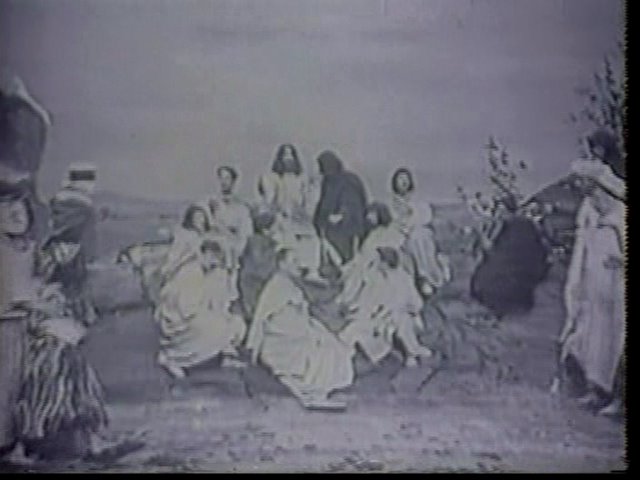
The Death of Christ (c1900)
More information at http://biblefilms.blogspot.com/2006/03/death-of-christ-c1900.html, the contents of which I am reproducing below almost integrally. The author of the page (and of the blog) is Matt Page.
*begin quote*
Thursday, March 02, 2006
Death of Christ (c.1900)
Following on from the last two days' posts where I have been looking at a couple of very early Jesus films, I wanted to post today, in more detail on the second of these The Death of Christ. It was hard enough trying to date The Life of Christ, but at least it provided a date to be sceptical about! With this film I would place it at around the same time, maybe even slightly earlier than The Life of Christ, but I wouldn't place it any early than the date claimed at the start of the Life of Christ. Anyway - the full discussion of that was two days ago.
This film is actually more interesting to right about than the earlier one since whereas that film largely contained material that was incorporated into The Life and Passion of Jesus Christ. Whilst this film is shorter (only 10 minutes long), most of the material is original to this film. First things first the scenes guide with scripture citations.
Last Supper (start of) - (Mark 14:16-17)
*Gethsemane - (Mark 14:32-42)
*Arrest of Jesus - (Mark 14:43-46)
*Trial before Pilate - (Mark 15:1-14)
*Scourging & Mocking - (Mark 15:15-20)
*Presented before the People - (Matt 27:24-26)
Road to the cross - (Luke 23:26-28)
*Crucifixion - (Mark 15:22-33)
*Death of Jesus - (John 19:30,34)
*Resurrection - (Mark 16:1-8)
Ascension - (Luke 24:50-53)
A Few Notes
*These scenes are different from those in The Life and Passion of Jesus Christ, although in many cases they have strongly influenced that film, with it being really clear that it re-filmed some scenes almost exactly the same, with only minor "improvements". A good example of this is the trial of Jesus in front of Pilate where in this film it is not very clear that Barabbas is present, whereas in the later The Life and Passion of Jesus Christ Barabbas is far more distinct. The shot is very similar in most other respects.
Only three scenes then are used in The Life and Passion of Jesus Christ. Firstly, the last supper, where the scant footage shown here is actually that which immediately preceds the longer scene in The Life and Passion. Next is the road to the cross scene, and finally, the ascension scene. These last two scenes are actually in all three films. The latter scene is far more complex than any of the other scenes in this film, and has been reasonably well done so it is not surprising that no-one went to the trouble fo re-filming it.
Two further points. Firstly, in comparing the scenes here with the Life of Christ, I noticed that that film seems to jump from the money-changers scene straight to Jesus's trail. Even for viewers who know the story this is a strange move. It does make me wonder if some of the material here was at one stage part of that film.
Secondly, of all three of these early films I think this is my favourite. This is partly because it is the least coloured, and the technique is a bit of a distraction, it's partly because it contains one really great scene - that in the Garden of Gethsemane, as well as being the source, I assume, for the innovative ascension scene. I also like the depiction of the scourging in contrast to The Life and Passion of Jesus Christ. Here Jesus offers some resistance, there Jesus almost seems to volunteer for it. I wonder if this was the main reason that this scene was re-filmed as except for a difference in background it is more or less the same. I also much refer the resurrection scene. It's one of the hardest things to film, and film-makers have used a variety of approaches. This is one of the best. Fairly literal, and yet not sensational, kitschy, or cheesy. That said it doesn't really rely on any of the gospels (non of which describe the actual resurrection), and perhaps is most similar to Mel Gibson's version, but it's far more simple, and effective, and not nearly so pleased with itself.
All in all, I'm glad I've uncovered this early classic. Jesus films for the next 110 years have swung between the kitsch and the more profound, and I'm glad that at least one of the very earliest Jesus films falls into the latter category.
Matt
Labels: Life and Passion of Jesus Christ
posted at 9:04 AM © Matt Page 2005-2008
*end quote*
*begin quote*
Thursday, March 02, 2006
Death of Christ (c.1900)
Following on from the last two days' posts where I have been looking at a couple of very early Jesus films, I wanted to post today, in more detail on the second of these The Death of Christ. It was hard enough trying to date The Life of Christ, but at least it provided a date to be sceptical about! With this film I would place it at around the same time, maybe even slightly earlier than The Life of Christ, but I wouldn't place it any early than the date claimed at the start of the Life of Christ. Anyway - the full discussion of that was two days ago.
This film is actually more interesting to right about than the earlier one since whereas that film largely contained material that was incorporated into The Life and Passion of Jesus Christ. Whilst this film is shorter (only 10 minutes long), most of the material is original to this film. First things first the scenes guide with scripture citations.
Last Supper (start of) - (Mark 14:16-17)
*Gethsemane - (Mark 14:32-42)
*Arrest of Jesus - (Mark 14:43-46)
*Trial before Pilate - (Mark 15:1-14)
*Scourging & Mocking - (Mark 15:15-20)
*Presented before the People - (Matt 27:24-26)
Road to the cross - (Luke 23:26-28)
*Crucifixion - (Mark 15:22-33)
*Death of Jesus - (John 19:30,34)
*Resurrection - (Mark 16:1-8)
Ascension - (Luke 24:50-53)
A Few Notes
*These scenes are different from those in The Life and Passion of Jesus Christ, although in many cases they have strongly influenced that film, with it being really clear that it re-filmed some scenes almost exactly the same, with only minor "improvements". A good example of this is the trial of Jesus in front of Pilate where in this film it is not very clear that Barabbas is present, whereas in the later The Life and Passion of Jesus Christ Barabbas is far more distinct. The shot is very similar in most other respects.
Only three scenes then are used in The Life and Passion of Jesus Christ. Firstly, the last supper, where the scant footage shown here is actually that which immediately preceds the longer scene in The Life and Passion. Next is the road to the cross scene, and finally, the ascension scene. These last two scenes are actually in all three films. The latter scene is far more complex than any of the other scenes in this film, and has been reasonably well done so it is not surprising that no-one went to the trouble fo re-filming it.
Two further points. Firstly, in comparing the scenes here with the Life of Christ, I noticed that that film seems to jump from the money-changers scene straight to Jesus's trail. Even for viewers who know the story this is a strange move. It does make me wonder if some of the material here was at one stage part of that film.
Secondly, of all three of these early films I think this is my favourite. This is partly because it is the least coloured, and the technique is a bit of a distraction, it's partly because it contains one really great scene - that in the Garden of Gethsemane, as well as being the source, I assume, for the innovative ascension scene. I also like the depiction of the scourging in contrast to The Life and Passion of Jesus Christ. Here Jesus offers some resistance, there Jesus almost seems to volunteer for it. I wonder if this was the main reason that this scene was re-filmed as except for a difference in background it is more or less the same. I also much refer the resurrection scene. It's one of the hardest things to film, and film-makers have used a variety of approaches. This is one of the best. Fairly literal, and yet not sensational, kitschy, or cheesy. That said it doesn't really rely on any of the gospels (non of which describe the actual resurrection), and perhaps is most similar to Mel Gibson's version, but it's far more simple, and effective, and not nearly so pleased with itself.
All in all, I'm glad I've uncovered this early classic. Jesus films for the next 110 years have swung between the kitsch and the more profound, and I'm glad that at least one of the very earliest Jesus films falls into the latter category.
Matt
Labels: Life and Passion of Jesus Christ
posted at 9:04 AM © Matt Page 2005-2008
*end quote*
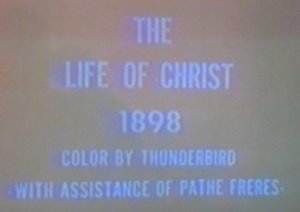
The Life of Christ (c1900)
More information at http://biblefilms.blogspot.com/2006/03/life-of-christ-1898.html, the contents of which I am reproducing below almost integrally. The author of the page (and of the blog) is Matt Page.
*begin quote*
Wednesday, March 01, 2006
Life of Christ (1898)
Yesterday's entry looked at the problems of dating some early films picked up on eBay. Today's post will look at the first of those (as it arrived on the disc), The Life of Christ, purporting to be from 1898. The film is just 14:23 minutes long, and none of the actors' names are given. Here's the scene order (as ever, scripture citations are in the normal format.)
Angels and Joseph's Dream - Matt 2:13-14
Escape to Egypt - Matt 2:15
*The Boy Jesus and the Doctors - Luke 2:40-52
Baptism - Mark 1:6-11
*Woman at Samaria - John 4:4-29
†Feeding 5000 with Fish and Bread - Mark 6:30-44
Christ Walks on Water - Mark 6:47-48
*Entering into Jerusalem - Mark 11:1-10
*Driving out the Money Changers - Mark 11:15-19
Trial before Pilate - Mark 15:1-15
*Ecce Homo - John 19:5
(Veronica) - Tradition
Road to the cross - Luke 23:26-28
Crucifixion - Mark 15:22-33
Death of Jesus - John 19:30,34
Resurrection - Mark 16:1-8
Acension - Luke 24:50-53
A Few Notes:
†This scene (the feeding of the 5000, or the "Fish and Bread" as the intertitles call it is the only one in the film without parallel in The Life and Passion of Jesus Christ. That said...
*Scenes marked with a * are different from those in The Life and Passion of Jesus Christ, even if the later film copies / improves upon them. Sometimes the details are fairly minor (e.g. different actors or backgrounds), at other times the whole composition of the shot is fundamentally different.
Four scenes use camera trickery - essentially double exposure. The two appearances by angels in the first two scenes both use this technique fairly simply, but the resurrection scene, where Jesus floats out of his grave, and "Christ Walks on Water" are both a bit more sophisticated. The later is possibly significant as renown camera trickery pioneer George Méliès released a film in 1899 called Christ Walks on Water. This was thought to be the first part of the bible to be shown on camera outside of Jesus's Passion. Part of me wonders if this scene (later incorporated into The Life and Passion of Jesus Christ) was Méliès's original, and whether this effects the potential dating of this film.
The film starts in a strange place as well, not showing the nativity or any of the events leading up to it, but starting after the departure of the wise men as Joseph is about to have the dream that instructs him to take his family to Egypt. Having thought about the dating of the film more since yesterday, this was one piece of evidence I didn't really consider enough.
As with The Life and Passion of Jesus Christ this film was shot in black and white, but a number of scenes have been hand coloured. In addition some scenes stencil on extra details, most notably the Holy Spirit stenciled on as a dove in the baptism scene (see left) and the ascension scene.
In terms of episodes that rarely make Jesus films, obviously this film has nearly all of it's material in common with The Life and Passion of Jesus Christ. Even so, both films show the Ascension in an unusual way, and in fact, depictions of this are rare in themself. The scene with the woman of Samaria is also fairly rare in film version of Jesus's life, which is unusual as it gives us a rare three dimensional female role. Directors are usually keen on such roles, note for example one of the most frequently filmed scenes outside of his Passion - the woman taken in adultery.
Finally, one comment that is often made about The Life and Passion of Jesus Christ is worth repeating here. As this was filmed in the very early days of cinema, it's very obvious from this film that even the most basic aspects of moviemaking have yet to be discovered. For example, the camera is always static, and the acting takes place in front of it - this works similarly to watching a play. In a similar vein, nearly all the action takes place in the middle distance. There are a couple of exceptions in this film, and these may have been the first films to pioneer these new techniques. The first is the Ecce Homo moment. The camera get that bit closer to Jesus, just showing his upper half as he stands in front of the words "Ecce Homo" behind him. The second is a shot of Veronica, after she has wiped his face. The camera cuts to a shot of her holding her cloth, close enough for the viewer to see she has a perfect image of Jesus's face upon it.
This film will probably be available from this seller on eBay as part of a compilation DVD Early Religious Films.
Matt
Labels: Life and Passion of Jesus Christ
posted at 10:00 AM © Matt Page 2005-2008
3 Comments:
(...)
At 2:45 AM, March 16, 2008, Antonio Ventaja said…
Sorry, I don´t speak and not wright in english ( I am spanish).I beliver that this film is La Vie et la Passion de Jésus-Christ of 1898 of directors Georges Hatot and Louis Lumière.Thanks for your blog.
At 3:11 AM, March 16, 2008, Matt Page said…
Thanks for that, I'm not sure I've heard that before.
Thanks
Matt
*end quote*
*begin quote*
Wednesday, March 01, 2006
Life of Christ (1898)
Yesterday's entry looked at the problems of dating some early films picked up on eBay. Today's post will look at the first of those (as it arrived on the disc), The Life of Christ, purporting to be from 1898. The film is just 14:23 minutes long, and none of the actors' names are given. Here's the scene order (as ever, scripture citations are in the normal format.)
Angels and Joseph's Dream - Matt 2:13-14
Escape to Egypt - Matt 2:15
*The Boy Jesus and the Doctors - Luke 2:40-52
Baptism - Mark 1:6-11
*Woman at Samaria - John 4:4-29
†Feeding 5000 with Fish and Bread - Mark 6:30-44
Christ Walks on Water - Mark 6:47-48
*Entering into Jerusalem - Mark 11:1-10
*Driving out the Money Changers - Mark 11:15-19
Trial before Pilate - Mark 15:1-15
*Ecce Homo - John 19:5
(Veronica) - Tradition
Road to the cross - Luke 23:26-28
Crucifixion - Mark 15:22-33
Death of Jesus - John 19:30,34
Resurrection - Mark 16:1-8
Acension - Luke 24:50-53
A Few Notes:
†This scene (the feeding of the 5000, or the "Fish and Bread" as the intertitles call it is the only one in the film without parallel in The Life and Passion of Jesus Christ. That said...
*Scenes marked with a * are different from those in The Life and Passion of Jesus Christ, even if the later film copies / improves upon them. Sometimes the details are fairly minor (e.g. different actors or backgrounds), at other times the whole composition of the shot is fundamentally different.
Four scenes use camera trickery - essentially double exposure. The two appearances by angels in the first two scenes both use this technique fairly simply, but the resurrection scene, where Jesus floats out of his grave, and "Christ Walks on Water" are both a bit more sophisticated. The later is possibly significant as renown camera trickery pioneer George Méliès released a film in 1899 called Christ Walks on Water. This was thought to be the first part of the bible to be shown on camera outside of Jesus's Passion. Part of me wonders if this scene (later incorporated into The Life and Passion of Jesus Christ) was Méliès's original, and whether this effects the potential dating of this film.
The film starts in a strange place as well, not showing the nativity or any of the events leading up to it, but starting after the departure of the wise men as Joseph is about to have the dream that instructs him to take his family to Egypt. Having thought about the dating of the film more since yesterday, this was one piece of evidence I didn't really consider enough.
As with The Life and Passion of Jesus Christ this film was shot in black and white, but a number of scenes have been hand coloured. In addition some scenes stencil on extra details, most notably the Holy Spirit stenciled on as a dove in the baptism scene (see left) and the ascension scene.
In terms of episodes that rarely make Jesus films, obviously this film has nearly all of it's material in common with The Life and Passion of Jesus Christ. Even so, both films show the Ascension in an unusual way, and in fact, depictions of this are rare in themself. The scene with the woman of Samaria is also fairly rare in film version of Jesus's life, which is unusual as it gives us a rare three dimensional female role. Directors are usually keen on such roles, note for example one of the most frequently filmed scenes outside of his Passion - the woman taken in adultery.
Finally, one comment that is often made about The Life and Passion of Jesus Christ is worth repeating here. As this was filmed in the very early days of cinema, it's very obvious from this film that even the most basic aspects of moviemaking have yet to be discovered. For example, the camera is always static, and the acting takes place in front of it - this works similarly to watching a play. In a similar vein, nearly all the action takes place in the middle distance. There are a couple of exceptions in this film, and these may have been the first films to pioneer these new techniques. The first is the Ecce Homo moment. The camera get that bit closer to Jesus, just showing his upper half as he stands in front of the words "Ecce Homo" behind him. The second is a shot of Veronica, after she has wiped his face. The camera cuts to a shot of her holding her cloth, close enough for the viewer to see she has a perfect image of Jesus's face upon it.
This film will probably be available from this seller on eBay as part of a compilation DVD Early Religious Films.
Matt
Labels: Life and Passion of Jesus Christ
posted at 10:00 AM © Matt Page 2005-2008
3 Comments:
(...)
At 2:45 AM, March 16, 2008, Antonio Ventaja said…
Sorry, I don´t speak and not wright in english ( I am spanish).I beliver that this film is La Vie et la Passion de Jésus-Christ of 1898 of directors Georges Hatot and Louis Lumière.Thanks for your blog.
At 3:11 AM, March 16, 2008, Matt Page said…
Thanks for that, I'm not sure I've heard that before.
Thanks
Matt
*end quote*
Tuesday, March 25, 2008
I Am David (2003)
Synopsis: In the 50's, a little boy escapes from a concentration camp in Bulgaria. He faces many perils in his journey to a safe place. Based on the novel "David", by Anne Holm (1st ed. 1963).
Appraisal: Total incompetence are the defining words here, so let's not waste our time. The book is considered somewhat of a classic in literature for children, and the skeleton of the plot does reveal the possibility of a sound divertissement, which evidently was spoiled.
Rating: 16
Appraisal: Total incompetence are the defining words here, so let's not waste our time. The book is considered somewhat of a classic in literature for children, and the skeleton of the plot does reveal the possibility of a sound divertissement, which evidently was spoiled.
Rating: 16
Monday, March 24, 2008
Dark Blue (2002)
Synopsis: A cop and his rookie partner are assigned to investigate a multiple murder at a store. It turns out to be a very complicated affair, involving police corruption and the theft of a safe full of money.
Appraisal: One of the better cop movies of the last few years. The interconnection among the several elements of the story is very well handled, and the film flows in a crescendo of action and dramatic tension right until the end. Gleeson's performance is absolutely amazing. Russell doesn't do so badly either.
Rating: 69
Appraisal: One of the better cop movies of the last few years. The interconnection among the several elements of the story is very well handled, and the film flows in a crescendo of action and dramatic tension right until the end. Gleeson's performance is absolutely amazing. Russell doesn't do so badly either.
Rating: 69
Le grand restaurant (1966)
English titles: What's Cooking in Paris; The Big Restaurant.
Synopsis: The president of a foreign country disappears from a restaurant and a kidnapping is assumed; the restaurant's owner is summoned by the police to help find him.
Appraisal: It's practically two different films; it begins as a comedy set at a restaurant and later becomes a more action-oriented film. Both parts are moderately enjoyable.
Rating: 41
Synopsis: The president of a foreign country disappears from a restaurant and a kidnapping is assumed; the restaurant's owner is summoned by the police to help find him.
Appraisal: It's practically two different films; it begins as a comedy set at a restaurant and later becomes a more action-oriented film. Both parts are moderately enjoyable.
Rating: 41
Les bronzés font du ski (1979)
Synopsis: The same group of friends from Les bronzés are now on a ski resort.
Appraisal: Passable sequel.
Rating: 46
Appraisal: Passable sequel.
Rating: 46
Saturday, March 22, 2008
Martha Behind Bars (2005) (TV)
Synopsis: A TV show host who has built a corporate empire is charged with insider trading, goes to trial, is convicted, serves time, is released.
Appraisal: I have thought about the difficulties of depicting real events in this kind of movie, and came to the conclusion that they are big. Consequently, the difficulty of assessing this film's credibility is also big. Abstracting it from the actual case, this telefilm provides some matter for reflection regarding the justice system. From the human angle, it provides some slight entertainment.
Rating: 39
Appraisal: I have thought about the difficulties of depicting real events in this kind of movie, and came to the conclusion that they are big. Consequently, the difficulty of assessing this film's credibility is also big. Abstracting it from the actual case, this telefilm provides some matter for reflection regarding the justice system. From the human angle, it provides some slight entertainment.
Rating: 39
Juana la loca (2001)
English titles: Mad Love; Madness of Joan; Madness of Love.
Synopsis: In the 15th century, the Spanish princess Joan is sent to Flanders to marry the Archduke Philip. Their marriage is characterized by his infidelities and her intense jealousy. Based on the play "La locura de amor" (Madness of Love), of 1855, by Manuel Tamayo y Baus (and according to some sources also on the film Locura de amor (1948), which was also based on that play).
Appraisal: The analysis of jealousy was reportedly the central theme of the source play. The film seems to be afraid to commit to this angle; as the political events unfold the central character seems to recede from the edge of madness into a more mature position. As a result, the film loses its focus and strength; we as the audience are left wondering why we should care in the first place.
Rating: 39
Synopsis: In the 15th century, the Spanish princess Joan is sent to Flanders to marry the Archduke Philip. Their marriage is characterized by his infidelities and her intense jealousy. Based on the play "La locura de amor" (Madness of Love), of 1855, by Manuel Tamayo y Baus (and according to some sources also on the film Locura de amor (1948), which was also based on that play).
Appraisal: The analysis of jealousy was reportedly the central theme of the source play. The film seems to be afraid to commit to this angle; as the political events unfold the central character seems to recede from the edge of madness into a more mature position. As a result, the film loses its focus and strength; we as the audience are left wondering why we should care in the first place.
Rating: 39
The Legend of Sleepy Hollow (1958)
Synopsis: In the 18th century an ugly schoolteacher comes to a small town and sets his eyes on the farmer's beautiful daughter. An athletic local youth is also interested in her, but the teacher is favored by the lady, maybe due to his better social skills, maybe to an unfathomable woman's whim. This is one of the halves of The Adventures of Ichabod and Mr. Toad (1949), released as a standalone piece in 1958.
Appraisal: I haven't read Washington Irving's short story (1st ed. 1820, in "The Sketch Book of Geoffrey Crayon, Gent."), but, this being regarded as a faithful adaptation, I can only say that it must be a work of genius. The animated film properly is finely crafted and enjoyable, as was the norm of the studio which made it at that time. I saw a Portuguese-dubbed version.
Rating: 60
Appraisal: I haven't read Washington Irving's short story (1st ed. 1820, in "The Sketch Book of Geoffrey Crayon, Gent."), but, this being regarded as a faithful adaptation, I can only say that it must be a work of genius. The animated film properly is finely crafted and enjoyable, as was the norm of the studio which made it at that time. I saw a Portuguese-dubbed version.
Rating: 60
Friday, March 21, 2008
Art School Confidential (2006)
Synopsis: An art student at a school where a series of murders is taking place falls in love with a female model, but he thinks she is only interested in his classmate.
Appraisal: While perhaps not always as brilliant as could be expected, it has an intelligent plot and some funny developments; on average it works fine, offering a rather comprehensive satiric panel about its subject.
Rating: 57
Appraisal: While perhaps not always as brilliant as could be expected, it has an intelligent plot and some funny developments; on average it works fine, offering a rather comprehensive satiric panel about its subject.
Rating: 57
Layer Cake (2004)
Synopsis: A drug dealer wants to quit the business, but is forced into doing a last job which consists of pushing a huge load of ecstasy pills. Everything goes wrong.
Appraisal: A high number of secondary characters and plot subtleties characterizes it. The main attraction are the competent actors, but other than that, and despite the script's complexity, or maybe because of it, this doesn't pay off as it should; although watchable on a superficial level, it doesn't add significantly to the already extensive filmography of its genre.
Rating: 47
Appraisal: A high number of secondary characters and plot subtleties characterizes it. The main attraction are the competent actors, but other than that, and despite the script's complexity, or maybe because of it, this doesn't pay off as it should; although watchable on a superficial level, it doesn't add significantly to the already extensive filmography of its genre.
Rating: 47
Dottie Gets Spanked (1993) (TV)
Synopsis: A little boy is obsessed with a sitcom and in particular with its female protagonist.
Appraisal: A masterpiece. It's 30 minutes long and one of the finest films of all times. A plunge into a child's mind, with a wealth of layers and connections which would be enough for long discussions, and yet is immensely rewarding even on a first viewing unencumbered by rationalizations.
Rating: 100 [best film of 1993]
Appraisal: A masterpiece. It's 30 minutes long and one of the finest films of all times. A plunge into a child's mind, with a wealth of layers and connections which would be enough for long discussions, and yet is immensely rewarding even on a first viewing unencumbered by rationalizations.
Rating: 100 [best film of 1993]
Thursday, March 20, 2008
Bewitched (2005)
Synopsis: A witch gets a job playing a witch in a TV show. She wants to be a normal person, just like her character. The show is a vehicle for its male star.
Appraisal: Not exactly good, but I'd say marginally interesting for the narrative problems it poses, and the solutions it finds. And also as a comedy it's not as bad as some said at the time of its release, anyway it doesn't seem so to me. All that being said, there is at least one joke that is evil, and I don't mean unfunny -- which it is -- but offensive. Or maybe it's just me.
Rating: 40
Appraisal: Not exactly good, but I'd say marginally interesting for the narrative problems it poses, and the solutions it finds. And also as a comedy it's not as bad as some said at the time of its release, anyway it doesn't seem so to me. All that being said, there is at least one joke that is evil, and I don't mean unfunny -- which it is -- but offensive. Or maybe it's just me.
Rating: 40
Wednesday, March 19, 2008
Le Gendarme se marie (1968)
English title: The Gendarme Gets Married.
Synopsis: Inspector Cruchot falls in love with a rich widow. The exam for the position of Chief-Inspector is approaching and Cruchot will have a go at it, competing with his own boss.
Appraisal: Very agitated and featuring some nice car stunts; the humor is still elementary and naive, but it works as an unpretentious pastime.
Rating: 37
Synopsis: Inspector Cruchot falls in love with a rich widow. The exam for the position of Chief-Inspector is approaching and Cruchot will have a go at it, competing with his own boss.
Appraisal: Very agitated and featuring some nice car stunts; the humor is still elementary and naive, but it works as an unpretentious pastime.
Rating: 37
Impostor (2001)
Synopsis: In the near future, the Earth is at war with Alfa-Centaur. A man is arrested under the accusation of not being the scientist he resembles but an extraterrestrial cyborg made to look exactly like him, and equipped with a bomb inside his body which is programmed to detonate in the proximity of the Earth's government leader. Based on a short story by Philip K. Dick written in 1953.
Appraisal: After an arresting first act, what follows is rather conventional, in the form of chases, fights, and the like. The camerawork relies heavily on fast panning, which I found to be headache-inducing. The film has interesting philosophical implications, derived from the fact that the cyborgs are supposed to be programmed to think they are really the humans they impersonate.
Rating: 38
Appraisal: After an arresting first act, what follows is rather conventional, in the form of chases, fights, and the like. The camerawork relies heavily on fast panning, which I found to be headache-inducing. The film has interesting philosophical implications, derived from the fact that the cyborgs are supposed to be programmed to think they are really the humans they impersonate.
Rating: 38
Le gendarme de St. Tropez (1964)
English title: The Gendarme of St. Tropez.
Synopsis: A small town policeman is promoted and assigned to the city of St. Tropez, in the coast of France. There, he surprises everyone with his dilligency and rigor. His daughter's antics, however, threaten to harm his career. Throw in a stolen Rembrandt and confusion sets in.
Appraisal: It is built around simple jokes and and a plot wich provides some action. It's not devoid of good moments, though, particularly in its prologue, and on the whole it's not too hard to see.
Rating: 37
Synopsis: A small town policeman is promoted and assigned to the city of St. Tropez, in the coast of France. There, he surprises everyone with his dilligency and rigor. His daughter's antics, however, threaten to harm his career. Throw in a stolen Rembrandt and confusion sets in.
Appraisal: It is built around simple jokes and and a plot wich provides some action. It's not devoid of good moments, though, particularly in its prologue, and on the whole it's not too hard to see.
Rating: 37
Tuesday, March 18, 2008
Looking for Comedy in the Muslim World (2005)
Synopsis: A declining comedian takes a government job consisting of a research about the Muslim people's predilections in the subject of humor.
Appraisal: Very poor as comedy -- or as whatever else one may fancy it.
Rating: 18
Appraisal: Very poor as comedy -- or as whatever else one may fancy it.
Rating: 18
Monday, March 17, 2008
Dreamer: Inspired by a True Story (2005)
Synopsis: A little girl has a father who works evaluating the physical condition of racing horses. One of the horses breaks a leg during racing and to prevent her from being put down, he buys her.
Appraisal: I don't know whether it is the story in itself, or the excessively sedate way it is told, the fact is that this film didn't connect to me in any deeper way.
Rating: 32
Appraisal: I don't know whether it is the story in itself, or the excessively sedate way it is told, the fact is that this film didn't connect to me in any deeper way.
Rating: 32
O homem que desafiou o Diabo (2007)
Synopsis: Zé Araújo is a traveling salesman and a womanizer. He has sex with the store owner's daughter and is obliged to marry her. She is a ballbreaker. One day he gets tired and gets away, forging himself a new identity as Ojuara. He meets an old man who keeps a chest full of gold coins in his house half of which he says belongs to the devil; the latter appears and Ojuara fights him. The old man dies and Ojuara buries the chest intending to come back for it. He then meets a prostitute who is being harassed by a strong man. Ojuara fights him too. Ojuara goes to the circus, where he falls in love with the ballerina. Ojuara leaves for a castle in which a witch and her hunchback servant live. The witch says Ojuara may conjure up anyone he pleases, so he chooses the ballerina; they have sex. The second night belongs to the witch; she is said to have a 'vagina dentata', so Ojuara inserts a rapadura (a kind of Brazilian candy bar) in her and flees. Ojuara tames a bull for a local farmer and is offered her daughter to marry; she loves another guy so Ojuara declines. He meets a violent outlaw who has been spreading terror in the region with his killings; he turns out to be a kid from the town where he got married several years before so the two don't fight; instead they go to a brothel where they meet the farmer's daughter -- her beloved turned out to be impotent so she fled to be a prostitute; they also meet the other prostitute who was being bullied in the other brothel. Ojuara marries the latter and they head to a mythical land where the rivers are said to be made of milk and the mountains of sugar. The devil catches up with them and kills his pregnant wife. He claims his gold, Ojuara fights him and wins.
Appraisal: Awful. Nothing against the text per se, which is inspired in the novel "As Pelejas de Ojuara" (Ojuara's Fights), by Nei Leandro de Castro (1st ed. 1986). It's just that the actual realization in filmic form is unsavorily incompetent.
Rating: 15
Appraisal: Awful. Nothing against the text per se, which is inspired in the novel "As Pelejas de Ojuara" (Ojuara's Fights), by Nei Leandro de Castro (1st ed. 1986). It's just that the actual realization in filmic form is unsavorily incompetent.
Rating: 15
Les surmenés (1958)
Synopsis (spoilers): An introduction is shown about the fast urbanization of the 20th century and the change in pace that it has brought about in people's lives. The short story which follows tells of a country girl who moves to Paris to work as a typist for her fiancé, and who becomes addicted to the hectic nightlife of the city; it eventually affects her work negatively. A parallel subplot tells about her brother-in-law -- in whose apartment the typist girl is living -- who works as a newspaper editor and stays at his job until late hours and then gets up very early in the morning to exercise; it's no wonder he is overcome by fatigue too, and in a severer form than her sister-in-law.
Appraisal: This deliciously anachronic short is the perfect cinematic equivalent of those health articles which used to appear in 50's and 60's magazines and ended up in abridged form on the pages of Reader's Digest. The hand of a soon-to-be-famous filmmaker is unmistakably felt in the screenplay. The title's meaning is "The Fatigued Ones".
Appraisal: This deliciously anachronic short is the perfect cinematic equivalent of those health articles which used to appear in 50's and 60's magazines and ended up in abridged form on the pages of Reader's Digest. The hand of a soon-to-be-famous filmmaker is unmistakably felt in the screenplay. The title's meaning is "The Fatigued Ones".
Sunday, March 16, 2008
Les bronzés (1978)
English title: French Fried Vacation.
Synopsis: A summer resort in France, its guests and the folks who work there. A couple which tolerate each other's infidelities but down deep is not too comfortable with that policy; a socially inept fellow who is ridiculed by everyone; and several other characters.
Appraisal: An obviously unpretentious film which has a certain amount of charm; its collective character is not exactly balanced, with the Bernard-Nathalie couple being a sort of dramatic axis, and Jean-Claude the goofy fellow the comical one. It's uneven, with its fair amount of unfunny bits; to be sure, there are funny ones too, and the general spontaneity of mise-en-scene is remarkable in its own right. I saw the shorter version, with approximately 90 minutes (the longer one has 105, according to IMDb).
Rating: 51
Synopsis: A summer resort in France, its guests and the folks who work there. A couple which tolerate each other's infidelities but down deep is not too comfortable with that policy; a socially inept fellow who is ridiculed by everyone; and several other characters.
Appraisal: An obviously unpretentious film which has a certain amount of charm; its collective character is not exactly balanced, with the Bernard-Nathalie couple being a sort of dramatic axis, and Jean-Claude the goofy fellow the comical one. It's uneven, with its fair amount of unfunny bits; to be sure, there are funny ones too, and the general spontaneity of mise-en-scene is remarkable in its own right. I saw the shorter version, with approximately 90 minutes (the longer one has 105, according to IMDb).
Rating: 51
Blood Diamond (2006)
Synopsis: Sierra Leone, 1999. The diamond trade finances a ravaging civil war. A poor man has his family torn apart from him; he is enslaved at the mines by the guerilla. A smuggler will ally with him in the quest for a huge diamond he found and buried.
Appraisal: Hyperconventional adventure which wears the "political awareness" disguise whenever it can. The shooting on location brings a marginal sense of authenticity to an otherwise overwhelmingly inauthentic melodrama.
Rating: 38
Appraisal: Hyperconventional adventure which wears the "political awareness" disguise whenever it can. The shooting on location brings a marginal sense of authenticity to an otherwise overwhelmingly inauthentic melodrama.
Rating: 38
Le coût de la vie (2003)
English title: The Cost of Living.
Synopsis: Several characters and how they deal with money in their lives; the miser, the irresponsible spender, the prostitute, the heir, the billionaire, etc.
Appraisal: Its schematic, encyclopedic nature is evident, as is the psychological shallowness which veers into silliness on occasion.
Rating: 30
Synopsis: Several characters and how they deal with money in their lives; the miser, the irresponsible spender, the prostitute, the heir, the billionaire, etc.
Appraisal: Its schematic, encyclopedic nature is evident, as is the psychological shallowness which veers into silliness on occasion.
Rating: 30
Saturday, March 15, 2008
Harold & Kumar Go to White Castle (2004)
Synopsis: Two guys decide to eat at a certain fast food place, but are diverted from their goal by several incidents.
Appraisal: Sort of entertaining, in a cheap way.
Rating: 39
Appraisal: Sort of entertaining, in a cheap way.
Rating: 39
A Fei zheng chuan (1991)
English titles: Days of Being Wild; The True Story of Ah Fei.
Synopsis: A young man who doesn't like commitment gets involved first with a stadium ticket seller, then with a cabaret dancer; he was adopted as a baby and his stepmother won't tell him who his biological mother is, despite his continuous plea for her to do so.
Appraisal: A soap opera, no more and no less, albeit with some extra care in the mise-en-scene and excellent camerawork.
Rating: 39
Synopsis: A young man who doesn't like commitment gets involved first with a stadium ticket seller, then with a cabaret dancer; he was adopted as a baby and his stepmother won't tell him who his biological mother is, despite his continuous plea for her to do so.
Appraisal: A soap opera, no more and no less, albeit with some extra care in the mise-en-scene and excellent camerawork.
Rating: 39
A fost sau n-a fost? (2006)
English titles: 12:08 East of Bucharest; Was It or Was It Not?
Synopsis: In a small town in Romania, a talk show host from the local TV station invites two men to talk about their memories of the day of Ceausescu's fall. The film shows these three characters' lives on the morning before the show, and then the show proper, during which they will try to answer whether there was a Revolution or not in their town.
Appraisal: Observational cinema, composed of small incidents through which one may get a glimpse of an entire country. I wish it were a little more exciting.
Rating: 52
Synopsis: In a small town in Romania, a talk show host from the local TV station invites two men to talk about their memories of the day of Ceausescu's fall. The film shows these three characters' lives on the morning before the show, and then the show proper, during which they will try to answer whether there was a Revolution or not in their town.
Appraisal: Observational cinema, composed of small incidents through which one may get a glimpse of an entire country. I wish it were a little more exciting.
Rating: 52
Friday, March 14, 2008
Accepted (2006)
Synopsis: A high school graduate doesn't get accepted in any college, so he fakes an acceptance letter for his parents, from a fictitious college. To sustain the lie, he subsequently has to fake the entire college.
Appraisal: This is probably a record breaker for stupidity in movies, but one that proceeds from a good idea. As is so often the case, the filmmakers spoil it by inserting a hokey and hypocritical serious angle into what could have been a perfectly anarchic and fun satire. Glimpses of that are seen occasionally. I wonder if the authors were aware of the similarity with Poe's 'The System of Doctor Tarr and Professor Feather' and if that's what motivated the choice of a shut-down insane asylum for the fake college building.
Rating: 24
Appraisal: This is probably a record breaker for stupidity in movies, but one that proceeds from a good idea. As is so often the case, the filmmakers spoil it by inserting a hokey and hypocritical serious angle into what could have been a perfectly anarchic and fun satire. Glimpses of that are seen occasionally. I wonder if the authors were aware of the similarity with Poe's 'The System of Doctor Tarr and Professor Feather' and if that's what motivated the choice of a shut-down insane asylum for the fake college building.
Rating: 24
Remo Williams: The Adventure Begins (1985)
Synopsis: A policeman is kidnapped and his death is faked; he is then subjected to plastic surgery and submitted to an intensive training to become an agent of a secret government agency. His first target is a villainous weapons manufacturer. Based on the The Destroyer series of novels by Warren Murphy and Richard Sapir, the first installment of which was published in 1971 (but written in 1963) and which continues to this day.
Appraisal: Actioner which entertains, sort of. It's very comic-book-ish. The most remarkable things are Grey's make-up and performance.
Rating: 40
Appraisal: Actioner which entertains, sort of. It's very comic-book-ish. The most remarkable things are Grey's make-up and performance.
Rating: 40
Thursday, March 13, 2008
Curse of the Pink Panther (1983)
Synopsis: An American inspector is hired by the French police to locate Inspector Clouseau, who is missing. Also missing is the famous Pink Panther diamond. The new inspector, who is just as clumsy as the man he is looking for, conducts his searches in Lugash, South of France, and Valencia.
Appraisal: Sequel which is not all that bad. Despite its overall tepidity, it is visually pleasing (lots of nice places) and has enough gags to hold one's attention.
Rating: 40
Appraisal: Sequel which is not all that bad. Despite its overall tepidity, it is visually pleasing (lots of nice places) and has enough gags to hold one's attention.
Rating: 40
The Exorcism of Emily Rose (2005)
Synopsis: A priest is charged with the death of a young woman whom he exorcized. Loosely inspired on the real case of Anneliese Michel who died in Germany in 1976 after a history of medical problems dating back to 1968.
Appraisal: Effective potboiler. Despite the inherent dishonesty which permeates it, there are some interesting philosophical issues which it suscitates. Both it and The Exorcist (1973) bring forth the notion that if demons exist then God must too. What this basically tries to reason is that possessions, by persuading people of the existence of the supernatural, would open the way to belief in other supernatural entities, God included. At first, this seemed logically sound to me, but later I saw its other side, namely, that the existence of demons, and possessions, is actually a sign of chaos and anarchy in the universe, which would be evidence of the absence of a God-like regulating entity. Anyway, it is obvious that what drives people's faiths is ultimately the selfish concern about whether they will somehow defeat death, and the mechanism which is employed is not really important. A more accurate rendition of the real events is said to be given in the film Requiem, which I haven't seen.
Rating: 51
Appraisal: Effective potboiler. Despite the inherent dishonesty which permeates it, there are some interesting philosophical issues which it suscitates. Both it and The Exorcist (1973) bring forth the notion that if demons exist then God must too. What this basically tries to reason is that possessions, by persuading people of the existence of the supernatural, would open the way to belief in other supernatural entities, God included. At first, this seemed logically sound to me, but later I saw its other side, namely, that the existence of demons, and possessions, is actually a sign of chaos and anarchy in the universe, which would be evidence of the absence of a God-like regulating entity. Anyway, it is obvious that what drives people's faiths is ultimately the selfish concern about whether they will somehow defeat death, and the mechanism which is employed is not really important. A more accurate rendition of the real events is said to be given in the film Requiem, which I haven't seen.
Rating: 51
Wednesday, March 12, 2008
Gabrielle (2005)
Synopsis: A woman abandons her husband, leaving him a letter saying she would never return, and then does.
Appraisal: Unpleasantly affected. It's based on a short story by Joseph Conrad named "The Return", which was first published in "Tales of Unrest" in 1898, and which Conrad said he hated.
Rating: 35
Appraisal: Unpleasantly affected. It's based on a short story by Joseph Conrad named "The Return", which was first published in "Tales of Unrest" in 1898, and which Conrad said he hated.
Rating: 35
Monday, March 10, 2008
Sermões - A história de Antônio Vieira (1989)
Synopsis: The film is based on Padre António Vieira's life and works. He was a 17th century priest who lived most of his life in Brazil.
Appraisal: A child of 5 could not do worse than this collection of Vieira's excerpts intercut with semi-correlated or non-correlated snippets of silent classics, assorted poetry, and baroque music. If it weren't for the inspired leading performance, this film would be a complete waste of celluloid. As a side note, based on what I have seen and read about Vieira (this film, and Palavra e Utopia, and an encyclopedia entry), the man was as mad as a hatter and still he is considered the greatest Portuguese-language writer of the 17th century. Go figure.
Rating: 21
Appraisal: A child of 5 could not do worse than this collection of Vieira's excerpts intercut with semi-correlated or non-correlated snippets of silent classics, assorted poetry, and baroque music. If it weren't for the inspired leading performance, this film would be a complete waste of celluloid. As a side note, based on what I have seen and read about Vieira (this film, and Palavra e Utopia, and an encyclopedia entry), the man was as mad as a hatter and still he is considered the greatest Portuguese-language writer of the 17th century. Go figure.
Rating: 21
Alfred Hitchcock Presents: The Older Sister (1956) (TV)
Synopsis: A year after the Fall River murders, Lizzie Borden and her sister Emma are visited by a reporter.
Appraisal: An atypical episode, and arguably one more ambitious than the show's average. The story presents a new hypothesis for the notorious real-life case; it's an ingenious take, but as I am probably not aware of all of the case's details I am not ideally fit to assess its plausibility.
Appraisal: An atypical episode, and arguably one more ambitious than the show's average. The story presents a new hypothesis for the notorious real-life case; it's an ingenious take, but as I am probably not aware of all of the case's details I am not ideally fit to assess its plausibility.
Alfred Hitchcock Presents: You Got to Have Luck (1956) (TV)
Synopsis: An escaped convict breaks into a house where a woman is alone.
Appraisal: More ironies of fate.
Appraisal: More ironies of fate.
Alfred Hitchcock Presents: The Big Switch (1956) (TV)
Synopsis: A guy intends to kill his former girlfriend who dumped him for another man while he was in jail. He sets up an alibi playing poker with his friend, a bar owner.
Appraisal: Another entertaining piece of black humor.
Appraisal: Another entertaining piece of black humor.
The Last King of Scotland (2006)
Synopsis: A young doctor goes to Uganda in search of adventure and ends up becoming the personal physician of that nation's new ruler. The dictator develops a sort of dependence towards him.
Appraisal: This is an interesting work about personal responsibility and the limits of friendship. The films mixes historical fact and fictional characters such as Dr. Garrigan.
Rating: 65
Appraisal: This is an interesting work about personal responsibility and the limits of friendship. The films mixes historical fact and fictional characters such as Dr. Garrigan.
Rating: 65
The Extreme Adventures of Super Dave (2000) (V)
Synopsis: A stunt man in his declining years decides to retire but is then betrayed by his student, and accepts his challenge in order to get the money for a kid's heart surgery.
Appraisal: Innocuous little comedy, which has some entertaining value.
Rating: 41
Appraisal: Innocuous little comedy, which has some entertaining value.
Rating: 41
Kokoda (2006)
Synopsis: In World War II, a precariously equipped outfit in Papua New Guinea must stop the Japanese from reaching a harbor which would be crucial for invading Australia.
Appraisal: Very realistic depiction of war in its grim physicality.
Rating: 56
Appraisal: Very realistic depiction of war in its grim physicality.
Rating: 56
Sukkar banat (2007)
English title: Caramel.
Synopsis: The lives of several women who work at a beauty parlor. One of them has an affair with a married man and is loved by a policeman, another is a divorcée who is trying to find work as an actress in commercials, another is a lesbian who falls in love with a client, the other is about to get married and is worried because she is no longer a virgin; another character is an older woman who is a seamstress who has never married and looks after an even older woman with mental problems.
Appraisal: Commercial cinema that's short on new ideas and relies heavily on clichés.
(Saw it dubbed in French.)
Rating: 31
Synopsis: The lives of several women who work at a beauty parlor. One of them has an affair with a married man and is loved by a policeman, another is a divorcée who is trying to find work as an actress in commercials, another is a lesbian who falls in love with a client, the other is about to get married and is worried because she is no longer a virgin; another character is an older woman who is a seamstress who has never married and looks after an even older woman with mental problems.
Appraisal: Commercial cinema that's short on new ideas and relies heavily on clichés.
(Saw it dubbed in French.)
Rating: 31
Wednesday, March 05, 2008
The Bucket List (2007)
Synopsis: Two terminal patients escape from the hospital and go on a trip around the world.
Appraisal: It's hokey, but that's not all; it's unimaginative and follows a predictable course of worn-out clichés.
Rating: 23
Appraisal: It's hokey, but that's not all; it's unimaginative and follows a predictable course of worn-out clichés.
Rating: 23
Tuesday, March 04, 2008
The Many Adventures of Winnie the Pooh (1977)
Synopsis: Three short animation films (Winnie the Pooh and the Honey Tree (1966), Winnie the Pooh and the Blustery Day (1968), and Winnie the Pooh and Tigger Too! (1974)) united. Winnie flies with a balloon towards a honey spot; a terrible wind brings the owl's house down; Tigger's jumping over people gets to be a nuisance to the rabbit. Based on the books written by English author A. A. Milne and illustrated by E. H. Shepard, the first of which was published in 1926.
Appraisal: A work of art for small children, perfectly enjoyable by adults, I think. My experience was somewhat diminished by having watched a Portuguese-dubbed version.
Rating: 63
Appraisal: A work of art for small children, perfectly enjoyable by adults, I think. My experience was somewhat diminished by having watched a Portuguese-dubbed version.
Rating: 63
Sunday, March 02, 2008
Audrey Rose (1977)
Synopsis: A man believes that his dead daughter has reincarnated in another girl and tells it to her parents. Meanwhile, the girl suffers from nightmares and inexplicable burnings.
Appraisal: One of the worst films of the seventies, I believe, a glorious piece of nonsense whose infinite atrociousness is only diminished by Mason's earnest performance.
Rating: 14
Appraisal: One of the worst films of the seventies, I believe, a glorious piece of nonsense whose infinite atrociousness is only diminished by Mason's earnest performance.
Rating: 14
Saturday, March 01, 2008
Alfred Hitchcock Presents: A Bullet for Baldwin (1956) (TV)
Synopsis: A file clerk at an investment bank is fired and shoots his boss. The next day of work he finds out that his boss is still alive and has no recollection or symptom of having been shot -- or at least that's what the appearances indicate.
Appraisal: This is the weirdest and most contrived story of this show, so far. It is not completely bad, though.
Appraisal: This is the weirdest and most contrived story of this show, so far. It is not completely bad, though.
Alfred Hitchcock Presents: The Cheney Vase (1955) (TV)
Synopsis: A museum employee is fired and cons an old invalid woman into hiring him as her assistant, with the purpose of stealing a precious vase she possesses.
Appraisal: The story is on the same average, moderately entertaining, level of its predecessors. What I find remarkable about this whole series, and perhaps this episode in particular, is the sheer brilliance of the mise-en-scene, and the excellency of the acting. And, of course, the introduction and farewell comments are usually a treat in their own right.
Appraisal: The story is on the same average, moderately entertaining, level of its predecessors. What I find remarkable about this whole series, and perhaps this episode in particular, is the sheer brilliance of the mise-en-scene, and the excellency of the acting. And, of course, the introduction and farewell comments are usually a treat in their own right.
An Inconvenient Truth (2006)
Documentary which is mostly comprised of a lecture about the issue of global warming. It addresses mainly the phenomenon and its consequences. Its causes are addressed in very general terms, and the individual action is addressed only in brief guidelines during the end credits. I was a bit appalled that the specific fact that cattle raising (and all the economy that surrounds it) is the main responsible for global warming was not mentioned once in the film; it thus reinforces the myth that automobiles are that main responsible -- they are mentioned several times. Those final guidelines should include "lower your cow meat consumption". Anyway, as I said, this is primarily about the acknowledgement of the problem and its consequences; as such it fares well.
Friday, February 29, 2008
Ju-on: The Grudge 2 (2003)
Synopsis: An actress and her boyfriend suffer a car accident which leaves him in a coma and does nothing to her. Several people which she has contact with subsequently start dying.
Appraisal: The same comments I made for the previous Ju-on film apply here as well. Both are empty films, which provide some creepy imagery and some narrative formalism which are an end in themselves. The effect is less than powerful.
Rating: 40
Appraisal: The same comments I made for the previous Ju-on film apply here as well. Both are empty films, which provide some creepy imagery and some narrative formalism which are an end in themselves. The effect is less than powerful.
Rating: 40
Thursday, February 28, 2008
Alfred Hitchcock Presents: Santa Claus and the Tenth Avenue Kid (1955) (TV)
Synopsis: A paroled convict is employed as a store Santa Claus.
Appraisal: The tone is considerably lightened here, in the spirit of the holiday it evokes; every episode but one so far has a little surprise or twist; in this one, it consists of a witty remark at the end. Bad Santa (2003) has some similarities with it.
Appraisal: The tone is considerably lightened here, in the spirit of the holiday it evokes; every episode but one so far has a little surprise or twist; in this one, it consists of a witty remark at the end. Bad Santa (2003) has some similarities with it.
Notes on a Scandal (2006)
Synopsis: In an English high school, a new teacher is the focus of the attentions. She and a spinster who has secret lesbian inclinations toward her become close friends. The new teacher -- a married woman with two children -- is fucking one of her students; the spinster sees them doing it.
Appraisal: Entertaining, smartly written and correctly directed.
Rating: 64
Appraisal: Entertaining, smartly written and correctly directed.
Rating: 64
Monday, February 25, 2008
Timecop (1994)
Synopsis: In 2004, time travel is technologically feasible. A police section has been established to punish those who do it for personal gain thus -- according to the film's peculiar physics -- altering the course of history. One cop finds out that one senator is using it to improve his financial status so that he can back his own presidential campaign.
Appraisal: This one was way better than I expected. The plot is quite ingenious, as long as its scientifical improprieties - such as the elimination of the concept of multiplying time lines -- are taken as the film's raison d'être rather than an oversight.
Rating: 51
Appraisal: This one was way better than I expected. The plot is quite ingenious, as long as its scientifical improprieties - such as the elimination of the concept of multiplying time lines -- are taken as the film's raison d'être rather than an oversight.
Rating: 51
Sunday, February 24, 2008
Venus (2006/I)
Synopsis: A very old man gets infatuated with a young woman.
Appraisal: Oh, how boring this is.
Rating: 32
Appraisal: Oh, how boring this is.
Rating: 32
Alfred Hitchcock Presents: Guilty Witness (1955) (TV)
Synopsis: A man and his wife are concerned about the disappearance of a neighbor after he had an argument with his wife.
Appraisal: Another of those entertaining but ultimately unsatisfactory concoctions. This one borrows from "Rear Window" -- unless it anticipates it, or is just a simultaneous idea.
Appraisal: Another of those entertaining but ultimately unsatisfactory concoctions. This one borrows from "Rear Window" -- unless it anticipates it, or is just a simultaneous idea.
Alfred Hitchcock Presents: The Case of Mr. Pelham (1955) (TV)
Synopsis: A man begins to suspect of the existence of a double; he also ponders on the possibility of having gone mad.
Appraisal: This episode has an important difference from all the previous ones, which I won't tell here. Let's just say that they seemed to follow a formula, and this time they violated one of the rules of that formula. I can't say in all honesty that I liked it much; this whole series is watchable, but, let's face it, just barely so.
Appraisal: This episode has an important difference from all the previous ones, which I won't tell here. Let's just say that they seemed to follow a formula, and this time they violated one of the rules of that formula. I can't say in all honesty that I liked it much; this whole series is watchable, but, let's face it, just barely so.
Alfred Hitchcock Presents: The Long Shot (1955) (TV)
Synopsis: A man who owes money to a bookie flees town as the chauffeur of an Englishman; he is also from England and his employer makes him talk a lot about the old country. Halfway into the journey, the chauffeur finds out that his employer is going to San Francisco to collect an inheritance, and that no one there knows what he looks like.
Appraisal: Another ingenious concoction with a twist at the ending.
Appraisal: Another ingenious concoction with a twist at the ending.
Alfred Hitchcock Presents: Our Cook's a Treasure (1955) (TV)
Synopsis: A man starts feeling bad in his stomach right after he hires a new cook. His wife shows some indisposition as well. All this happens while the newspapers report that a serial killer who employs herself as a housekeeper is on the loose.
Appraisal: Another nice concoction.
Appraisal: Another nice concoction.
Alfred Hitchcock Presents: Breakdown (1955) (TV)
Synopsis: A man suffers a car crash and survives but gets completely paralyzed except for one finger. Everyone thinks he is dead, and he is scared that he will be buried alive.
Appraisal: This is a very good story, possibly the best so far among the ones I have watched in this series. Strictly from a cinematic angle, though, it's arguably not the best episode; it is very static and depends heavily on the voice-over which expresses the protagonist's thoughts.
Appraisal: This is a very good story, possibly the best so far among the ones I have watched in this series. Strictly from a cinematic angle, though, it's arguably not the best episode; it is very static and depends heavily on the voice-over which expresses the protagonist's thoughts.
Tuesday, February 19, 2008
Alfred Hitchcock Presents: Salvage (1955) (TV)
Synopsis: A woman faces up with the revenge urge of a man whose brother's death she ultimately caused.
Appraisal: Although its ending is predictable about halfway into it, this is remarkable in some aspects; the sheer precision and intensity of the direction, which features some stunning close-ups, is quite outstanding; the performances are also very good, particularly the leading actor's. While its plot is practically the telling of a joke, it is competently developed.
Appraisal: Although its ending is predictable about halfway into it, this is remarkable in some aspects; the sheer precision and intensity of the direction, which features some stunning close-ups, is quite outstanding; the performances are also very good, particularly the leading actor's. While its plot is practically the telling of a joke, it is competently developed.
Alfred Hitchcock Presents: Into Thin Air (1955) (TV)
Synopsis: Mother and daughter arrive in Paris for the Exposition in 1900. The mother feels bad and the doctor sends the daughter to fetch the medicine. When she returns to the hotel her mother has disappeared and no one seems to remember either of them.
Appraisal: Stories of disappearance enjoy a persistent popularity. It's interesting to observe that the solution, although implausible, is rather prosaic, unlike in recent film productions.
Appraisal: Stories of disappearance enjoy a persistent popularity. It's interesting to observe that the solution, although implausible, is rather prosaic, unlike in recent film productions.
Alfred Hitchcock Presents: Don't Come Back Alive (1955) (TV)
Synopsis: A man has his wife go to another town incognito for seven years so that he can claim her dead and thus collect her life insurance.
Appraisal: Entertaining.
Appraisal: Entertaining.
La folie des grandeurs (1971)
English title: Delusions of Grandeur.
Synopsis: In Spain of some centuries ago (I don't know exactly which century this is set in, probably the 16th), the Minister of Finance and Taxes is exonerated over a small incident; he then plots a scheme to have his job back while at the same time avenging himself at the Queen, who was responsible for his disgrace. The man who replaces him in his former job is his former valet, whom he plans to use in his evil schemes.
Appraisal: Predictably, this is another unattractive comedy by the same guy(s) who made Le Corniaud and La Grande Vadrouille. This one is even less attractive because it does not have Bourvil, who was probably the only interesting thing about the other two films.
Rating: 25
Synopsis: In Spain of some centuries ago (I don't know exactly which century this is set in, probably the 16th), the Minister of Finance and Taxes is exonerated over a small incident; he then plots a scheme to have his job back while at the same time avenging himself at the Queen, who was responsible for his disgrace. The man who replaces him in his former job is his former valet, whom he plans to use in his evil schemes.
Appraisal: Predictably, this is another unattractive comedy by the same guy(s) who made Le Corniaud and La Grande Vadrouille. This one is even less attractive because it does not have Bourvil, who was probably the only interesting thing about the other two films.
Rating: 25
Recreation (1914)
Synopsis: A park. A couple. A bum. Two police officers.
Appraisal: Awful short comedy.
Appraisal: Awful short comedy.
La grande vadrouille (1966)
English title: Don't Look Now - We're Being Shot at.
Synopsis: During World War II, some English airbombers are taken down while flying over occupied France, and their plane occupants jump with their parachutes. On French soil, they are chased by the Nazis. Two French men -- an orchestra conductor and a house painter -- help them to escape.
Appraisal: Another insipid French comedy by the same guy who made Le Corniaud.
Rating: 26
Synopsis: During World War II, some English airbombers are taken down while flying over occupied France, and their plane occupants jump with their parachutes. On French soil, they are chased by the Nazis. Two French men -- an orchestra conductor and a house painter -- help them to escape.
Appraisal: Another insipid French comedy by the same guy who made Le Corniaud.
Rating: 26
Friday, February 15, 2008
Baby Boom (1987)
Synopsis: Female executive inherits a baby from a distant cousin.
Appraisal: Nice comedy, with an intelligent screenplay and an outstanding leading performance. My understanding of the dialogue was less than 100%.
Rating: 56
Appraisal: Nice comedy, with an intelligent screenplay and an outstanding leading performance. My understanding of the dialogue was less than 100%.
Rating: 56
Poison (1991)
Synopsis: 1. "Horror". A scientist discovers the substance responsible for the sex drive. He accidentally drinks it and as a result he turns into a maniac and horrible leperlike wounds appear in his skin, both conditions being contagious to the touch. 2. "Hero". Several persons are interviewed regarding a kid who killed his father and mysteriously disappeared. 3. "Homo". A man is sent first to a reformatory, later to prison, because of his thefts. The homosexual world of these microcosmos is depicted, with their own rules and power structures. This segment is based on Jean Genet; I don't know about the other two.
Appraisal: Three segments having apparently little in common; perhaps the underlying theme is the interplay of instinct and society, although the segment "Hero" doesn't fit so nicely in this description. In the black-and-white "Horror" the conventions of B-science-fiction films are adopted to explicitate the dichotomy between Eros and civilization, in a story which owes much to Stevenson's The Strange Case of Dr. Jekyll and Mr. Hyde. In "Homo", filled with pictorial and literary lyricism, environment shapes desire and identity, but there is still a division between group followers and individualists. "Hero", the most complex and ambiguous of the three stories, adopts an indirect approach where the only absent character is the protagonist himself. It's as if the main character is a perfect void, or a perfect mirror. It is a bit enigmatic, but there appears to be a thematic resemblance with the film La meilleure façon de marcher (1976).
Rating: 63
Appraisal: Three segments having apparently little in common; perhaps the underlying theme is the interplay of instinct and society, although the segment "Hero" doesn't fit so nicely in this description. In the black-and-white "Horror" the conventions of B-science-fiction films are adopted to explicitate the dichotomy between Eros and civilization, in a story which owes much to Stevenson's The Strange Case of Dr. Jekyll and Mr. Hyde. In "Homo", filled with pictorial and literary lyricism, environment shapes desire and identity, but there is still a division between group followers and individualists. "Hero", the most complex and ambiguous of the three stories, adopts an indirect approach where the only absent character is the protagonist himself. It's as if the main character is a perfect void, or a perfect mirror. It is a bit enigmatic, but there appears to be a thematic resemblance with the film La meilleure façon de marcher (1976).
Rating: 63
Waist Deep (2006)
Synopsis: A man's son is kidnapped and he must raise the ransom in a short amount of time.
Appraisal: Not very original and definitely not to be taken seriously, yet watchable all the same, if you are in a very undemanding mood.
Rating: 31
Appraisal: Not very original and definitely not to be taken seriously, yet watchable all the same, if you are in a very undemanding mood.
Rating: 31
Global Heresy (2002)
Alternative title: Rock My World.
Synopsis: An American rock band goes to a secluded mansion in England to rehearse; the mansion is being let by an impoverished couple of aristocrats who disguise themselves as the house servants for the occasion.
Appraisal: Although nothing very innovative or brilliant, this comedy with occasional bits of drama is well constructed and well put together and may be seen with some pleasure.
Rating: 50
Synopsis: An American rock band goes to a secluded mansion in England to rehearse; the mansion is being let by an impoverished couple of aristocrats who disguise themselves as the house servants for the occasion.
Appraisal: Although nothing very innovative or brilliant, this comedy with occasional bits of drama is well constructed and well put together and may be seen with some pleasure.
Rating: 50
Death on the Staircase: The Aftermath (2005) (TV)
This provides a summary of what was shown in the series, as well as some further interviews with some of its protagonists and also its director after the events which were shown in it. The interviews with the jury members are essential viewing.
Soupçons (2004) (TV)
English titles: The Staircase; Death on the Staircase.
This documentary covers the indictment and subsequent trial of a man in North Carolina who was accused of the murder of his wife. It's an excellent show although the filmmaker didn't have as much access to the prosecution as he had to the defense team. It's very important that everyone who has the chance to and considers himself (herself) as a responsible citizen watches this, as it touches on very important aspects of the justice system in the U.S. (but that are no doubt present in varying degrees in many other so-called democracies); the one aspect which is prominently in evidence here is the jury system. This documentary's political,institutional, educational, anthropological, forensic, and, last but by no means least, domestic safety implications are big and by far surpass the scope of these modest notes. All I can do is stress that this miniseries should be seen by as many people as possible; more than that, it should be studied and meditated upon, if we want this world to function in a more rational and civilized way. Just as a side note, I would like to add that the fact that it's also tremendously entertaining does not detract from its seriousness one bit; this is good entertainment, achieved through honesty and intelligence. The implications of what is demonstrated in this telefilm are far wider in scope than the specific case which is analysed. Basically, its point is that in a trial the defendant's fate is put in the hands of twelve people whose education level, moral integrity, mental health, religious beliefs, political inclinations, and intelligence quotients, are anyone's guess, and who probably in most cases would have some difficulty understanding (or at any rate accepting) the concepts "burden of proof" and "reasonable doubt"; they might dislike the defendant for a vast number of reasons, and if someone linked to the defense tries to explain chaos theory or biomechanics to them, then you can abandon all your hopes; they also will very probably suffer peer pressure either explicitly or tacitly, not to mention outside influences which this film discusses at length. In view of all that, let me finish with one single question: is it possible that this is the best we can come up with, in terms of the application of justice?
Dealing with somewhat related subjects, see also a great nonfiction film named "Capturing the Friedmans".
Rating: 75 (4th position in my list of 2004's best)
This documentary covers the indictment and subsequent trial of a man in North Carolina who was accused of the murder of his wife. It's an excellent show although the filmmaker didn't have as much access to the prosecution as he had to the defense team. It's very important that everyone who has the chance to and considers himself (herself) as a responsible citizen watches this, as it touches on very important aspects of the justice system in the U.S. (but that are no doubt present in varying degrees in many other so-called democracies); the one aspect which is prominently in evidence here is the jury system. This documentary's political,institutional, educational, anthropological, forensic, and, last but by no means least, domestic safety implications are big and by far surpass the scope of these modest notes. All I can do is stress that this miniseries should be seen by as many people as possible; more than that, it should be studied and meditated upon, if we want this world to function in a more rational and civilized way. Just as a side note, I would like to add that the fact that it's also tremendously entertaining does not detract from its seriousness one bit; this is good entertainment, achieved through honesty and intelligence. The implications of what is demonstrated in this telefilm are far wider in scope than the specific case which is analysed. Basically, its point is that in a trial the defendant's fate is put in the hands of twelve people whose education level, moral integrity, mental health, religious beliefs, political inclinations, and intelligence quotients, are anyone's guess, and who probably in most cases would have some difficulty understanding (or at any rate accepting) the concepts "burden of proof" and "reasonable doubt"; they might dislike the defendant for a vast number of reasons, and if someone linked to the defense tries to explain chaos theory or biomechanics to them, then you can abandon all your hopes; they also will very probably suffer peer pressure either explicitly or tacitly, not to mention outside influences which this film discusses at length. In view of all that, let me finish with one single question: is it possible that this is the best we can come up with, in terms of the application of justice?
Dealing with somewhat related subjects, see also a great nonfiction film named "Capturing the Friedmans".
Rating: 75 (4th position in my list of 2004's best)
Rules of Engagement (2000)
Synopsis (spoilers): A rescue operation at the American embassy in Yemen ends with the U.S. soldiers shooting at the angry mob. The commander of that operation is sent to court martial for violating the rules of engagement. He asks a fellow military whose life he had saved in Vietnam to defend him. The whole case boils down to deciding whether there were shooters among the crowd; a videotape proving that there were is destroyed by the American International Affairs bureaucrat, for political reasons.
Appraisal: Hopelessly silly, which is no surprise considering its screenwriter's other works; mildly entertaining at some points, but you can sense the underlying ridiculousness throughout.
Rating: 36
Appraisal: Hopelessly silly, which is no surprise considering its screenwriter's other works; mildly entertaining at some points, but you can sense the underlying ridiculousness throughout.
Rating: 36
Sunday, February 10, 2008
Alfred Hitchcock Presents: Triggers in Leash (1955) (TV)
Synopsis: Western. The owner of a canteen does everything she can to stop two men from engaging in a duel.
Appraisal: Quite good, this one.
Appraisal: Quite good, this one.
Diamonds for Breakfast (1968)
Synopsis: A descendant from the Russian imperial family architects the heist of the Russian imperial jewels. The plan is carried out with the assistance of several female robbers.
Appraisal: Awful comedy, in which nothing works.
Rating: 12
Appraisal: Awful comedy, in which nothing works.
Rating: 12
Alfred Hitchcock: Premonition (1955) (TV)
Synopsis: A man returns home after a long absence, and finds that his father has died in mysterious circumstances.
Appraisal (mild spoiler): One of the several examples of how cinema and television have built a mythology of mental disorders according to simplistic notions with no empiric validation. Strictly as melodrama, it's not completely worthless.
Appraisal (mild spoiler): One of the several examples of how cinema and television have built a mythology of mental disorders according to simplistic notions with no empiric validation. Strictly as melodrama, it's not completely worthless.
Saturday, February 09, 2008
Alfred Hitchcock Presents: Revenge (1955) (TV)
Synopsis (mild spoilers): A man returns to his trailer home after work, and finds his wife lying in shock after an alleged assault by an unknown man. Presumably, the assailant was a traveling salesman who saw her in her bathing suit and then raped her (or tried to) -- although she claimed he wanted her money.
Appraisal: This is just so-so; nothing offensive, but nothing brilliant or exciting either.
Appraisal: This is just so-so; nothing offensive, but nothing brilliant or exciting either.
Friday, February 08, 2008
Le corniaud (1965)
English title: The Sucker.
Synopsis: A naive man is conned by a criminal into borrowing his car to make a vacation trip in Italy; there are drugs and stolen jewels concealed in the car.
Appraisal: Inferior comedy, which boasts some nice landscapes of Rome, Naples and Paris.
Rating: 26
Synopsis: A naive man is conned by a criminal into borrowing his car to make a vacation trip in Italy; there are drugs and stolen jewels concealed in the car.
Appraisal: Inferior comedy, which boasts some nice landscapes of Rome, Naples and Paris.
Rating: 26
Thursday, February 07, 2008
Ruthless (1948)
Synopsis: A rich man invites to a cerimony all the people he harmed or estranged during his rising.There he recollects his life, from his adoption by a generous man to his bold financial transactions in Wall Street.
Appraisal: Consistently watchable and occasionally interesting; some things are badly thought out (e.g. his mother's rather convenient detestability), others are downright awful (e.g. the ending). The film's dialogue goes deep into financial concepts, so it's expected that many viewers will have a rather superficial understanding of what goes on at certain spots; I'm afraid I'm one of them.
Rating: 39
Appraisal: Consistently watchable and occasionally interesting; some things are badly thought out (e.g. his mother's rather convenient detestability), others are downright awful (e.g. the ending). The film's dialogue goes deep into financial concepts, so it's expected that many viewers will have a rather superficial understanding of what goes on at certain spots; I'm afraid I'm one of them.
Rating: 39
Saint Ralph (2004)
Synopsis: A young boy whose mother is in a coma pledges to run in a marathon in the hopes that it would supernaturally bring her back.
Appraisal: Weak stuff, very uninspired. What can you expect from a film whose very premise is based on a semantical misconstruction -- if "only a miracle could bring her back", then winning the marathon could do it (since it would be a miracle); when of course the sentence doesn't mean that at all, but rather that only a supernatural intervention could bring her back, which in itself would constitute a miracle.
Rating: 21
Appraisal: Weak stuff, very uninspired. What can you expect from a film whose very premise is based on a semantical misconstruction -- if "only a miracle could bring her back", then winning the marathon could do it (since it would be a miracle); when of course the sentence doesn't mean that at all, but rather that only a supernatural intervention could bring her back, which in itself would constitute a miracle.
Rating: 21
La promesse (1996)
English title: The Promise.
Synopsis: An adolescent boy helps his father in his business of exploiting illegal immigrants. When one of the workers die, the man's wife becomes a threat and a conflict arises between the boy and his father, with the boy taking the side of the woman.
Appraisal: The usual fare from these filmmakers; mildly interesting conflicts, competent direction of actors, slightly unrealistic behavior immersed in a socially realistic context.
Rating: 48
Synopsis: An adolescent boy helps his father in his business of exploiting illegal immigrants. When one of the workers die, the man's wife becomes a threat and a conflict arises between the boy and his father, with the boy taking the side of the woman.
Appraisal: The usual fare from these filmmakers; mildly interesting conflicts, competent direction of actors, slightly unrealistic behavior immersed in a socially realistic context.
Rating: 48
Never Talk to Strangers (1995)
Synopsis: A criminal psychiatrist starts a relationship with a handsome stranger, and from then on strange things start to happen to her, even putting her life in danger. Her suspicions start to turn to her new boyfriend.
Appraisal: This is a frivolous little thing, without aspirations to realism or depth of any kind, but with a certain wicked sense of humor to it; despite what you may hear to the contrary, its finale is the only one possible which makes the film a coherent whole.
Rating: 38
Appraisal: This is a frivolous little thing, without aspirations to realism or depth of any kind, but with a certain wicked sense of humor to it; despite what you may hear to the contrary, its finale is the only one possible which makes the film a coherent whole.
Rating: 38
Wednesday, February 06, 2008
Heller in Pink Tights (1960)
Synopsis: A theatrical troupe traveling in the West in the 19th century gets into constant trouble because of their beautiful female star.
Appraisal: Funny and intelligent western, with splendid performances and high production values.
Rating: 65
Appraisal: Funny and intelligent western, with splendid performances and high production values.
Rating: 65
Tuesday, February 05, 2008
Indecent Proposal (1993)
Synopsis: A billionaire offers one million dollars to a married couple for a night with the woman.
Appraisal: It's hard for me to judge this film because I am not sure whether I have the necessary empathy with the characters and their dilemma; the way I see it, the whole thing seems based on a nonissue. Of course, if one can ignore that fact, or believe otherwise, the film follows a predictable pattern, and is reasonably well made.
Rating: 36
Appraisal: It's hard for me to judge this film because I am not sure whether I have the necessary empathy with the characters and their dilemma; the way I see it, the whole thing seems based on a nonissue. Of course, if one can ignore that fact, or believe otherwise, the film follows a predictable pattern, and is reasonably well made.
Rating: 36
Monday, February 04, 2008
Massa'ot James Be'eretz Hakodesh (2003)
English title: James' Journey to Jerusalem.
Synopsis: An African young man comes to Israel to visit Jerusalem, but is recruited as an illegal worker.
Appraisal: The process of survival and learning is depicted here in a simplified but still honest way; also interesting is the depiction of class (and race) relations in Israel, made without any attempt at ideologic or moral preaching.
Rating: 59
Synopsis: An African young man comes to Israel to visit Jerusalem, but is recruited as an illegal worker.
Appraisal: The process of survival and learning is depicted here in a simplified but still honest way; also interesting is the depiction of class (and race) relations in Israel, made without any attempt at ideologic or moral preaching.
Rating: 59
Showgirls (1995)
Synopsis: A young woman arrives in Las Vegas to be a nightclub dancer.
Appraisal: Strictly cliché melodrama, that nevertheless is well directed and sexy.
Rating: 38
Appraisal: Strictly cliché melodrama, that nevertheless is well directed and sexy.
Rating: 38
Place Vendôme (1998)
Synopsis: A woman finds among her dead husband's stuff some stolen diamonds which she tries to sell.
Appraisal: Interesting film, whose symmetry-ridden plot moves along nicely and without any shadow of dullness.
Rating: 60
Appraisal: Interesting film, whose symmetry-ridden plot moves along nicely and without any shadow of dullness.
Rating: 60
Sunday, February 03, 2008
Alpha Dog (2006)
Synopsis: A middle-class drug dealer kidnaps the teenage brother of a debtor.
Appraisal (mild spoiler): This film is perfect in every aspect, and yet I can't say that I cared much for it. It's a terrible story, to be sure, but it's so predictable that one can't help feeling down in anticipation of its ending. Every actor is pitch perfect. The mother's final scene is going to break your heart, unless it's made of stone.
Rating: 59
Appraisal (mild spoiler): This film is perfect in every aspect, and yet I can't say that I cared much for it. It's a terrible story, to be sure, but it's so predictable that one can't help feeling down in anticipation of its ending. Every actor is pitch perfect. The mother's final scene is going to break your heart, unless it's made of stone.
Rating: 59
Steel City (2006)
Synopsis: A young man has to live with his uncle after his father gets arrested. Meanwhile, his brother is cheating on his wife.
Appraisal: Reasonably well directed but unmemorable and indistinct from other current independent U.S. productions. The plot has some obscure details, which apparently the filmmaker didn't think necessary to clarify. I won't go into that, though.
Rating: 41
Appraisal: Reasonably well directed but unmemorable and indistinct from other current independent U.S. productions. The plot has some obscure details, which apparently the filmmaker didn't think necessary to clarify. I won't go into that, though.
Rating: 41
Rough Night in Jericho (1967)
Synopsis: A former deputy joins a former sheriff in a trip to another town where they expect to start a partnership with a woman in a stagecoach business. The town boss wants a share of the business, but the woman does not agree. The situation of injustice in the town becomes intolerable and some people decide to take action against the town boss and their men.
Appraisal: Interesting western, with an interesting and well developed theme.
Rating: 51
Appraisal: Interesting western, with an interesting and well developed theme.
Rating: 51
Que la fête commence... (1975)
English title: Let Joy Reign Supreme.
Synopsis: After the death of Louis XIV, his son being still an infant, Philippe d'Orléans rules France as regent. In Bretagne, an insurrection arises intending to proclaim it an independent republic. Meanwhile, abbey Dubois, the regent's former tutor and best friend, makes a deal with the English by which he will have an insurrection leader hanged in exchange of his being made archbishop.
Appraisal: Extremely eventful account of France's history in the XVIIIth century. It's well written and sufficiently directed, but the excess of points of view and subplots in such a short film length takes a little of the dramatic strength.
Rating: 62
Synopsis: After the death of Louis XIV, his son being still an infant, Philippe d'Orléans rules France as regent. In Bretagne, an insurrection arises intending to proclaim it an independent republic. Meanwhile, abbey Dubois, the regent's former tutor and best friend, makes a deal with the English by which he will have an insurrection leader hanged in exchange of his being made archbishop.
Appraisal: Extremely eventful account of France's history in the XVIIIth century. It's well written and sufficiently directed, but the excess of points of view and subplots in such a short film length takes a little of the dramatic strength.
Rating: 62
Fort Massacre (1958)
Synopsis: In 1879, an army outfit moving in the desert, and running out of water, is ordered by its leader, a ruthless sergeant, to strike against some Apache who are controlling a water pond. Later, they run into a house inhabited by an old Piute man and his granddaughter, and they decide to take refuge there.
Appraisal: Decent B western, well scripted and well directed, and with excellent cinematography.
Rating: 51
Appraisal: Decent B western, well scripted and well directed, and with excellent cinematography.
Rating: 51
Ren xiao yao (2002)
English title: Unknown Pleasures.
Synopsis: Two youngsters in China are unemployed and inseparable. The first one has a girlfriend who is going to the University; the other courts a singer/prostitute who has a very possessive and violent boyfriend (apparent he is her pimp too, but I couldn't care enough to figure that out).
Appraisal: Uninspired chronicle of small lives, for those enamoured with banality and immature quirkiness. Speaking strictly from the mise-en-scene angle, the filmmaker shows some skill.
Rating: 41
Synopsis: Two youngsters in China are unemployed and inseparable. The first one has a girlfriend who is going to the University; the other courts a singer/prostitute who has a very possessive and violent boyfriend (apparent he is her pimp too, but I couldn't care enough to figure that out).
Appraisal: Uninspired chronicle of small lives, for those enamoured with banality and immature quirkiness. Speaking strictly from the mise-en-scene angle, the filmmaker shows some skill.
Rating: 41
Subscribe to:
Posts (Atom)